Tip #208 – Jazzy Progressions with the III7 Chord

Oh no, here is another dominant chord.

Well, this isn’t as boring as it could be – trust me. While dominant chords appear often in music (as well as in these blog posts) there is something new to learn about them every time.

Typically, a dominant chord would resolve down to the chord a P5 below it. So in this case it would be III7 – vi like in this progression:

I – III7 – vi7 – Imaj7

But, another way that I found interesting that appears in jazz music is a resolution up a m2 interval to the predominant chord:

I – III7 – IVmaj7 – Imaj7

Here we see a motion opposite to that of the tritone substitution bII7 chord, but this time it is resolving up. Also, the root motion of III to IV is common in music, so the ear tunes in to the bass. Try it out!

Thank you so much for taking the time to read! Feel free to comment, share, and subscribe for more daily tips below! Till next time.

Teach Yourself Music Theory – 31.) Figured-Bass and Lead-Sheet Notation

Even though we have been using the staff and writing notes to communicate which notes to play, there are other ways of notating music.

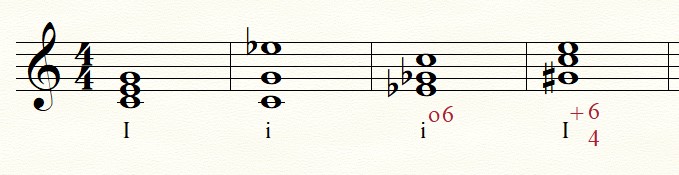
The first way we are going to talk about is figured-bass, which is a more “classical music way” of using Roman numerals and symbols to notate what chords to play in relation to the key.  To notate with figured-bass, you take the following steps:

  • Start by finding the key that you are in (with the example below, we are in C major)
  • Next, determine the chord harmonies with their qualities and inversion
  • Place a Roman numeral underneath each chord, with the numeric value corresponding to the root of the chord in relation to the kay
  • If it is a major triad, use uppercase letters
  • If it is a minor triad, use lowercase letters
  • If it is a diminished triad, use lowercase letters plus an “ o “ symbol
  • If it is an augmented triad, use uppercase letters plus a “ + “ symbol
  • Finally, add extra figures if inverted
  • If it is in first inversion, add a “ 6 “
  • If it is in second inversion, add a “ 6 “ with a “ 4 “ below it

Notice how the “ 6 “ and “ 4 “ correspond to the interval made with the root during an inversion.

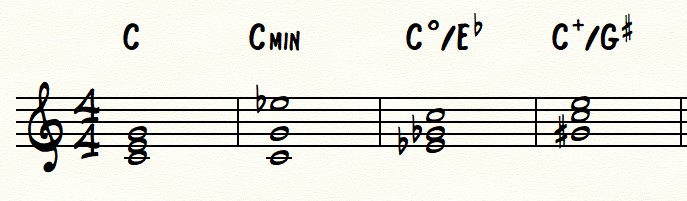
Another way is lead-sheet, which is a way commonly found in jazz, pop, and rock tunes of writing out the letter names, chord qualities, as well as inversions of the harmonies.  To notate in a lead-sheet style, you take the following steps:

  • Determine the root of the chord and write it in an uppercase letter above the chord
  • If it is a major triad, do nothing more for its chord quality
  • If it is a minor triad, add “ min “
  • If it is a diminished triad, add an “ o “ symbol
  • If it is an augmented triad, add a “ + “ symbol
  • Finally, add extra figures if inverted
  • Add a slash mark “ / “ and write the bass note after it

Tah-dah!  There you have it.  Give it some practice, but we will be using these forms of communicating and writing for now on.

Thank you so much for taking the time to read! Feel free to comment, share, and subscribe for more daily tips below! Till next time.

Tip #207 – Two Ways of Resolving Secondary Dominants

Seems a bit silly that we have gone this bar in the blog without mentioning secondary dominants as much as they should be. Nonetheless, they are common in music composition and deserved to be discussed.

A secondary dominant is the V7 of a chord besides I (usually the V7 / V ). The progression would be:

V7/V – V7 – I

And that is one way to resolve it. Simply use it like the nature of the V7 chord and resolve to the chord a P5 below it.

Another way, that is common in jazz, is to have it resolve to the minor version of itself. That progression would be:

V7/V – ii – V7 – I

Both the V7/V and ii have the same function of being the “predominant area” so it makes sense that they can lead into one another.

Thank you so much for taking the time to read! Feel free to comment, share, and subscribe for more daily tips below! Till next time.
Tip #206 – Understanding the Harikhamboji Scale

The Carnatic music of South India has 72 scales (melakartas) comprised of seven different notes in either an ascending (arohana) or descending (avarohana) fashion. These scales are used in a kind of India music called rāga and are extremely beautiful. In addition these scales are grouped into different chakras, based on certain similarities.

Today’s melakarta is the Harikhamboji scale (very roughly translating to “removing evil”), the fourth scale from the fifth chakra.

Below is a representation of the scale as if it was put into Western notation:

It is really a Mixolydian scale.

Try playing around with the scale, possible harmonies, and progressions!

Thank you so much for taking the time to read! Feel free to comment, share, and subscribe for more daily tips below! Till next time.

Tip #205 – Progress by Voicing

In music theory, we are taught a certain way that chords progress by – following one by another based on their Roman numeral analysis. Such as:

  • V7 goes to I
  • Progression follow the Circle Of Fifths, I-IV-viio-iii-vi-ii-V-I
  • IVmaj7 can act as a predominant area or a Plagal cadence figure.
  • Etc.

Instead of thinking about chords by their Roman numerals, think about their voicings (in relation to the key or outside of it).

For example a dominant-seventh chord. You would think of that as the fifth scale degree to resolve to the root. So, G7 to C.

But, the function of the domain-seventh chord doesn’t always have to be the V7. It can be the:

  • Tritone Substitute, bII7 – I , G7 to F#
  • Dorian Vamp, V7 – ii , G7 to Dmin
  • Bluesy Vamp, IV7 – I, G7 to D
  • I7 chord in a 12-Bar Blues, I7 – V7 – IV7 – I7 , G7 to D7 to C7 to G7
  • Etc.

And now look! You have more possibilities than you can ever think of because you valued the chord voicing more than the Roman numerals in regard to the key.

Thank you so much for taking the time to read! Feel free to comment, share, and subscribe for more daily tips below! Till next time.
Thinking Out Loud – Appropriation of Rearranging

When it comes to versions of songs, there are two options: the original and the cover/rearrangement of it.

Some people prefer the originals, while others find how a different artist or arranger reworked the song into new.

In classical music, you sometimes see other prolific composers rework other’s pieces. As for jazz, it is very common – in fact, a standard – to play covers from the fake book. And rock music has many people doing covers of each other’s tunes.

But, one thing that strikes me odd is when I see a rearrangement of a spiritual in a classical context.

On the outside, it may seem like nothing is wrong… but I want to bring to the table to idea of cultural appropriation.

With spirituals coming from an African American background (especially during the times of slavery and segregation), the music has a weight of history behind it. Reworking the spiritual into a piece that sounds like music from the classical era is – what I consider to be – an act of white washing. To take a piece of history and rearrange it to sound like Western music is like taking cultural identity away.

So does that mean that different races cannot cover each other’s tunes? I’m not suggesting that, but I am saying to consider the history behind a piece of music before deciding to rearrange it into a different style or for a different purpose.

Just thinking out loud..

Tip #204 – Bluesy Vamp

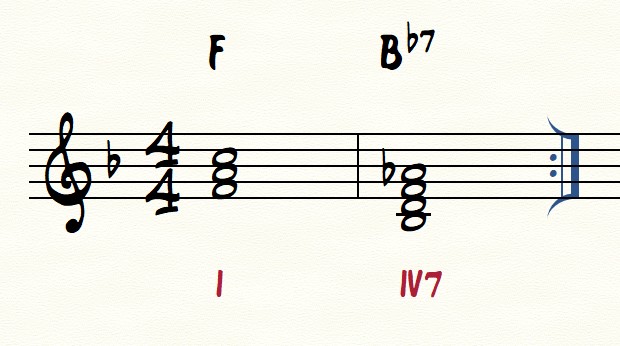
Another vamp chord progression you can use is this:

I – IV7

Some of you might be thinking “but the IV chord isn’t usually a dominant-seventh chord… nor does it resolve to the I.”

Remember this from previous posts: in the twelve-bar blues progression the IV chord resolves more naturally to the I than the V does. Plus, the IV chord harmony appears more frequently than the V chord.

In addition, the IV7 chord provides the b3 scale degree. b3, which is in the blues scale.

Play around with it and see how it works!

Thank you so much for taking the time to read! Feel free to comment, share, and subscribe for more daily tips below! Till next time.

Tip #203 – Jazzy Way of Modulating to Predominant Key Area

Most music typically modulates from the tonic to the dominant, but that is not the only place it can go to.

Say that you wanted to go to the predominant (which is the fourth scale degree). That is like going from the key of C to the key of F.

One way that can be done is with an I – v7 – I7 – IV progression that utilizes the common ii – V7 formula found in jazz music:

Essentially, because the tonic chord hasn’t played the seventh, we are in ambiguous terms as to whether the triad expands to a major-seventh chord or dominant seventh chord. This works to our advantage that when we set up the ii – V motion, all we do is lower the leading tone down (making it mixolydian). Finally, the ii – V tonicizes the IV chord to become the new tonic and having the piece modulate to the subdominant area.

Try it out and see how you can vary this up.

Thank you so much for taking the time to read! Feel free to comment, share, and subscribe for more daily tips below! Till next time.

Tip #202 – Understanding the Sarasangi Scale

The Carnatic music of South India has 72 scales (melakartas) comprised of seven different notes in either an ascending (arohana) or descending (avarohana) fashion. These scales are used in a kind of India music called rāga and are extremely beautiful. In addition these scales are grouped into different chakras, based on certain similarities.

Today’s melakarta is the Sarasangi scale (roughly translating to “lake”), the third scale from the fifth chakra.

Below is a representation of the scale as if it was put into Western notation:

Both the first (SA) and fifth (PA) scale degrees are in a placement normal to most scales found in Western music. In addition, it contains the major tetrachord in the beginning with a raised seventh degree (NI).

Try playing around with the scale, possible harmonies, and progressions!

Thank you so much for taking the time to read! Feel free to comment, share, and subscribe for more daily tips below! Till next time.

Tip #201 – Ghost Notes

Because there are many types, notations, and definitions of ghost notes, I will be doing my best to cover them all in one example:

Essentially, a ghost note is a note that is unaccented, soft in dynamic to the point that it is inaudible but still helps with the rhythmic groove, or is “choked” in sound.

Typically, on most melodic instruments, a ghost note is noted with an “x” symbol. You should use these in a majority of the time when you want to indicate to a performer in your piece that you want the not ghosted-over.

However, in guitar and other stringed instruments like the violin, and “x” notehead indicates to mute, dampen, chop bow, or “choke” the strings while playing. One can argue that this is another way of ghosting a note, but it will create a different timbre besides lowering the dynamic.

“X” noteheads are typically used by drums for the cymbals, so to indicate a ghosted hit they use brackets and parenthesis around the notehead.

Learning how to properly notate is the best way to communicate to your performers how you want a part to be played and sounded.

Thank you so much for taking the time to read! Feel free to comment, share, and subscribe for more daily tips below! Till next time.