Improve Your Lyrics – Tip #36

Continuing with the framework aspect of the beginning songwriting process, it is important to be commuted to whatever you title your song to be.


Your title should be unique, easily identifiable with the listener, and is tangent to the meaning of the song (unless the title is supposed to be a double-entendre). In addition, the title should reflect the one overall mood of the song while avoiding conflicting words.


Titles can be/come from:

  • a single word
  • alliteration
  • antonym
  • places
  • quotes
  • color
  • a person
  • an axiom
  • an idiom
  • a new word completely made-up
  • etc.

The title should also be the focus with the most power. To try to make sure that you repeat the title enough in the song to drive the point, but not too much where it dilutes the power.

Thank you so much for taking the time to read! Feel free to comment, share, and subscribe for more daily tips below! Till next time.


Improve Your Lyrics – Tip #35

Before starting anything, you want to be in the right framework. The right framework of mind for achieving your goal, and your goal should be in the right frame work for being achieved.

In songwriting, you need to start out with a frame to craft your lyrics in. Just like a house, everything needs to hold together to create something spectacular.

We are going to talk about one element to your inception of lyric writing: the idea.

Your idea should be unique, but also be an idea understood by other people. Getting a car for your 16th Birthday (while is unique) is not something too many people experience.

Your idea can appear as:

  • an emotion
  • a situation
  • a meaning/moral to the story

Once you have settled on an idea that you are passionate about, fine-tune it a bit:

  • Can other people connect to it?
  • Can and should it be controversial?
  • Is it believable?
  • Does it have any conflicting mini-ideas attached to it?
  • Do you want a song like this on the radio?

Now that you have a good framework and idea, start putting pen to paper!

Thank you so much for taking the time to read! Feel free to comment, share, and subscribe for more daily tips below! Till next time.
Teach Yourself Music Theory – 24.) Diatonic Modes

Now, there are more scales in music than just the major, natural minor, harmonic minor, and melodic minor. In fact, I have came across a reference book that listed over 2,000 different scales. That being said, we are not going to cover all those (just yet), but we do want to cover a new way to look and build scales.


Modes are scales the encompass the same pitches as a key area, but are not technically our known major or natural minor. Their “tonic” and tonal sense of gravity is elsewhere away from the accepted tonic. Diatonic modes are ones constructed from the diatonic pitches of a key – we will go over this shortly.


There are 7 diatonic modes (6 to some people that do not include Locrian), with one scale built on each pitch of a key. Taking the key of C Major for example, here are the modes with their names:


Notice that each mode is a scale that travels an octave length in distance; basically C major scales starting on different pitches. However, they are all obvious different scales even though the contain the same pitch-class collection because of the intervals in the scale.

NOTE: the major scale is the Ionian Mode, and the natural minor scale is the Aeolian Mode.


To build a diatonic modal scale, you can do one of two things:


Say you wanted to build E Dorian. Dorian is the second mode – so, we know that Dorian comes from D Major, just keep the accidentals and start a scale on the second pitch. Or, you can memorize that Dorian is | 1 – 2 – b3 – 4 – 5 – 6 – b7 – 8 | and construct it from there.


Practice building the modes, playing them, and memorizing the names.

Thank you so much for taking the time to read! Feel free to comment, share, and subscribe for more daily tips below! Till next time.
Tip #187 – The Beauty of Randomness

When people hear the word “random” with music, most people tend to think with the idea of improvisation – like soloing over a bunch of chord changes in the piece. Others might think with rolling a dice to compose the music.

While those certainly do employ the act of randomness to create music, they should not be considered as the only options.

May times, people forget that you can create parameters on which an aspect of your musical work will be decided at random.

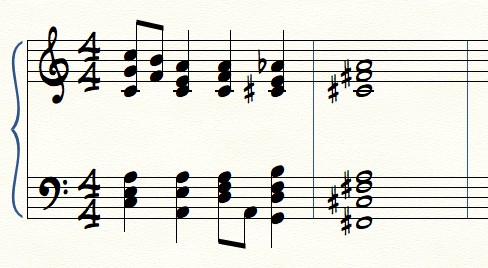
For example: giving chord voicings and asking the performer to choose how they wish to arpeggiate it. In that case, the performance will be at chance because you cannot control what the person will do.

Another example: not giving a tempo indication. While people may consider that unprofessional, you can allow the performers to decide at will or to draw a number out of a hat. Or even ask the audience!

So, what I am basically asking you the reader to do is to be create and get in touch with thinking outside-the-box.

Thank you so much for taking the time to read! Feel free to comment, share, and subscribe for more daily tips below! Till next time.
Tip #186 – Understanding the Gaurimanohari Scale

The Carnatic music of South India has 72 scales (melakartas) comprised of seven different notes in either an ascending (arohana) or descending (avarohana) fashion. These scales are used in a kind of India music called rāga and are extremely beautiful. In addition these scales are grouped into different chakras, based on certain similarities.

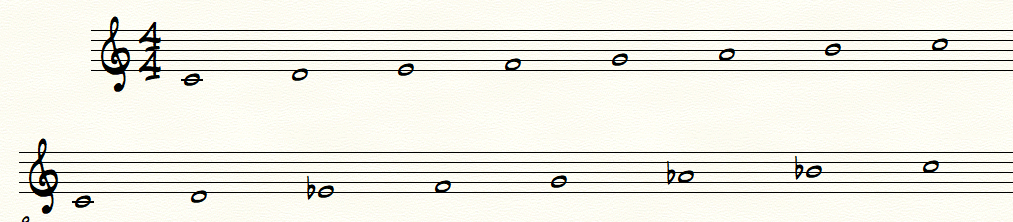
Today’s melakarta is the Gaurimanohari scale (meaning “steals the heart”), the fifth scale from the fourth chakra.

Below is a representation of the scale as if it was put into Western notation:

Both the first (SA) and fifth (PA) scale degrees are in a placement normal to most scales found in Western music. In addition, it looks similar to a melodic minor scale.

Try playing around with the scale, possible harmonies, and progressions!

Thank you so much for taking the time to read! Feel free to comment, share, and subscribe for more daily tips below! Till next time.

Tip #185 – Alternative Tuning

Today is going to feature a short tip to composing original music, but nonetheless an important one.

Remember: you are never confined to the standard tunings of stringed instruments such as the violin, bass, guitar, etc. Just because a note you want or a chord voicing is impossible in the regular tuning doesn’t mean that it can’t be accomplished if you use an alternative tuning.

Scordatura, or telling the performer how to retune their instrument before a piece or section can be used to obtain new possibilities.

For some insight on how to do this – I recommend researching about famous rock artists/bands that frequently use innovative alternative tunings such as Joni Mitchell, Lou Reed, and Sonic Youth.

Thank you so much for taking the time to read! Feel free to comment, share, and subscribe for more daily tips below! Till next time.

How To Beat Writer’s Block – Tip #16

For those out there who work and compose through a DAW (digital audio workstation), this one is for you:

Say that you have all these virtual instruments and plugins, but are overwhelmed by the possibilities. Overwhelmed to the point where you don’t know where to start.

The best thing I would advise someone to do is to first program into your MIDI a simple chord progression. I’ll chose it for you… a progression of I – IV – vi – V7.

Next, set that progression on a loop.

Now, while it is in a loop, slowly go through all the instrument and preset possibilities through your DAW till you find something that you like. This will force you be mentally articulate as to which instrument/preset sounds the best.

And from there, you can start building off of what you have chosen. Pick complementary sounding instruments. Change the chord progression. Add a melody. Do some automation. Etc.

Thank you so much for taking the time to read! Feel free to comment, share, and subscribe for more daily tips below! Till next time.

Tip #184 – Unique Use of Dominant 13 (b9 #11) Chord

Some jazz performers, arrangers, and composers have the inclination to add tension tones and various extensions on top of simple triad chord harmonies. Not that it is a bad thing, but it can become mundane if used too often or too frivolously.

With that out of the way, one chord that I have noticed some people using is the dominant 13 chord with alterations of a b9 and #11. Usually, this is recognized as a V 13(b9 #11) in the jazz tune – but here is another use of it:

Let’s first start by separating the dominant 7 from the upper extensions. That gives us the V7 chord and the (b9 #11 13) above.

If we reharmonize the (b9 #11 13) be their enharmonic, we get a minor triad a tritone above the root of the chord.

Typically, there is no major or natural minor key that has both a V7 and bii. However, who said that the dominant chord has to function as a V7 chord? Instead, we can think of it as a tritone substation making it a bII7 in a minor key with the minor triad acting as a v. In which case, both the bII7 and v chords resolve to the minor tonic triad of i.

Try it out for yourself!

Thank you so much for taking the time to read! Feel free to comment, share, and subscribe for more daily tips below! Till next time.

Improve Your Lyrics – Tip #34

Two things you need to consider for each section of a song (and possibly the song as a whole) is its form and function.

Form, as we talked about, is its structure. The function is what it intends to do (act as a verse, be a chorus, summarize, detail, etc.)

As you are brainstorming and starting your rough draft, it would be wise to keep them in find.

For example: say you wanted to write a country song. Your function is that you want a country song. So, what are some typical forms of country songs? How are verses and choruses stylistic in the country genre?

Similarly, say you wanted to delay the arrival to the chorus. That is the function in mind. Your form that would come after would be to use one of those tools we’ve talked about by adding a fifth line to a verse.

Now for the opposite process. Say you have a music section with four lines that have a rhyme pattern of XAXA and mention the song’s title. You most certainly have the form, but now it is time to decide on the function. Does the section work better as a verse or chorus? How about a bridge if we edit it?

As you are writing you draft, ask yourself “how can I craft the form to fit the function I want,” as well as “how can this form work and function in a song?”

Thank you so much for taking the time to read! Feel free to comment, share, and subscribe for more daily tips below! Till next time.

Teach Yourself Music Theory – 23.) Relative Versus Parallel Keys

We have talked about this before when covering major and natural minor scales. So be sure to review those sections if these concepts seem unfamiliar or difficult.

Relative keys, are two key that share the same number of accidentals. We know that the key of D Major and the key of B minor are relative keys because they both have the same number of accidentals added to their key signature (two sharps).

We figured this out before that in a major key, the minor key (where the natural minor scale is derived from) is a m3 interval below the tonic. Vice-versa, in a minor key we can tell that the relative major is a m3 above the tonic.

Parallel keys are ones that don’t necessarily (if ever) share the same accidentals, but share the same tonic.

Let’s take a look at the two parallel keys of C major and C minor:

Notice how they don’t have the same accidentals, but they do share the same tonic of C. More to come on how to use parallel keys in composition, but more now this is learning on how to distinguish between relative and parallel keys.

Thank you so much for taking the time to read! Feel free to comment, share, and subscribe for more daily tips below! Till next time.