Mix and Master Yourself – Quick Mix Guide (Part 4)

The next step that you might want to take if you were to do a rough mix of your recording session is to add compression.

Compression is used for leveling out the dynamics of a recording. Meaning, that the dynamic range is compromised and squashed.

Take this for an example: say you have a recording where the instrumentalist plays very loud at some sections, normal throughout most, and very quiet at other places. To make this more even, you use a compressor to bring down the loudest parts to a normal level. Then, with a gain knob, you can bring up the entire modified recording to a louder level to make the quitter sections more audible.

Be mindful of the ratio of how much you compress the recording.

Thank you so much for taking the time to read! Feel free to comment, share, and subscribe for more daily tips below! Till next time.

Tip #212 – Building a Jazzy Progression from a Chromatic Line

Say that you have a chromatic lead-line like this below:

How would you harmonize this line? Write down all the possibilities.

Well, one way you can do so is with a frequently used chord progression amongst blues/jazz artists (as well as Stevie Wonder):

I – Imaj7 – I7 – IV – iv

Another variation is to substitute the iv chord with the bVII7 chord. It would look something like this:

Try it out and see how many songs you know use them!

Thank you so much for taking the time to read! Feel free to comment, share, and subscribe for more daily tips below! Till next time.

Tip #211 – Understanding the Naganandini Scale

The Carnatic music of South India has 72 scales (melakartas) comprised of seven different notes in either an ascending (arohana) or descending (avarohana) fashion. These scales are used in a kind of India music called rāga and are extremely beautiful. In addition these scales are grouped into different chakras, based on certain similarities.

Today’s melakarta is the Naganandini scale (translating to “mountain born”), the sixth scale from the fifth chakra.

Below is a representation of the scale as if it was put into Western notation:

Both the first (SA) and fifth (PA) scale degrees are in a placement normal to most scales found in Western music. In addition, it contains the major tetrachord in the beginning with a chromatic run at the top of the scale.

Try playing around with the scale, possible harmonies, and progressions!

Thank you so much for taking the time to read! Feel free to comment, share, and subscribe for more daily tips below! Till next time.

Mix and Master Yourself – Quick Mix Guide (Part 3)

The next step you should take into mixing your music is adding a gate. This is more ideal for situation where you are working with recorded material in stead of sample based/electronically programmed music… but, it is still valuable to know.

A gate works like a “backwards compressor” where if the sound hits there threshold the gate is pushed open. However, if the sound going through the gate is below the threshold, it does not open – and therefore, doesn’t sound.

So, the purpose of the gate is to cut out the bleed/leakage from other instruments that are less in amplitude, but still audible.

You will want to set the attack, hold, and release to breathe with the song. In addition, the threshold should just be enough to allow the main instruments with a few ghost notes come through.

Thank you so much for taking the time to read! Feel free to comment, share, and subscribe for more daily tips below! Till next time.

Thinking Out Loud – Happy Mistakes?

This is a philosophical issue that I have been struggling to resolve, so do not expect there to be a right or wrong (or even a conclusive) answer at the end of this blog post. The purpose of today’s post is to pose a debate.

The scenario:

Say a person was asked to write a hit pop song combining modern influences of the time with trap beats, EDM-like bass, and retro synthwave dance. That was the person’s intention. After writing the song, it happened to become a classical song worthy of Mozart’s praise.

Did this person write a good or bad song?

Is it good because the music is good and the person is being artistic? Or, is it bad because it did not fulfill the original intention?

If you say that the song was good, then how do we define a good or bad song then if it seems the only criteria for it to be good is that it received praise?

On the other hand, if you say that it was a bad song, does that mean all “happy accidents” (like playing an unintentional note during improvisation, but working really well with the harmony) are labelled wrong or unmusical because they were done without fulfilling the original intention?

Personally, I am still undecided, but it is still worth to talk about and say…

Just thinking out loud.

Tip #210 – Jazzy Progression with the Hindu Scale

For those that don’t recall the Hindu Scale, I suggest looking back at some music theory posts I have covered. But to bring you up to speed, the Hindu scale is one of the modes of the melodic minor scale – specifically, the fifth mode.

That being said, we can think of the Hindu scale as the dominant (or mixolydian) of the melodic minor scale. And what do you know! Take a look at what kind of chord is built on the root of the Hindu scale. A dominant-seventh chord.

But that isn’t the only dominant seventh chord of the scale. In fact, there are two that are found in it, creating this famous jazz progression:

I7 – bVII7

While this progression certainly sounds modal because of the scale as well as jazzy because of the dominant-seventh chords, it flows well because it is similar to the “backdoor” progression we have talked about before. Only now the tonic is an unstable dominant figure.

Thank you so much for taking the time to read! Feel free to comment, share, and subscribe for more daily tips below! Till next time.
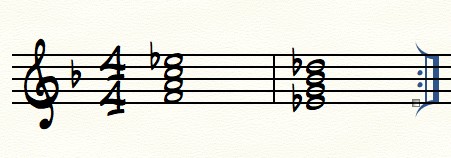
Teach Yourself Music Theory – 32.) Building Triads from Scales

Continuing with our topic of triads, we are going to be discussing what and which triads are built from scales… covering major, natural, harmonic, and melodic minor.

Beside the lead-sheet note note names, the Roman numeral figured-bass and triad quality remains the same from each respective scale regardless of starting pitch.

Let’s start with the major scale:

Building triads on each note, we get what we have above. 3 major triads, 3 minor triads, and 1 diminished triad. Chords I , IV , and V will always be major in a major key.

Now, natural minor:

We have the same amount of major, minor, and diminished triads… but they are in a different order.

As for harmonic minor:

With the inclusion of the raised leading tone, we see a quality of the chords change. Instead of v being minor, V is major in harmonic minor. Also, we have two diminished chords.

Finally, melodic minor:

With two raised pitches, we get another completely different group of triads. Now, the ii chord is minor… but the vio chord is diminished.

NOTE: the “B” symbol in the pictures means “flat” just like the “b” sign.

Thank you so much for taking the time to read! Feel free to comment, share, and subscribe for more daily tips below! Till next time.

Tip #209 – Understanding the Dhirasankarabharani Scale

The Carnatic music of South India has 72 scales (melakartas) comprised of seven different notes in either an ascending (arohana) or descending (avarohana) fashion. These scales are used in a kind of India music called rāga and are extremely beautiful. In addition these scales are grouped into different chakras, based on certain similarities.

Today’s melakarta is the Dhirasankarabharani scale (roughly translating to “the jewel of Shankara”), the fifth scale from the fifth chakra.

Below is a representation of the scale as if it was put into Western notation:

It is really a major scale.

Try playing around with the scale, possible harmonies, and progressions!

Thank you so much for taking the time to read! Feel free to comment, share, and subscribe for more daily tips below! Till next time.

Mix and Master Yourself – Quick Mix Guide (Part 2)

Today we are going to be talking about a quick guide in several installations on how to give your recorded song a good mix.  These tips can also be applied to using live sound as well, so keep your imagination wide with possibilities.

The next step you want to take is filtering out some unneeded frequencies.  This is a MUST in recorded audio, but it can also help when working with MIDI and the sound coming from virtual instruments.

In situation where you have mic bleeding (meaning that you are capturing unintended recorded audio – say from another instrument playing or from another room) you need to make sure it is not there for when you do the final mastering.  Using a low pass filter (LPF) that cuts high frequencies, or a high pass filter (HPF) that cuts low frequencies will be the best bet in a plug-in to use for cleaning out your audio.

This will allow instruments that naturally sound in the extreme low or high ends of our hearing to have less frequencies competing against them.  The filtering out of unnecessary sounds will make the necessary ones pop-out!

Thank you so much for taking the time to read! Feel free to comment, share, and subscribe for more daily tips below! Till next time.

Mix and Master Yourself – Quick Mix Guide (Part 1)

Today we are going to be talking about a quick guide in several installations on how to give your recorded song a good mix.  These tips can also be applied to using live sound as well, so keep your imagination wide with possibilities.

Once all the tracks and parts of your song is recorded, the first step you want to do is set all the volume and panning to where they should be using a “reference track.”

A reference track is a fully mixed, mastered, and produced song that you are taking inspiration from.  Simply, place the audio from the song into a track in the DAW and use it as a “reference” as to how loud/soft the instruments should sound, as well as to which side they should be panned.

Remember, you don’t have to stay strict to the reference track.  It is a means of support so you have a place on where to start from.  You can adjust after that.

Thank you so much for taking the time to read! Feel free to comment, share, and subscribe for more daily tips below! Till next time.
