Tip #238 – Sliding Into Home Base

Just like a baseball player sliding into home base is unnecessary in compared to just running home – so can sliding into certain “home” notes of a chord. Yes, this extra accented passing tone is note needed, but it can give some cool flavor as well as style to your music.

As you are playing a chord progression, try using these accented passing tones in relationship to the chord:

  • Seventh goes to the root
  • Second goes to the third
  • Sixth goes to the fifth

…and with sliding motion if your instrument allows you to!

Thank you so much for taking the time to read! Feel free to comment, share, and subscribe for more daily tips below! Till next time.

Tip #237 – Understanding the Salagam Scale

The Carnatic music of South India has 72 scales (melakartas) comprised of seven different notes in either an ascending (arohana) or descending (avarohana) fashion. These scales are used in a kind of India music called rāga and are extremely beautiful. In addition these scales are grouped into different chakras, based on certain similarities.

Today’s melakarta is the Salagam scale, the first scale from the seventh chakra.

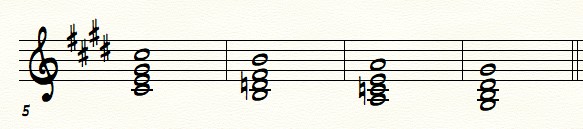
Below is a representation of the scale as if it was put into Western notation:

Both the first (SA) and fifth (PA) scale degrees are in a placement normal to most scales found in Western music.  However, the lowered second (RI) and third (GA) scale degrees create a chromatic line.  So do the raised fourth (MA) and lowered seventh (NI) scale degrees create a chromatic line.

Try playing around with the scale, possible harmonies, and progressions!

Thank you so much for taking the time to read! Feel free to comment, share, and subscribe for more daily tips below! Till next time.

Tip #236 – Squishing Down Voicing Possibilities

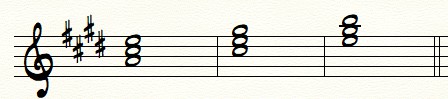
Say you have a harmonic progression like this:

There is an unlimited amount of possibilities in regards to how you can voice them to have good voice leading.

A quick two rule for harmonic voicings is to determine the bottom and the top by:

  1. Keeping the root/bass note at the bottom
  2. Make a roughly stagnant melodic line at the top.

This is because the chord voicings are to give harmony and nothing else; not to give a counter melody that will interfere.

Thank you so much for taking the time to read! Feel free to comment, share, and subscribe for more daily tips below! Till next time.
How To Beat Writer’s Block – Tip #20

Can it be possible to bore yourself into creativity?

When things are so mind-numbingly boring, people usually tend to do something about it to make it more exciting (unless they are content with it or just plain lazy).

Try this exercise: start by playing the simplest rhythm you can think of (possibly quarter-notes) on a single pitch. Play it over and over again. More and more until the natural urge to change it comes out.

You will probably start by changing the rhythm, getting bored with the constant quarter-notes. Then, you’ll probably start varying the pitch – creating a melody.

And there you go! A start of a piece born from plain boredom!

Thank you so much for taking the time to read! Feel free to comment, share, and subscribe for more daily tips below! Till next time.
Teach Yourself Music Theory – 35.) Building Seventh-Chords from Scales

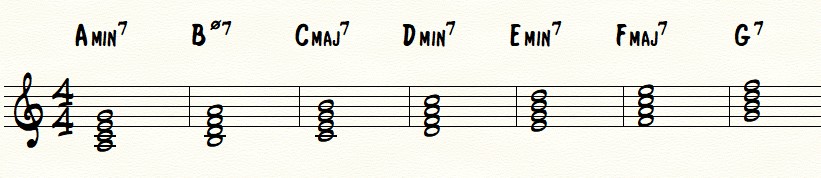
Now, we are going to be covering where all of these different kinds of seventh-chords appear within a key by building them off of different scale degrees.

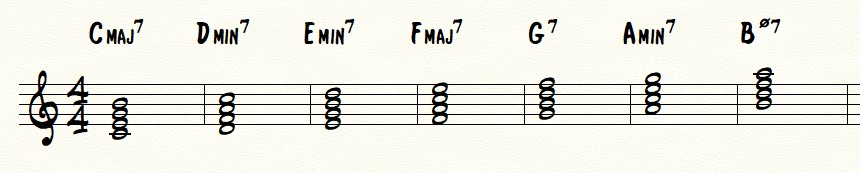
First, we will take the major scale:

Notice how there are only four different seventh chord possibilities: the major seventh, minor seventh, half-diminished seventh, and dominant seventh. This should be pretty easy to memorize.

As for the natural minor scale, it is just a reordering of the major scale:

Now, we add the leading tone for the harmonic minor scale:

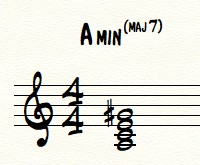
The harmonic minor scale, because of the raised leading tone, creates an augmented seventh as well as a fully-diminished seventh. Also, we have a seventh-chord we have never discussed before… the minor-major seventh which is a minor triad with a M7 interval from the root on top:

Finally, the melodic minor scale:

Thank you so much for taking the time to read! Feel free to comment, share, and subscribe for more daily tips below! Till next time.

Tip #235 – Neo-Soul Progressions

This is a generalization – so that means that there are certainly more chord progressions found in the music of neo-soul than just this, but this is a good place to start.

Also, keep in mind that the chords in these examples are just the basic triads and seventh-chords, and not the expanded voices we talked about in a previous post. We will just be talking about root movement today.

What I have found interesting about neo-soul music, is that instead of where most pop music starts in the I chord and uses the V7 chord at the end of a repeated section to get back to the I chord in the beginning, neo-soul does the opposite:

Starting on the V7 or its variants give an instability to then resolve on the I chord on the weaker measure of the vamp. This keeps the motion rolling.

Then, there is the use of parallel motions (especially by minor chords) where the chord quality doesn’t change, but the root does:

Finally, a common neo-soul chord progression is movement by thirds. Music tends to follow the common circle-of-fifth, where the roots move by descending fifths. Moving by either ascending or descending thirds can give a neo-soul feel to your music:

Thank you so much for taking the time to read! Feel free to comment, share, and subscribe for more daily tips below! Till next time.
Tip #234 – Understanding the Chalanata Scale

The Carnatic music of South India has 72 scales (melakartas) comprised of seven different notes in either an ascending (arohana) or descending (avarohana) fashion. These scales are used in a kind of India music called rāga and are extremely beautiful. In addition these scales are grouped into different chakras, based on certain similarities.

Today’s melakarta is the Chalanata scale, the sixth scale from the sixth chakra.

Below is a representation of the scale as if it was put into Western notation:

Both the first (SA) and fifth (PA) scale degrees are in a placement normal to most scales found in Western music, but now you have a raised second degree (RI) acting as an augmented second from the root.  In addition, there is a chromatic run at the top of the scale.

Try playing around with the scale, possible harmonies, and progressions!

Thank you so much for taking the time to read! Feel free to comment, share, and subscribe for more daily tips below! Till next time.

Tip #233 – Expanding to Give a Neo-Soul Sound

There are many aspects that define a music genre. The kinds of harmonies, rhythms, lyrics, chord progressions, fashion, etc. all help classify a piece of music.

Before we get into a debate of whether labels are good or bad, it is skill for composers to know what makes a genre to draw direct inspirations from.

We are going to talk about how simply expanding the harmony of your chord choices and voicings can give your piece of music an interesting neo-soul feel.

Take a look below at some common chord types (never mind the key):

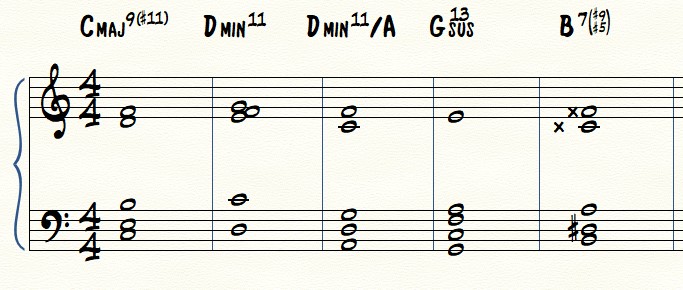
Typically, you would use some major chords, minor chords, dominant seventh, and diminished chords to write a song. To give it a neo-soul flavor, try expanding the harmonies this way:

  • Major Triad -> Major Ninth Sharp Eleventh
  • Minor Triad -> Minor Eleventh
  • Dominant Seventh -> Dominant Thirteenth Sus 4
  • Diminished Triad -> Altered Dominants

Also, taking inspiration from modal harmonies are re-voicing in quartal harmonies (of stacked fourth), can give your piece a neo-soul sound. Basically, jazz harmonies will be your best friend in this.

Thank you so much for taking the time to read! Feel free to comment, share, and subscribe for more daily tips below! Till next time.
Thinking Out Loud – A Break from Similar Minded People

Recently, I had the pleasure of catching-up with a friend I haven’t seen since… gosh, maybe high school or further. We took different paths, but we both were in the realms of art (visual, performance, acoustic, etc.).

During our moments talking to each other, we expressed the similar need to take breaks from people who shared the same interest as ours. That while going to school, being in the same company working, or chilling with people that were in the same artistic field at you is a dream… it can be very exhausting.

Exhausting, and even annoying to be constantly bombarded by the constant stimuli of talking about one simple topic?

Why is that? Why did we need to take a break from art and like-minded artists to pursue art?

Could it be because of the expression “great minds think alike, but fools rarely differ,” where being with similar people can limit your perspectives? Or a forewarning that “jack of all trades, master of none; but better than a master of one,” where staying on one path also limits artistic growth?

Does anyone else have the need to take breaks from people of your field to grow more? Or, am I…

Just thinking out loud.

Tip #232 – Root-less Chords

By default, when you eliminate the root from being at the bottom of a chord, it becomes an inversion of itself.

This can become a useful tool when constructing a bass line by avoiding the root in order to give an unstable feeling or imply a different harmony.

So, now the question is, how does the bass move?

Before, we talked about the root of one chord harmony move to the root of the next. What does one do when it is either the third, sixth, or seventh in the bass.

Above anything else: experiment. However, it might be wise to connect similar notes or move stepwise. Meaning, if the third of one chord harmony is the same as the seventh of the next, keep on that note.

Play with these ideas and see how they can improve with building bass lines.

Thank you so much for taking the time to read! Feel free to comment, share, and subscribe for more daily tips below! Till next time.