Improve Your Lyrics – Tip #49

Another lyrical form you should consider on using is the ABAC form.  While it is not conventual or popular, many great hits in the past have used this form.

Similar to the ABAB form, the A section contains the main musical theme/motif/idea.  The B section is the development while also serving as the catapult to return back to the A section.  Length for each lettered section is typically 8-bars long, but it can vary.

The C section is new…

Well, the C lyrics section is new, it that it is only performed once in the entire structure of the song.  It can contain a bit of thematic material found in the B section (acting as B’) or being completely new.

Titles usually appear (that is, if you want to incorporate the title into the lyrics) at the beginning or at the end of the AB or AC sections.

Try playing around with this form; especially if the structure of your lyrics is to create an emotional climax.

Thank you so much for taking the time to read! Feel free to comment, share, and subscribe for more daily tips below! Till next time.
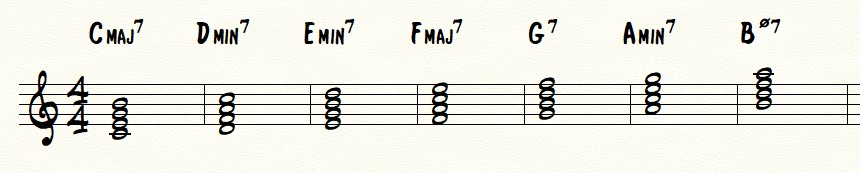
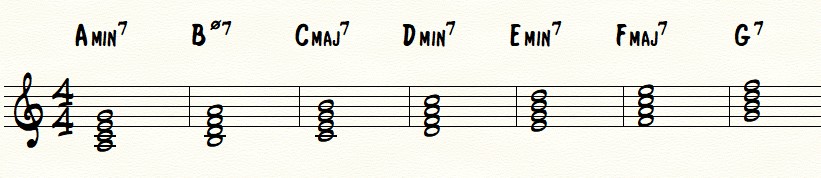
Teach Yourself Music Theory – 35.) Building Seventh-Chords from Scales

Now, we are going to be covering where all of these different kinds of seventh-chords appear within a key by building them off of different scale degrees.

First, we will take the major scale:

Notice how there are only four different seventh chord possibilities: the major seventh, minor seventh, half-diminished seventh, and dominant seventh. This should be pretty easy to memorize.

As for the natural minor scale, it is just a reordering of the major scale:

Now, we add the leading tone for the harmonic minor scale:

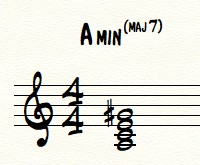
The harmonic minor scale, because of the raised leading tone, creates an augmented seventh as well as a fully-diminished seventh. Also, we have a seventh-chord we have never discussed before… the minor-major seventh which is a minor triad with a M7 interval from the root on top:

Finally, the melodic minor scale:

Thank you so much for taking the time to read! Feel free to comment, share, and subscribe for more daily tips below! Till next time.

Tip #234 – Understanding the Chalanata Scale

The Carnatic music of South India has 72 scales (melakartas) comprised of seven different notes in either an ascending (arohana) or descending (avarohana) fashion. These scales are used in a kind of India music called rāga and are extremely beautiful. In addition these scales are grouped into different chakras, based on certain similarities.

Today’s melakarta is the Chalanata scale, the sixth scale from the sixth chakra.

Below is a representation of the scale as if it was put into Western notation:

Both the first (SA) and fifth (PA) scale degrees are in a placement normal to most scales found in Western music, but now you have a raised second degree (RI) acting as an augmented second from the root.  In addition, there is a chromatic run at the top of the scale.

Try playing around with the scale, possible harmonies, and progressions!

Thank you so much for taking the time to read! Feel free to comment, share, and subscribe for more daily tips below! Till next time.
Tip #232 – Root-less Chords

By default, when you eliminate the root from being at the bottom of a chord, it becomes an inversion of itself.

This can become a useful tool when constructing a bass line by avoiding the root in order to give an unstable feeling or imply a different harmony.

So, now the question is, how does the bass move?

Before, we talked about the root of one chord harmony move to the root of the next. What does one do when it is either the third, sixth, or seventh in the bass.

Above anything else: experiment. However, it might be wise to connect similar notes or move stepwise. Meaning, if the third of one chord harmony is the same as the seventh of the next, keep on that note.

Play with these ideas and see how they can improve with building bass lines.

Thank you so much for taking the time to read! Feel free to comment, share, and subscribe for more daily tips below! Till next time.

Improve Your Lyrics – Tip #48

Another lyric form you can try experimenting with is the ABAB form.  While it is not so common today, it can be found in many hits from country, to adult contemporary, to jazz, to funk, and broadway music.

While the ABAB form may look visually similar to that of the AABA form, the ABAB is more two different sections than three sections connected with a bridge.

The purpose of the A section is to embody the main music idea and theme while the B section is used to develop the material as well as serve as a platform to prepare the listener for returning back to the A section.  So, the B in the ABAB form is more fluid and transitional than the B in the AABA form which is contrasting.

Even though the ABAB form is typically 32-bars long with each AB section containing 16-bars, it can be changed.  In some cases, a songwriter might add a little extra at the end, making the form ABABB or ABABAB.

Titles, or main hooks are placed at the beginning of the A sections, or at the end of the B sections.

Try writing a song that calls for development of the main idea in a ABAB structure format.

Thank you so much for taking the time to read! Feel free to comment, share, and subscribe for more daily tips below! Till next time.

Tip #231 – Reducing to the Essentials

If you could only play two notes to suggest the harmony, which ones would you choose? How can you choose the right night to imply the right harmony without making it ambiguous?

Previously, we have talked about making harmonic accompaniment ambiguous by playing only octaves and fifths. What if we want to do the opposite.

Well, instead of the fifth, what other notes of the chord impact its quality? That would be the third (telling us if it is major of minor), the seventh (tell us what kind of seventh chord it is), and sixth (for extra color).

Some people have been known to call this “shell voicing” when you limit your harmonic voicings down to two notes: the root/bass and a tone that tells us the quality of the chord.

NOTE: if the chord was diminished, playing the flat fifth would be more of a priority, but not when it is a perfect fifth.

Try it out. When building a bass line, an accompaniment, or whatever, challenge yourself by only playing 2 notes.

Thank you so much for taking the time to read! Feel free to comment, share, and subscribe for more daily tips below! Till next time.

Tip #230 – Understanding the Sulini Scale

The Carnatic music of South India has 72 scales (melakartas) comprised of seven different notes in either an ascending (arohana) or descending (avarohana) fashion. These scales are used in a kind of India music called rāga and are extremely beautiful. In addition these scales are grouped into different chakras, based on certain similarities.

Today’s melakarta is the Sulini scale, the fifth scale from the sixth chakra.

Below is a representation of the scale as if it was put into Western notation:

Both the first (SA) and fifth (PA) scale degrees are in a placement normal to most scales found in Western music, but now you have a raised second degree (RI) acting as an augmented second from the root.  Think of it as a major scale with a raised second.

Try playing around with the scale, possible harmonies, and progressions!

Thank you so much for taking the time to read! Feel free to comment, share, and subscribe for more daily tips below! Till next time.
Tip #229 – Deciding Between Open-Fifths or Octaves

Sometimes, the piece of music you are writing doesn’t call for complex chord choices or complex chord voicings. It might be because of the style you are going after, or it just might match the mood better if you reduced to simplistic voicings.

DO NOT THINK THAT BECAUSE YOU AREN’T USING COMPLEX VOICINGS THAT YOUR MUSIC ISN’T ADEQUITE. The value of your piece isn’t based of of how challenging it is – but on how invested you are in it. If you believe all it needs is some simplistic voicings, go for it!

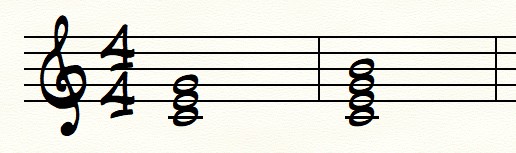
Now, two common reductions for harmony is to double the root at the octave, or just to play the root and the fifth.

If you were to choose between the two, which one would it be? What would be the advantages of each?

When doubling the root at the octave, you lose harmonic color because it is reduced down to one pitch class. However, the doubling reinforces the sound and makes that makes that singular color more bold.

Open fifths, as we have talked about previously in posts about power chords, will have a but more harmonic color because it uses two different pitches. Also, the sound will be denser, since the pitches are more closer together than octaves.

Try both and see what fits!

Thank you so much for taking the time to read! Feel free to comment, share, and subscribe for more daily tips below! Till next time.
Improve Your Lyrics – Tip #47

This is going to be a short post…

An allusion is a reference to another piece of work or to some “commonly-known” subject, object or whatever.

Basically, it can add a bit of “real life” to the song.  While a song can be personally, it might run into becoming too “imaginative” for listeners.  Using allusions or references to outside works can help make it a bit more realistic… or even add a bit of nostalgia for the audience.  Try it out!

Thank you so much for taking the time to read! Feel free to comment, share, and subscribe for more daily tips below! Till next time.
Teach Yourself Music Theory – 33.) Identifying Seventh-Chords

Before we begin, let’s review:

Previously, we have talked about triads, which are chords comprised of three different pitches, with the notes (from lowest to highest) are a third apart from each other.

If we add another third on top of the triads, we get a seventh-chord, which is a chord comprised of four different pitches with the notes (from lowest to highest) are a third apart from each other and span a distance of a seventh.

The alteration of a triad to a seventh-chord will look like as such:

Now, just like triads, seventh-chords have different names depending on the intervals between each chord member. However, if you can identify the triad the seventh-chord is built from as well as the extra interval above it – you will be more comfortable with identifying triads.

Let’s take a look:

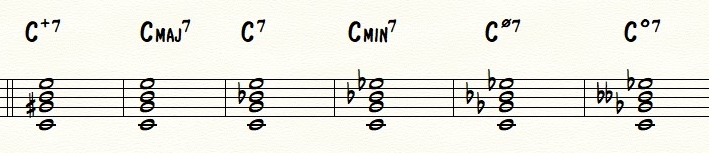
  • Augmented Seventh = Augmented Triad + M7 above root
  • Major Seventh = Major Triad + M7 above root
  • Dominant Seventh = Major Triad +m7 above root
  • Minor Seventh = Minor Triad + m7 above root
  • Half-Diminished Seventh = Diminished Triad + m7 above root
  • Fully-Diminished Seventh = Diminished Triad + d7 above root

This is how they would look (with the third of the chord placed an octave above):

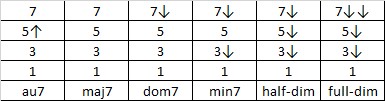
Another way of being able to distinguish between the different seventh-chords is through this diagram:

In comparison to the Major Seventh chord (which we will call “home base” due to its lack of alterations), all the other seventh chords have a pitch raised or lowered.

Thank you so much for taking the time to read! Feel free to comment, share, and subscribe for more daily tips below! Till next time.