Teach Yourself Music Theory – 16.) Calling Pitches by Scale-Degree Name

Today’s topic is more so about covering jargon used in music than actually understanding of music. However, the use of this terminology can help clear-up some confusion from previous lessons as well as aid in helping understand the next lessons.

When we talked about the major and natural minor scales, we talked about how they are made up of 7 different pitch classes with a repeat at the octave. Previously, we have just been calling the pitches of the scale just by there ascending number.

So, for example: we call the second note of the scale the second degree.

Well, there are some specific names for those pitches that make up the scales:
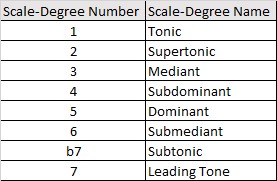
Now, going back to our previous example: when referring to the second scale degree of the major or natural minor scale, we would say the “supertonic” of the scale.

To further drill-in this terminology, let’s review the major pentatonic scale.

Remember that the major pentatonic scale has the same pitch class collections as the major scale… but 2 pitches less (hence how “penta” means “five”).

What scale degree names are in common with the major scale AND the major pentatonic scale?

Looking at the chart above, it would be:

  • The tonic
  • Supertonic
  • Mediant
  • Dominant
  • and submediant

And there you! That’s how you name pitches by their scale-degree names.

Thank you so much for taking the time to read! Feel free to comment, share, and subscribe for more daily tips below! Till next time.

Tip #162 – Understanding the Chakravakam Scale

The Carnatic music of South India has 72 scales (melakartas) comprised of seven different notes in either an ascending (arohana) or descending (avarohana) fashion. These scales are used in a kind of India music called rāga and are extremely beautiful. In addition these scales are grouped into different chakras, based on certain similarities.

Today’s melakarta is the Chakravakam scale (meaning “cyclone”), the fourth scale from the third chakra.

Below is a representation of the scale as if it was put into Western notation:

Both the first (SA) and fifth (PA) scale degrees are in a placement normal to most scales found in Western music. However, there is an augmented distance between the second (RI) and third (GA) scale degrees.  In addition, the sixth scale degree (DHA) is raised.  While this may sound dissonant or exotic, this scale gives a great amount of opportunity to play with tension and chromatic passing tones.

Try playing around with the scale, possible harmonies, and progressions!

Thank you so much for taking the time to read! Feel free to comment, share, and subscribe for more daily tips below! Till next time.

Tip #161 – Cheat-Sheet for Building Large Eight-Part Chord Structures

Previously, we have talked about reimagining the idea of eight-part chord structures. Instead of thinking the chords as one big harmony, we can mentally divide the chord into two different chords at smaller harmonic density – and then from there, arrange the two chords into unique voicings.

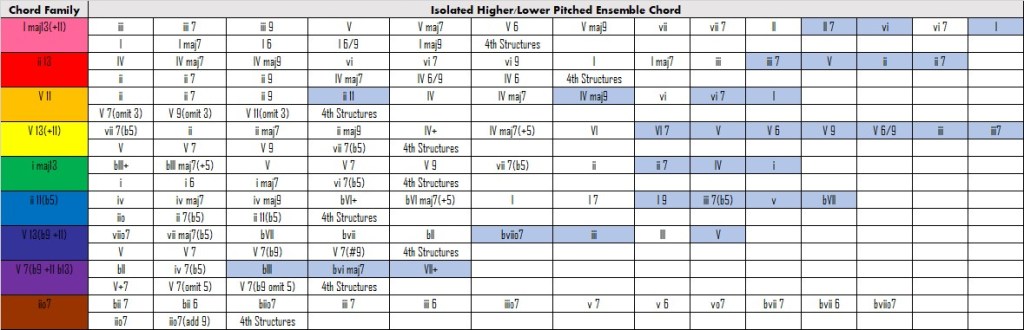
Below is a cheat-sheet on how to build these large chord structures:

To read the cheat-sheet, start by deciding what chord harmony/family you want to do in the left-most column. Then, you will notice that each selection is made up of two horizontal rows. The bottom horizontal rows are chord harmonies that work best for the bottom half. Likewise, the upper horizontal row is of chord harmonies that work best for the upper half.

If the chord is highlighted in light blues, that means that it is most optimal to use if you want the root to be in the melody.

Thank you so much for taking the time to read! Feel free to comment, share, and subscribe for more daily tips below! Till next time.

Tip #160 – Cheat-Sheet for Pairing Scales and Chords Together

Many times I hear among jazz musicians the idea of what scale(s) should go with what chord harmony.

It makes sense to understand what scale works best with what harmony so that you know which pitches to chose from when constructing a melody, improvisation, counterpoint, etc.

Below is a lengthy (but not perfect) cheat-sheet for multiple kids of scales, and what chords work best:

Note that this graph is turned on its side so that it can fit your screen better. To turn it, simply download the picture and edit it with a rotation app.

To read this cheat-sheet, find the scale you want starting on the right scale degree of the key that you are in. From there, look at the harmonic possibilities as the Roman numerals relate to the key that you are in.

Thank you so much for taking the time to read! Feel free to comment, share, and subscribe for more daily tips below! Till next time.

Improve Your Lyrics – Tip #21

One thing to be mindful of when writing your lyrics is (trying) to keep everything within the same tense… either being the past, present, or future tense.

Of course, you can switch between these with every verse, such as if one verse is in past tense, the next one is in present tense, and finally the last verse is in future). However, having different tenses within the same verse section can sound really awkward and ununiform.

So, here are simple ways on modifying verbs to match the correct tense you are going after:

  • Past: has, had, -ed
  • Present: is -ing, -s
  • Future: will

Another thing you can do is “neutralize” the tense. This is by strictly using the -ing form of the verbs, the to form of the verb, or avoiding all verbs completely. This will accurately make sure everything is in the correct tense, but the audience will have a harder time telling if you are in the past, present, or future.

Thank you so much for taking the time to read! Feel free to comment, share, and subscribe for more daily tips below! Till next time.
Teach Yourself Music Theory – 15.) Building Pentatonic Scales

As of right now, the only scales we have covered are those with 7 different pitch classes with a repeat of a note at the octave.

But there are other common scales that use less notes.

The pentatonic scale (the “penta” prefix meaning “five”) is a scale built from 5 different pitches within its pitch class collection with a repeat at the octave. This scale is commonly used in many genres of music from rock, to jazz, folk, pop, world, etc.

A good argument as to why these scales are so widely used is because they avoid certain dissonances. You will see why shortly.

First, let’s start by building the major pentatonic scale.

A major pentatonic scale is made up of a pattern of notes set apart from each other in an ascending manner of M2-M2-m3-M2-m3 from the root to the octave:

Notice how the scale and intervallic distances do not contain anything to form dissonances (m2, A4, d5, M7, etc.). Also, take a look at how the scale is very similar to that of a regular major scale, but is missing the fourth and seventh scale degrees.

Just like every major scale has a relative natural minor scale, so will every major pentatonic scale have a relative minor pentatonic scale.

To build a minor pentatonic scale, you just have to use the same pitch class collections as the relative major pentatonic scale, but start on the sixth scale degree. Or, you can also build it by using the intervallic pattern of m3-M2-M2-m3-M2:

Similarly, it looks like a natural minor scale, but it is missing a few members. Hence, that is why the pentatonic scale is called “penta;” because it is 2 pitches short of a major or natural minor scale, making it 5 instead of 7.

Thank you so much for taking the time to read! Feel free to comment, share, and subscribe for more daily tips below! Till next time.
Tip #159 – Reframing Thoughts on Eight-Part Chord Structures

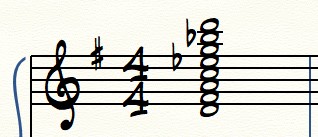
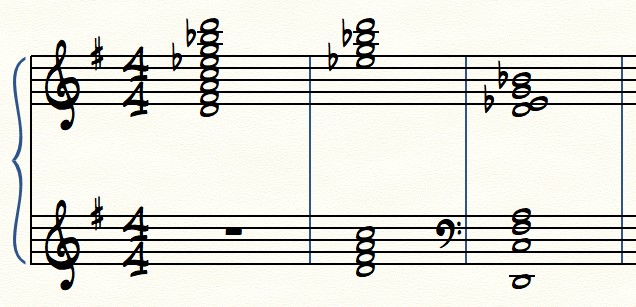
Say that you are being extravagant and want to incorporate a chord like this into your composition:

This is a D7(b9 b13) chord with the doubling of the root at the top.

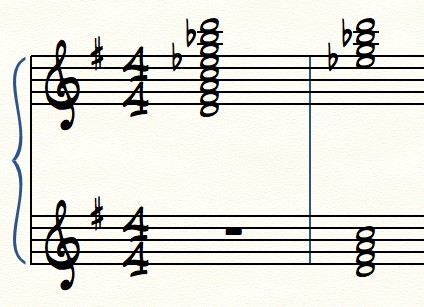
Instead of thinking of this as one big chord, you can divide it in half and get this result:

Now, you have a D7 chord on the bottom with an Ebmaj7 chord above it.

Thinking of large chords at a micro level can help with voicing. Now that we know that the D7(b9 b13) chord is really just a combination of the two chords (D7 and Ebmaj7), we can essentially “divide and conquer” with solving how we want to voice the chord harmony:

Thank you so much for taking the time to read! Feel free to comment, share, and subscribe for more daily tips below! Till next time.
Tip #158 – Understanding the Mayamalavagowla Scale

The Carnatic music of South India has 72 scales (melakartas) comprised of seven different notes in either an ascending (arohana) or descending (avarohana) fashion. These scales are used in a kind of India music called rāga and are extremely beautiful. In addition these scales are grouped into different chakras, based on certain similarities.

Today’s melakarta is the Mayamalavagowla scale (meaning “love affair”), the third scale from the third chakra.

Below is a representation of the scale as if it was put into Western notation:

Both the first (SA) and fifth (PA) scale degrees are in a placement normal to most scales found in Western music. However, there is an augmented distance between the second (RI) and third (GA) scale degrees.  In addition, the seventh scale degree (NI) is raised.  While this may sound dissonant or exotic, this scale gives a great amount of opportunity to play with tension and chromatic passing tones.

Try playing around with the scale, possible harmonies, and progressions!

Thank you so much for taking the time to read! Feel free to comment, share, and subscribe for more daily tips below! Till next time.

Tip #157 – Orchestrating to Avoid Minor Second Dissonance

Say that you are creating a closed fifth cluster (or any other cluster as a matter of fact) like the one below:

We have talked about previously about assigning the added tone the disrupts the triadic sound to another instrument family group. However, that rule is not so easy to apply to other clusters…

…especially, even when there is a m2 sound formed in the cluster.

To best resolve around the dissonance of the m2 sound, divide up the cluster chord so that the m2 harmonic interval sound doesn’t appear within the same instrument family.

So, one way of dividing this into two voices would be:

And there you go!

Thank you so much for taking the time to read! Feel free to comment, share, and subscribe for more daily tips below! Till next time.
Tip #156 – Orchestrating Closed Fifth Structures

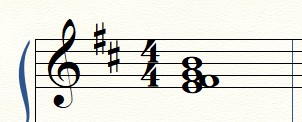
One interesting idea that I just read about that I want to share with you all is on how to orchestrate the closed fifth cluster.

To remind, the structure of the closed fifth cluster is a major or minor triad in root position with an extra note added a perfect fourth below the melody note.

The orchestration revolves around the idea of separating between two orchestral families.

In other words, try having the three notes that form the major/minor triad from one instrumental family in your orchestration while having the extra tone of the cluster come from a completely different instrument.

Not only will this create a variety and blend in the timbre, but it will also make the “cluster” sound become more pronounced.

Thank you so much for taking the time to read! Feel free to comment, share, and subscribe for more daily tips below! Till next time.