Improve Your Lyrics – Tip #12

Continuing with the recent weeks talking about making artistic comparisons, a songwriter can do so with a simile.

A simile is a comparison of two different things using “like” or “as”

You can compare two similar objects like:

  • Soft as a pillow
  • Hot like fire

Or compare two different things in a contrasting (almost sarcastic) juxtaposition:

  • He’s as alive as a tombstone
  • Strength like a feather

Regardless of how you choose to use a simile, be sure it enhances the creative and descriptive poetry of the song.

Thank you so much for taking the time to read! Feel free to comment, share, and subscribe for more daily tips below! Till next time.

Teach Yourself Music Theory – 13.) Pitch-Class Collections of Natural Minor Scales

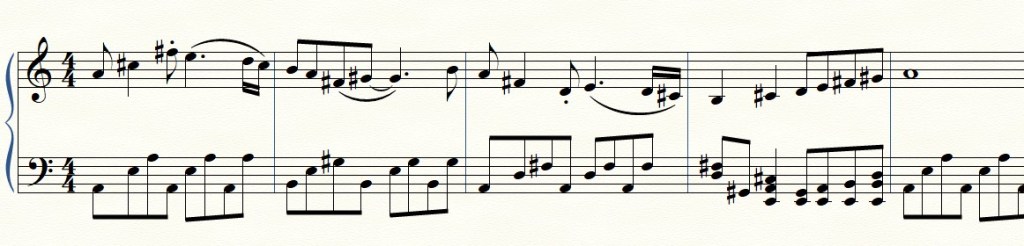
Continuing with the idea of pitch-class collections and how they can form scales, let’s introduce a new scale: the natural minor scale.

To make a natural minor scale, one has to have a collection of pitches that in ascending order go in an intervallic pattern of whole-step, half-step, whole-step, whole-step, half-step, whole-step, and whole-step back to the original pitch. One can also think of this as M2-m2-M2-M2-m2-M2-M2.

Take a look at the composition below, write the pitch-class collection, and then arrange the pitches into an ascending manner fitting the pattern of the natural minor scale:

If you did it correctly, you would get {F#, G#, A, B, C#, D, E, F#}, which means this composition uses a F# minor scale…

…but wait, don’t the same pitches used also make up the A Major scale?

That is correct! For every major scale, there is its own relative natural minor scale. All you have to do is go down a minor-third interval (or up a major-sixth interval) from the original major scale to find the relative minor scale. So C major is A minor, G major is E minor, E major is C# minor, etc.

Now, how can well tell if a song is using a major or minor scale? well, that will be saved as a topic for next time.

Thank you so much for taking the time to read! Feel free to comment, share, and subscribe for more daily tips below! Till next time.

Tip #115 – Altering the Fifth of a Chord

One thing you can do to make a simple harmonic progression more interesting is by altering the fifth of the triad chord.

Most people think adding upper extensions like the 7th, 9th, 11th, and 13th, are the only way to make a chord harmony more interesting, but altering the inner core of the triadic chord itself is a great way.

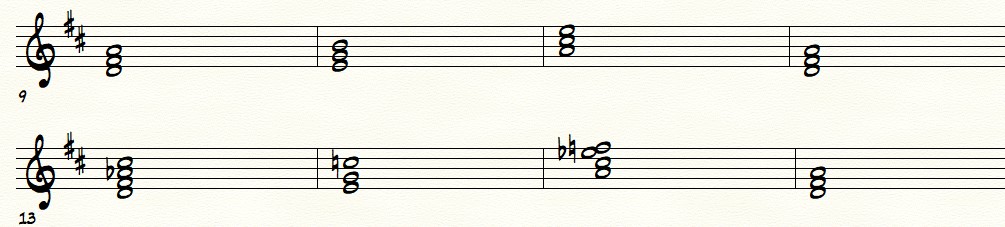
Take a look at the progression below:

Notice how the simple I-ii-V-I progression was repeated again but with a b5 of a #5 (or both!).

Some alterations way not work, so an in-depth discussion on what is the correct way to alter certain types of chords will be done in the future.

Till then, experiment!

Thank you so much for taking the time to read! Feel free to comment, share, and subscribe for more daily tips below! Till next time.
Tip #114 – Understanding the Senavati Scale

The Carnatic music of South India has 72 scales (melakartas) comprised of seven different notes in either an ascending (arohana) or descending (avarohana) fashion. These scales are used in a kind of India music called rāga and are extremely beautiful. In addition these scales are grouped into different chakras, based on certain similarities.

Today’s melakarta is the Senavati scale (meaning “maintenance”), the first scale from the second chakra.

Below is a representation of the scale as if it was put into Western notation:

Both the first (SA) and fifth (PA) scale degrees are in a placement normal to most scales found in Western music. However, the second scale degree (RI) is lowered, creating a tendency to resolve downward. In addition, the seventh scale degree (NI) is lowered as well.  While this may sound dissonant or exotic, this scale gives a great amount of opportunity to play with tension and chromatic passing tones.

Try playing around with the scale, possible harmonies, and progressions!

Thank you so much for taking the time to read! Feel free to comment, share, and subscribe for more daily tips below! Till next time.
Tip #113 – Avoid Rewriting with a D.S.

Sometimes when you are reading a score, you will notice a section that says D.S. al Coda or D.S. al Fine. Both can be used as a way to indicate to the performer of your music that you want a section to repeat in a particular way without having to rewrite the section yourself.

Not only will this save time and energy, but it will clearly communicate the message – if done correctly.

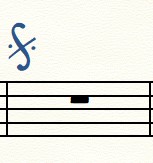
D.S. is short for Dal Segno, which means “from the sign.” When you come across a measure in the score that has D.S. above it – it means to repeat back to the measure with this sign right above it:

If the sign is D.S. al Coda, that means there is an extra step. Once returning to the sign shown above, the performer will play till they reach this sign:

…and then jump forward to an area marked “coda.”

If the sign is D.S. al Fine, the performer will play till they reach a measure marked Fine – or end.

Once again, this is a simple tip to help save time to avoid rewriting repeated sections.

Thank you so much for taking the time to read! Feel free to comment, share, and subscribe for more daily tips below! Till next time.
Tip #112 – Avoid Rewriting with a D.C.

Sometimes when you are reading a score, you will notice a section that says D.C. al Coda or D.C. al Fine. Both can be used as a way to indicate to the performer of your music that you want a section to repeat in a particular way without having to rewrite the section yourself.

Not only will this save time and energy, but it will clearly communicate the message – if done correctly.

D.C. is short for Da Capo, which means “from the head.” When you come across a measure in the score that has D.C. above it – it means to repeat back to the beginning!

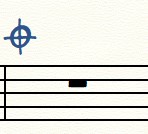
If the sign is D.C. al Coda, that means there is an extra step. Once returning to the beginning, the performer will play till they reach this sign:

…and then jump forward to an area marked “coda.”

If the sign is D.C. al Fine, the performer will play till they reach a measure marked Fine – or end.

Once again, this is a simple tip to help save time to avoid rewriting repeated sections.

Thank you so much for taking the time to read! Feel free to comment, share, and subscribe for more daily tips below! Till next time.
Tip #111 – Key Change with a Pivot Chord

Simple reminder: a pivot chord is a chord shared amongst two separate keys that is used as a connecting bridge to get from one key to another in a key change.

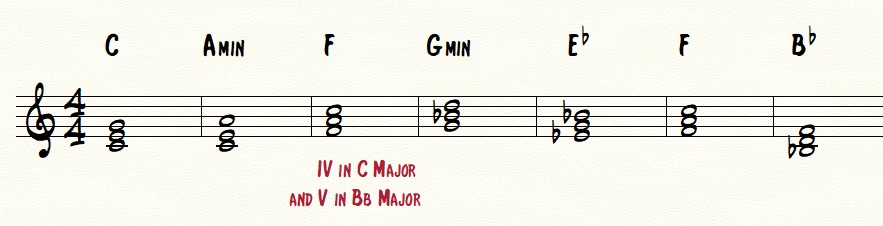
Take a look at the example below:

Notice how the F major triad is a chord in two keys: C Major and Bb Major. With the F major triad having multiple functions, we can direct the harmonic progression into a new key area.

Thank you so much for taking the time to read! Feel free to comment, share, and subscribe for more daily tips below! Till next time.

Improve Your Lyrics – Tip #11

Sometimes, before starting a song a band might say that they are going to play in the key of something. This is so everyone is in the same realm of pitches and everyone can play together cohesively.

That being said, a lyricist should attempt to do the same idea by writing in the “key of a word,” to create cohesiveness.

Now, what exactly does that mean? Well, when writing a song, try picking one overarching word or message – and then make a word bank that directly or similarly relate to the main idea.

So, if your main idea is “how tough work is,” you would probably see words like “sweat,” “tired,” “exhausting,” instead of “fluffy.”

One helpful way to organize ideas and process them is to use a spider-chart, and how all the connecting words branch-off from each other.

Thank you so much for taking the time to read! Feel free to comment, share, and subscribe for more daily tips below! Till next time.

Teach Yourself Music Theory – 12.) Pitch-Class Collections and Major Scales

Read, analyze, play, and/or listen to this compositional segment below:

Now, write out all of the note letter-names that you see where used in this small composition.

You should get (in order of appearance): { A, C#, E, F#, D, B, G#}

What we have written above is the composition’s pitch-class collection, or a collection of all the pitches listed by their letter-names used.

Time to introduce a new concept. A scale, which is a pitch-class collection but organized in a ascending/descending manner in an alphabetized way.

Which… using the same example above, if we put the pitch-class collection in an alphabetical order, it would be: {A, B, C#, D, E, F#, G#}

So, what kind of scale is this? Well, to spoil the answer – this is a major scale. But how can we tell? Just look at the intervallic distances between the notes.

A major scale is made up of a pattern of notes set apart from each other in an ascending manner of whole-step, whole-step, half-step, whole-step, whole-step, whole-step, half-step (which returns to the starting pitch). You can also think of this as M2-M2-m2-M2-M2-M2-m2.

So now, let’s take a look back at our pitch-class collection:

Does it match the pattern of the major scale interval formula? Yes it does!

Try now for an exercise by taking any starting pitch and see if you can build a major scale of your own!

Thank you so much for taking the time to read! Feel free to comment, share, and subscribe for more daily tips below! Till next time.

Tip #110 – Understanding the Tanarupi Scale

The Carnatic music of South India has 72 scales (melakartas) comprised of seven different notes in either an ascending (arohana) or descending (avarohana) fashion. These scales are used in a kind of India music called rāga and are extremely beautiful. In addition these scales are grouped into different chakras, based on certain similarities.

Today’s melakarta is the Ratnangi (meaning “the one that embodies improvisation”) scale, the sixth scale from the first chakra.

Below is a representation of the scale as if it was put into Western notation:

Both the first (SA) and fifth (PA) scale degrees are in a placement normal to most scales found in Western music. However, the other scale degrees are lowered as well as clustered in chromatic runs. In addition, the upper notes of the scale are clustered as well into a chromatic run, creating symmetry. While this may sound dissonant or exotic, this scale gives a great amount of opportunity to play with tension and chromatic passing tones.

Try playing around with the scale, possible harmonies, and progressions!


Thank you so much for taking the time to read! Feel free to comment, share, and subscribe for more daily tips below! Till next time.