Improve Your Lyrics – Tip #26

One aspect of your lyric writing you should be aware of is how the words line-up with the stresses of the meter in the music.

To review, meter and measure is the grouping of beats (pulses) together into a repeated hierarchy. In most music, the meter is 4/4 and the first beat is the strongest… followed by the third, second, and fourth.

As you speak your lyrics, you will notice that there are certain words (or maybe syllables of words) that have emphasis/strength. The overall goal is to make sure that those accents in your singing naturally line-up with the accents of the meter.

Strong words at the beginning of a verse should start on the downbeat while weak words at the beginning of a verse should start on an upbeat/anacrusis.

Of course, you can play with the syncopation and placement of accents. However, to achieve a fluid and natural sound – aim to get the lyrics stresses on the beat stresses.

Thank you so much for taking the time to read! Feel free to comment, share, and subscribe for more daily tips below! Till next time.


Teach Yourself Music Theory – 18.) Harmonic and Melodic Minor

Review time! What scale is this?:

If you said “a natural minor scale” you are correct! Don’t worry if you didn’t get the answer correctly, you can review on all the past posts on music theory.

We can tell that this is a natural minor scale because…

1.) The key signature has no sharps or flats, and it starts on the A pitch

2.) The scale is built in the intervallic pattern of all natural minor scales of M2-m2-M2-M2-m2-M2-M2.

Now, it is time to introduce two different kinds of minor scales.

The first is called the harmonic minor scale, and it is made by raising the seventh scale degree (the subtonic) up a half-step (the leading tone). It would look like this:

As the name goes, it is used for harmonic purposes to achieve a dominant V sound. More on that soon!

The second is called the melodic minor scale, and it is made by raising the sixth and seventh scale degree up a half-step. HOWEVER, that is only when you are ascending up the scale. Those scale degrees return back to their natural position as you descend down the scale:

As the name goes, it is used for melodic purposes to retain a “minor” sound with the lowered third degree, but have leading motion in the sixth and seventh degrees to resolve to the tonic.

Play those scales in different keys to see how they sound.

Thank you so much for taking the time to read! Feel free to comment, share, and subscribe for more daily tips below! Till next time.

Tip #164 – Understanding the Suryakantam Scale

The Carnatic music of South India has 72 scales (melakartas) comprised of seven different notes in either an ascending (arohana) or descending (avarohana) fashion. These scales are used in a kind of India music called rāga and are extremely beautiful. In addition these scales are grouped into different chakras, based on certain similarities.

Today’s melakarta is the Suryakantam scale (roughly translating to “the sun”), the fifth scale from the third chakra.

Below is a representation of the scale as if it was put into Western notation:

Both the first (SA) and fifth (PA) scale degrees are in a placement normal to most scales found in Western music. However, there is an augmented distance between the second (RI) and third (GA) scale degrees.  In addition, both the sixth (DHA) and seventh scale degree (NI) are raised.  While this may sound dissonant or exotic, this scale gives a great amount of opportunity to play with tension and chromatic passing tones.

Try playing around with the scale, possible harmonies, and progressions!

Thank you so much for taking the time to read! Feel free to comment, share, and subscribe for more daily tips below! Till next time.

Tip #163 – Building Heavy Chromatic Lines

In a lot of modern (and even classic) heavy metal songs, there is use of chromatics in the guitar riff.

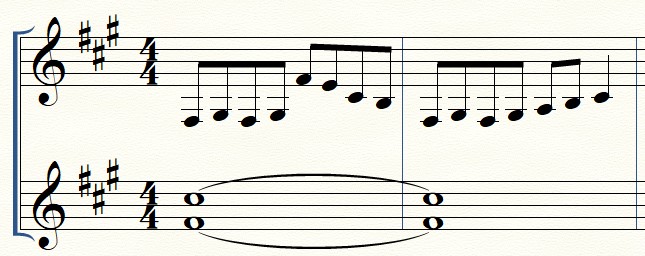
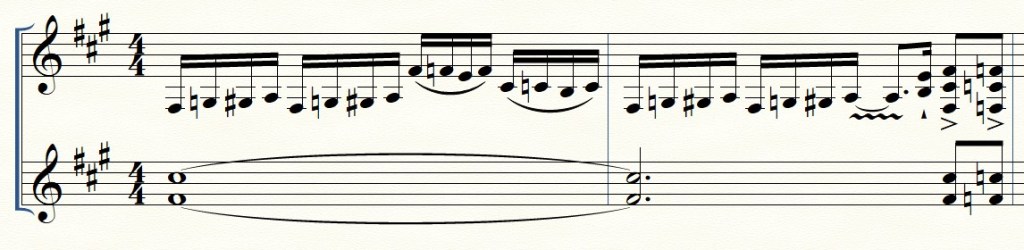
Today’s tip is about constructing a fast sixteenth-note riff that utilizes chromatics in a melodic way while appealing to the dissonance resolution tendencies.

First, start off by playing a chord member of the harmony on every quarter-note pulse. If the harmony is a power chord, decide if it is major of minor (most like it will be minor):

Then, add eighth-notes in between. These should be diatonic notes to the key or chord members:

Finally, add sixteenth-notes in between. These notes should be chromatic notes outside of the key; however, they can also be diatonic notes so long as the fit the direction of the moving melodic line:

From there, you can change the rhythm, notes, accentuation, etc. of your riff!

Thank you so much for taking the time to read! Feel free to comment, share, and subscribe for more daily tips below! Till next time.

Improve Your Lyrics – Tip #25

Today we are going to talk about the different points of view (separately) when writing lyrics.  It is important to be conscious of the song’s/story’s point of view because you want the intended message to come across to the audience.  For example: if you want to talk about a personal subject, would you be using the word “you?”  Probably not.

For this post, we are going to talk about the Direct tense.

Direct tense is similar to the Second Person point of view with the words as well as the level of intimacy.  However, this is used for talking more directly, as in a command.

  • Subject – you
  • Direct Object – you
  • Possessive Adjective – your
  • Possessive Predicate – yours

Thank you so much for taking the time to read! Feel free to comment, share, and subscribe for more daily tips below! Till next time.
Improve Your Lyrics – Tip #24

Today we are going to talk about the different points of view (separately) when writing lyrics.  It is important to be conscious of the song’s/story’s point of view because you want the intended message to come across to the audience.  For example: if you want to talk about a personal subject, would you be using the word “you?”  Probably not.

For this post, we are going to talk about Third Person.

Third Person is for storytelling because of how objective it is.  If you want to tell of a situation happening to outside characters, the Third Person point of view is the best option.

The following are words used to convey the Third Person point of view:

  • Subject – he, she, it, they
  • Direct Object – him, her, it, them
  • Possessive Adjective – his, her, its, their
  • Possessive Predicate – his, hers, its, theirs

So, if you want to convey the Third Person point of view, keep in mind of using those words above.

Thank you so much for taking the time to read! Feel free to comment, share, and subscribe for more daily tips below! Till next time.
Improve Your Lyrics – Tip #23

Today we are going to talk about the different points of view (separately) when writing lyrics.  It is important to be conscious of the song’s/story’s point of view because you want the intended message to come across to the audience.  For example: if you want to talk about a personal subject, would you be using the word “you?”  Probably not.

For this post, we are going to talk about Second Person.

Second Person has the most intimacy to it, because you are talking directly to another.  However, it needs to be used carefully – you don’t want it to come across like you are a dictator; you want the words to come across as conversational.

The following are words used to convey the Second Person point of view:

  • Subject – you
  • Direct Object – you
  • Possessive Adjective – your
  • Possessive Predicate – yours

So, if you want to convey the Second Person point of view, keep in mind of using those words above.

Thank you so much for taking the time to read! Feel free to comment, share, and subscribe for more daily tips below! Till next time.

Improve Your Lyrics – Tip #22

Today we are going to talk about the different points of view (separately) when writing lyrics.  It is important to be conscious of the song’s/story’s point of view because you want the intended message to come across to the audience.  For example: if you want to talk about a personal subject, would you be using the word “you?”  Probably not.

For this post, we are going to talk about First Person.

First Person has some intimacy to it, but can become objective.  It is also used to talk to the audience about other people, depending on if using and outsider narrative. 

The following are words used to convey the First Person point of view:

  • Subject – I, we
  • Direct Object – me, us
  • Possessive Adjective – my, our
  • Possessive Predicate – mine, ours

So, if you want to convey the First Person point of view, keep in mind of using those words above.

Thank you so much for taking the time to read! Feel free to comment, share, and subscribe for more daily tips below! Till next time.
Teach Yourself Music Theory – 17.) Solfège Syllables

Cue The Sound Of Music

Anyways, this is a continuation once again of explaining the jargon used amongst musicians when referring to scale degrees.

Solfège Syllables is a practiced used commonly with sight-singing (singing a musical work for the first time without prior rehearsal or practice) to train the performer how to recognize the intervals between pitches just by looking at a piece of sheet music.

“How is this done,” you ask?

Well, many of you might have heard of “do-re-mi-fa-sol-la-ti-do,” and that is basically solfège singing. The purpose of it is that when you assign any pitch to “do” (or to any syllable as a matter of fact) you can figure out how to sing the other syllables because the muscles in your vocal chords know the sonic distances between each syllable.

Still sounds complex?

Okay, let’s take a C Major scale. Play it and sing it. Now sing it with “do-re-mi-fa…”

Good! Now, choose any pitch you want (other than C) and make that “do.” From there, if you copy exactly what you did when you sang solfège syllables, you will be able to sing a major scale from any key!

Below is the list of solfège syllables and the chromatic alterations:

Thank you so much for taking the time to read! Feel free to comment, share, and subscribe for more daily tips below! Till next time.

Teach Yourself Music Theory – 16.) Calling Pitches by Scale-Degree Name

Today’s topic is more so about covering jargon used in music than actually understanding of music. However, the use of this terminology can help clear-up some confusion from previous lessons as well as aid in helping understand the next lessons.

When we talked about the major and natural minor scales, we talked about how they are made up of 7 different pitch classes with a repeat at the octave. Previously, we have just been calling the pitches of the scale just by there ascending number.

So, for example: we call the second note of the scale the second degree.

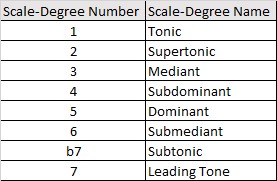
Well, there are some specific names for those pitches that make up the scales:

Now, going back to our previous example: when referring to the second scale degree of the major or natural minor scale, we would say the “supertonic” of the scale.

To further drill-in this terminology, let’s review the major pentatonic scale.

Remember that the major pentatonic scale has the same pitch class collections as the major scale… but 2 pitches less (hence how “penta” means “five”).

What scale degree names are in common with the major scale AND the major pentatonic scale?

Looking at the chart above, it would be:

  • The tonic
  • Supertonic
  • Mediant
  • Dominant
  • and submediant

And there you! That’s how you name pitches by their scale-degree names.

Thank you so much for taking the time to read! Feel free to comment, share, and subscribe for more daily tips below! Till next time.