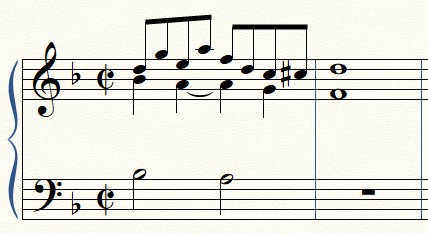
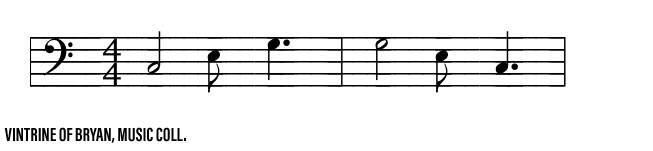
We can see a lot of things from this; in particular, we have some cadential motion going on with a raised C# to D in the key of d minor. Also, there is an F underneath the D which make up an i chord of Dm. Plus, there is an A bass root in the pervious bar which act as a V to i cadence.
But there really isn’t a root motion of V to i at all with the bass note missing. Yet, if performed, we do hear this as a cadence.
Point I’m getting at: sometimes even with the removal of “the floor beneath” you can still imply a cadence. While it is certainly not as strong as a perfect authentic cadence in full, it might be the weak cadence you are looking for.
Thank you so much for taking the time to read! Feel free to comment, share, and subscribe for more daily tips below! Till next time.
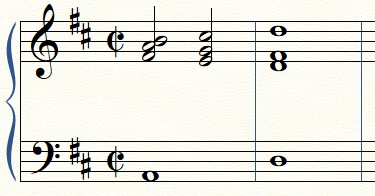
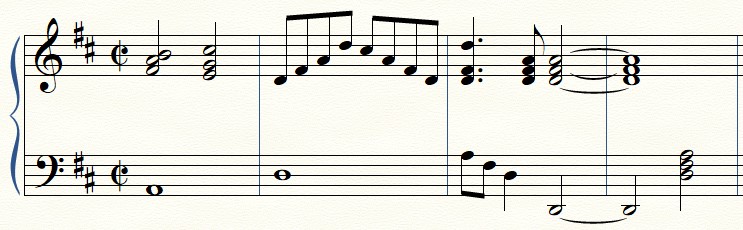
While one option is to end with a cadence that is short & sweet (or even to the short-end extreme of abrupt/without-warning), another is to milk it for as long as possible. Take a cadential phrase like this:
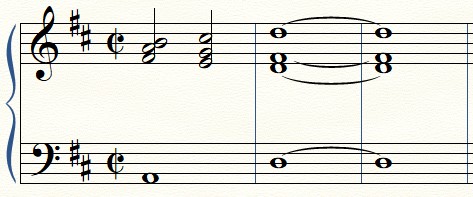
Even though a simple way is to stretch it out with some prolongation of the tones, there are more creative ways.
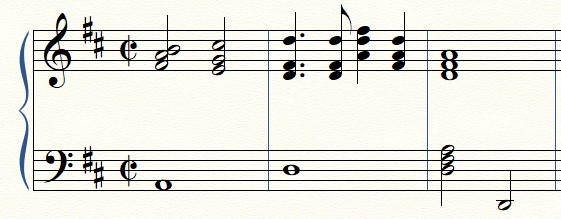
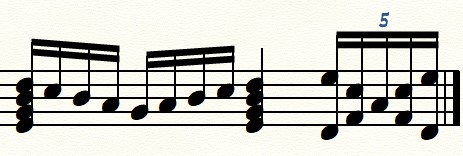
Commonly found in classical music, the cadential chord can receive some treatment of reiteration in different inversions, vertical structures, voicings, registers, etc.
Another way to lengthen the end is to arpeggiate the chord out:
Thank you so much for taking the time to read! Feel free to comment, share, and subscribe for more daily tips below! Till next time.
Continuing on the topic of lessening the impact of a cadential figure in order to maintain a sense of flow while signaling to the listener the termination of a phrase, we are going to look at the use of an elided cadence.
Think about using an elided cadence as crossing the finish line – but still continuing to run. It occurs in music when a new phrase begins before or at the same time as the cadential chord that is just about to close the previous musical idea.
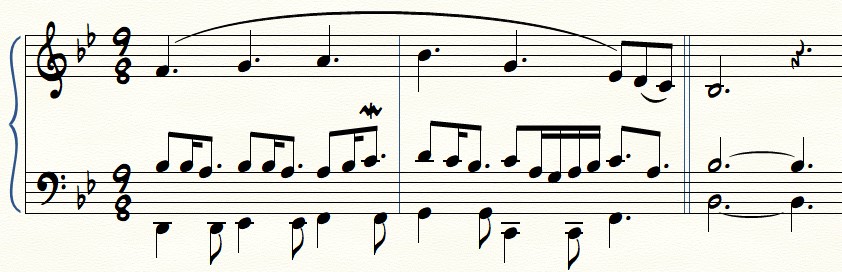
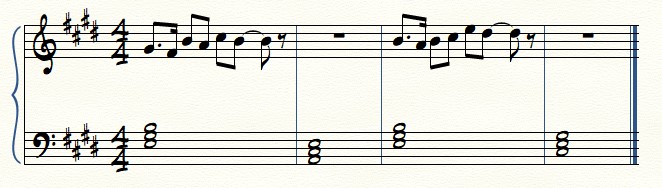
Here is the tail-end of a musical phrase with the cadence happening on beat one and stopping right there in its tracks:
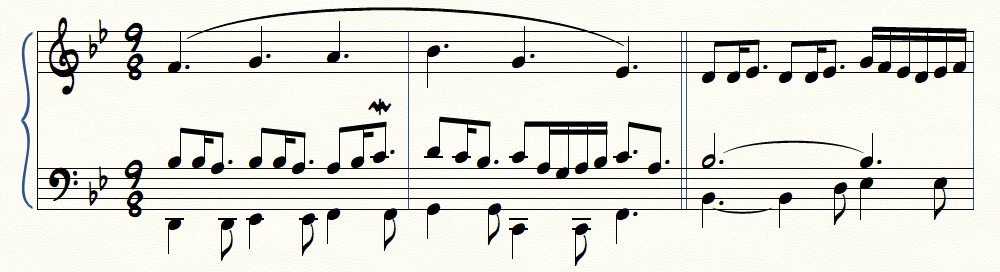
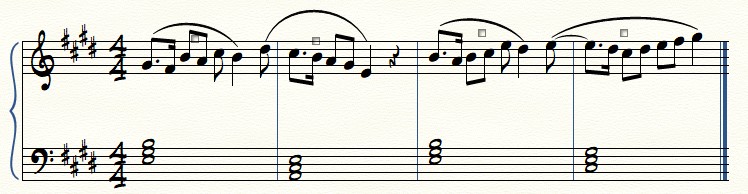
To lessen the sudden impact of the stop in motion, try having a voice start a new phrase. It could look something like this:
This gives the flow of being together, but at the same time being two different recognizable ideas.
Thank you so much for taking the time to read! Feel free to comment, share, and subscribe for more daily tips below! Till next time.
When nearing the end of a phrase or musical idea, a cadence is in order to signify to the listener that we have reached a point of conclusion in some way shape or form. However, a composer way wish that the cadence not be so drastic – in the necessity to have a continuation of motion.
So how does a composer acoustically signal the end, but do it in a sophisticated way to allow the flow to continue – like a yellow light at a traffic stop?
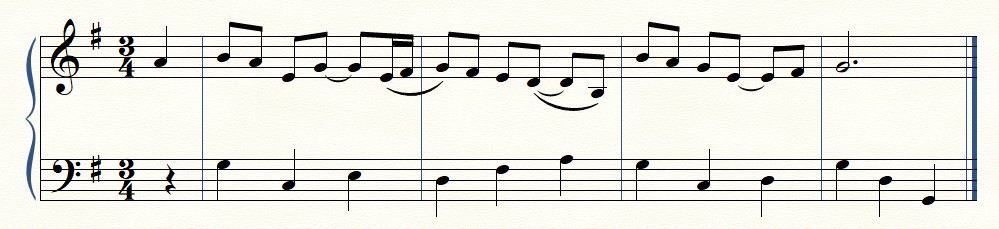
For compositions that feature an anacrusis, or pick-up measure, a shifted cadence can work to their benefit by working off the already shifted phrasing. Take a look at an example that cadences at the strong beat 1, coming to an ultimate conclusion:
There is nothing wrong with this, but we can improve the ending by shifting it to a weaker part of the beat to essentially “lessen the blow” of the cadential figure – thus, maintaining an element of continuity to the flow of music to progress further without an abrupt stop. Here is a possible edit:
Notice that the cadence is now on beat three, which in 3/4 time is the weakest part of the measure grouping.
Thank you so much for taking the time to read! Feel free to comment, share, and subscribe for more daily tips below! Till next time.
In a previous tip post, we talked about the idea of the call & response. Say, for example, you have a harmonic progression with set-in-stone musical themes that will act as a “call,” but are missing the “responses” in between:
Four ingredients to a tasteful execution of a response are: 1) space, 2) pitch, 3) rhythm, and 4) judgment.
For space, decide if the response need to occur immediately after the termination of the call, or if there can be measures of rest in between.
Aim to land on chord tones on strong beats, but don’t be afraid to add passing and chromatic pitches!
A good flow of rhythm would be to start as an anticipation on a weak part of the measure entering a stronger beat. Ending on a strong beat, too, can sound good – but that is up to the composer.
And finally, have good taste/use of economy as to what is needed and best complements he figures.
Here is a rough draft of adding “fills” to these previous blank measures:
In this case, space is tight – which means constant flow. Also, the response has its own unique shape while staying within the chordal tones. These are some nice qualities. However, there are breaks of silence between that can be abrupt. So, by incorporating an anticipating figure, and modifying the rhythm to look similar to the call, the response is workshopped into something completely better than before:
Thank you so much for taking the time to read! Feel free to comment, share, and subscribe for more daily tips below! Till next time.
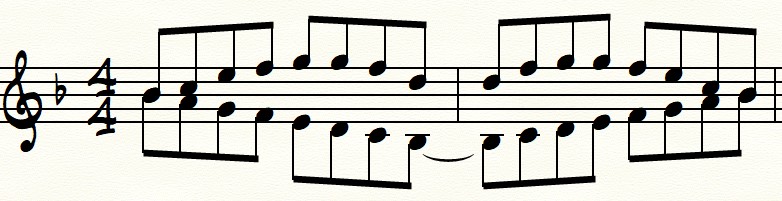
What does it look like? A pair of wings? Lips? Maybe a flatted heart? Either way, you could have probably understood right off the bat that this musical idea has more of a visual aesthetic that an acoustic kind.
While writing music in the way that you want it to sound should be a priority, there is nothing wrong with having some fun and experimenting with trying to draw pictures/shapes with the music. You never know – it might sound really could if possible to perform!
Thank you so much for taking the time to read! Feel free to comment, share, and subscribe for more daily tips below! Till next time.
In my personal opinion, upcoming composers never lack in having enough original materials & ideas for new works of music. However, a good portion of them do lack in the skill of seamlessly transitioning from one idea to another (unless that stark contrast is desired – but it shouldn’t happen all the time, as abrasive transitions sound cheap on the composer’s part over time).
Think of this technique of solving this problem like those apps that take two photos and fuse them together by finding the commonality point in the middle. The same thing can be done with musical figures/themes. Take two separate ideas and look at their shape, intervals, repeating patterns, contour, pitches, etc.
Take note of the similarities and differences between the two. Some stuff may overlap. Now, combine those aspects in different ways. Observe how each “offspring” figure has a commonality with each of the “parents.”
Thank you so much for taking the time to read! Feel free to comment, share, and subscribe for more daily tips below! Till next time.
Maybe when you were a kid you played with a toy that involved building your own character. You got separate cards of various heads, torsos, and bottoms… only for you to do something silly and have the head be in the middle, and the torso on the top.
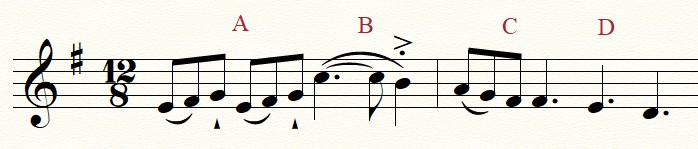
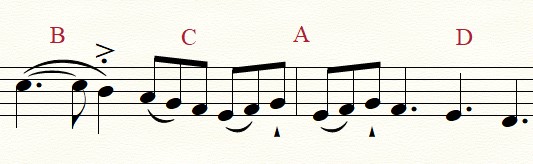
Let’s try something similar with expanding melodies with a lot of smaller figures within them. First, label each unique standalone figure within a melody. Group them to how you feel best fits and separates from the others.
After that, experiment by reordering the different parts. Some of them may not work, but others might be really cool and crafty!
Thank you so much for taking the time to read! Feel free to comment, share, and subscribe for more daily tips below! Till next time.
Want to do something sonically and acoustically creative, but not exactly sure on how to develop a melodic theme? Try using retrograde techniques!
As the name implies, retrograde means doing something backwards. Think of it like a mirror copy of the original. For example in practice, take a small (or large – whatever you prefer) melodic idea:
Now, copy and write the new melody in the following measures as if you placed a mirror across the bar line. Notice how the pitches and rhythm reflect over the bar line in backwards to ow it was originally written.
While retrograde typically involves repeating backwards the phrase on both levels of pitch frequency and rhythm, a composer can experiment by dropping one of them. What if we took the rhythm factor out of retrograde, and just had the pitches go backwards? It would look something like this:
And now the other way around: only keeping the rhythm in retrograde.
Thank you so much for taking the time to read! Feel free to comment, share, and subscribe for more daily tips below! Till next time.
I have been recently thinking about this argument posed, of which that claims how we cannot approach other forms of music (pop, rock, jazz, Latin, folk, etc.) in theory & analysis the way we approach classical art music. Reasoning behind is that it doesn’t take into account, or it essentially overlooks, what makes that particular genre different from the rest. That by putting the square pegs of other forms of music into the round hole of classical music – we would scrape off the edges and miss the understanding of what that kind of music is.
While I can entertain the idea that using the rules of strict school book-taught classical art theory to compose other genres of music is not a wise decision, I do believe that it is okay to use classical theory to understand – pick apart – and fundamentally analyze other kinds of music.
What needs to be reminded is that music theory & analysis is just like any other form of science; from psychology, to anthropology, to biology, etc., they all do essentially the same thing. They observe, group together, and name special occurring phenomenon to be used later in order to understand other properties of the subject.
Instead of advocating that every form of music needs its own theory, there should be more of an educational push to encourage music theorists to approach with the lenses and vocabulary of their desired theoretical base (whether in classical, jazz, pop, etc.), and make new rules to understand what makes a particular genre sound that way.
This is long-standing problem in the academic field – where colleges neglect, too, that there can be many music theory “lenses” to viewing a piece of music. Too many times has a person with a background of not reading music, but understanding it through their own way, become discouraged of pursuing music because they are branded “stupid” for not adopting the viewpoints of classical art theory. And teachers fear that unless a student knows how to use classical theory – classical music can’t be reproduced.
If you buy a table and you have to assemble it together, but the instructions are in a foreign language – do we say that the table is incomprehensible? No, it is a table for goodness sake. It can still be built despite not knowing how to read the instructions that came with it.
So instead of demanding that a form of theory has to stay with a particular genre, academia and scholars should instead approach all kinds of music with the understanding that they have already, and make new discoveries to the unique acoustic phenomenon of different kinds of music.








 Daily Music Writing Tips - Blog by Bryan M. Waring