Tip #123 – Conceptualizing a Thematic Bridge

Just as the name would suggest, a thematic bridge is somethings that acts as a connection between two fairly different themes in a piece of music.

It would help if the two themes are connect is some way to begin with – being fragmented developments of each other, or whatever. However, it is possible to do so with very different themes.

First thing to do would be to point out where in the composition you need the thematic bridge to be – obviously between the two contrasting parts. From there look at the measures before and after it to note what are the characteristics of the opposing themes.

Finally, (and this may be the hardest part) attempt to make a “natural sounding” combination of the two themes. Be like Dr. Frankenstein and mix-n-match different characteristics of the two to form one complete idea.

Of course, this is a tip on how to create smoothness between to sections IF smoothness is desired. It is your composition – do what you want!

Thank you so much for taking the time to read! Feel free to comment, share, and subscribe for more daily tips below! Till next time.

Tip #122 – Mindfulness When Using Wind Pads

I certain situations where your live performance/recording is in need of human performers instead of electronic or artificial instruments – you must keep in mind the limitations of a human, especially a wind player.

Unless they know how to do “circular breathing” chances of you having a wind section hold long notes for extended periods of time is slim to none.

So, what are some options that you can do for creating a wind instrument pad while being mindful the lung limitations of the performers.

One thing you can do, if there are multiple people in a section, is to write staggered points of breathing marks or rests. That helps create a smooth continuous line without the players taking a breath at the same time.

In the case you only have one person per instrument section, look as to wear you can add breath marks or rests that best complement the melody. Meaning, structure it around the phrasing of the main melody or harmonic rhythm. This will make the pad seem connect to another part of the music, even if it has to take a breath and break the pad.

Thank you so much for taking the time to read! Feel free to comment, share, and subscribe for more daily tips below! Till next time.
Tip #121 – Double Meter Mindfulness

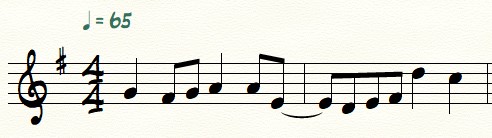
What is the difference between in playing this melody below correctly…:

And this one as well?:

Honestly, barely anything. Even though the tempos and note value lengths are written different, they are played exactly the same.

This is called a double meter, when the notes can be doubled in value and doubled in tempo to create the same affect as the original. Yes, this is an augmentation – but the tempo change evens it out.

It is important to be mindful of this and how you want to write out your score so that:

  1. The beats/rhythm best fit what you imagine.
  2. The musical ideas clearly presented to the performers to avoid any confusion.

So in other words; while the two examples above are the same thing, be mindful as to which you choose that will best help get the message across to the performers.

Thank you so much for taking the time to read! Feel free to comment, share, and subscribe for more daily tips below! Till next time.
Teach Yourself Music Theory – 14.) Key Signature

A key signature is a marking of sharps or flats found at the beginning of a piece of music (or section) right after the clef. It is used to tell the performer what pitches are to be sharpened/flattened throughout, which pitch collections are used, and what is the center of tonality.

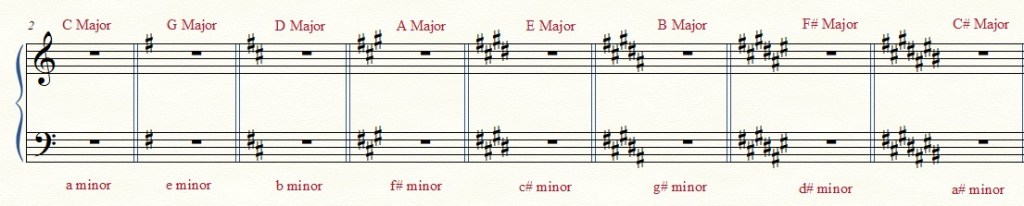
First, let’s take a look at the sharp keys:

With every sharp, the respective major/minor key goes up a perfect fifth. Also, notice that the addition of sharps in the key signature form a pattern of { F# – C# – G# – D# – A# – E# – B# } and are placed in there respective place on the staff lines.

So, if the piece has one sharp in the key signature, we can tell that it is in either G Major / e minor and that we must play F# throughout the entire composition.

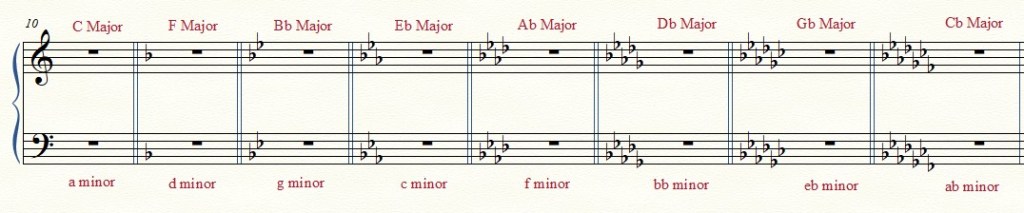
Now, let’s take a look at the flat keys:

Once again, we can see a similar pattern with the respective major/minor key going DOWN a perfect fifth with each flat added to the key signature. Also, the flats work in a backwards pattern from the sharps, going { Bb – Eb – Ab – Db – Gb – Cb – Fb } and still be placed on the correct line of the staff.

So, if the piece has four flats, we know to lower those notes down and play in the equivalent pitch collection of an Ab Major / f minor key.

Okay, so now how do we tell what key a piece of music is in?

  1. First, check the key signature to decipher how many sharps or flats it has.
  2. Second, look at the beginning and end of the piece and see what scale degree it lands on.
  3. Third from the information gathered, make a educated conclusion as to where the music is focused around – a major or minor key.

And there you go. Unfortunately, there are some exceptions to the guideline, but above all gather information and make a supportive conclusion as to where you think the piece of music lives in – being either a major or minor key within the given key signature.

Thank you so much for taking the time to read! Feel free to comment, share, and subscribe for more daily tips below! Till next time.

Tip #120 – Writing and Building Polychords

Polychords are when multiple chords (particularly triads) are played at the same time. They are used to expend the harmony and offer an interesting blend of acoustic colors.

While there is no limit to the combined chord qualities of the number of chords used to build a polychord, typically people make polychords just out of two triads.

Below is a representation of a poly chord with the proper notation (similar to a fraction sign):

Notice how this polychord above can also be written as a Bb13 chord with no 7th.

That being said, some polychords can ultimately be jazz chords (and this term is used lightly, as no chord belongs exclusively to a genre of music) with upper extensions. So, that is up to you, the composer, to play around with triadic combinations.

Thank you so much for taking the time to read! Feel free to comment, share, and subscribe for more daily tips below! Till next time.

Tip #119 – Understanding the Hanumatodi Scale

The Carnatic music of South India has 72 scales (melakartas) comprised of seven different notes in either an ascending (arohana) or descending (avarohana) fashion. These scales are used in a kind of India music called rāga and are extremely beautiful. In addition these scales are grouped into different chakras, based on certain similarities.

Today’s melakarta is the Hanumatodi scale (meaning “break”), the second scale from the second chakra.

Below is a representation of the scale as if it was put into Western notation:

Notice that this is also the Phrygian mode.

Try playing around with the scale, possible harmonies, and progressions!

Thank you so much for taking the time to read! Feel free to comment, share, and subscribe for more daily tips below! Till next time.

Tip #118 – Building a Hybrid Scale

Just like a hybrid-powered car, your scales can come from being a combination of two or more different scales.

A simple way to construct a hybrid scale is to take one-half of one scale, and combine it with one-half of the other.

So, for example; you can take the first half of the Phrygian scale and mix it with the second half of the Mixolydian scale.

Another way of constructing a hybrid scale is to take a known scale an alter certain notes by raising or lowering them.

Don’t be surprised either if your “hybrid scale” turns out to be an actually scale!

Thank you so much for taking the time to read! Feel free to comment, share, and subscribe for more daily tips below! Till next time.

Tip #117 – Using the Arabic Scale

Besides the weekly discussions of scales from rāga music in South India, you can also use the “Arabic scale” to get an exotic tonality to your composition.

To construct an Arabic scale, basically lower the second and sixth scale degrees of a major scale:

From there, use the tendency tones of resolution within the scale to write a melody:

And there you go! An exotic foreign-sounding melody just from lowering two scale degrees.

Thank you so much for taking the time to read! Feel free to comment, share, and subscribe for more daily tips below! Till next time.

Tip #116 – Key Change with a Predictable Melody

Once you established an “earworm” melody in the listener’s… ears of course, you have the ability to pull out the rug from underneath them and do a key change.

How?

Well, first take a look at the composition below:

Say that the first four measures is the original motif/chorus/theme… whatever you want to call it. We know that on every repeat the second measure of the four measure pattern the melody is an A4.

However, that pitch can be harmonized in a multitude of ways. Looking back at the example above, the pitch is now harmonized with an A major triad instead of an A minor triad. This chord then acts as a IV chord in a IV-V-I progression taking us to the key of E Major.

This sounds smooth to the ear because we were already expecting that A to happen… just not the other notes around it.

Thank you so much for taking the time to read! Feel free to comment, share, and subscribe for more daily tips below! Till next time.

Improve Your Lyrics – Tip #12

Continuing with the recent weeks talking about making artistic comparisons, a songwriter can do so with a simile.

A simile is a comparison of two different things using “like” or “as”

You can compare two similar objects like:

  • Soft as a pillow
  • Hot like fire

Or compare two different things in a contrasting (almost sarcastic) juxtaposition:

  • He’s as alive as a tombstone
  • Strength like a feather

Regardless of how you choose to use a simile, be sure it enhances the creative and descriptive poetry of the song.

Thank you so much for taking the time to read! Feel free to comment, share, and subscribe for more daily tips below! Till next time.