Tip #132 – The 373 or 737 Voice Leading

In situations where you want to use smooth voice leading over progressions that utilize the circle of fifths movement, the 373 (or 737) voice leading can help.

It can be used as a melody or inner voice. Regardless of what you choose, you start by putting the 3rd (or 7th) of the chord in the top voice. From there, place below the 7th (or 3rd), and then repeat the top note.

Usually, the lowest note is the root, and occasionally the 5th or 9th of the chord can be added for extra color.

From there, you resolve the chord into the next harmony within the circle of fifths progression by doing as such:
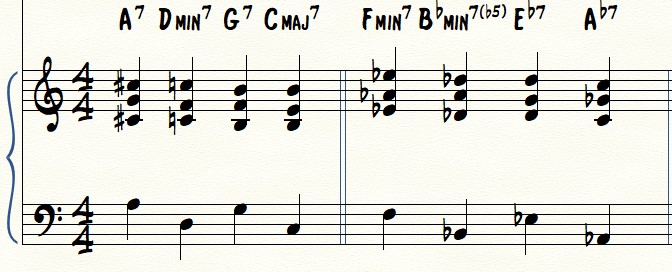
Try it out and feel how it sounds. This words great for open parallel movements.

Thank you so much for taking the time to read! Feel free to comment, share, and subscribe for more daily tips below! Till next time.

Tip #131 – Experimenting with Melodic Coupling

Melodic Coupling is when an additional melodic line in the same contour and rhythm is added to a main melodic line at an interval above or below it.

Rock, metal, and punk songs are notorious for using melodic coupling in the way of adding a new line above the main melody at a perfect fifth – hence, the power chord.

Doubling at the octave is also considered a form of melodic coupling, but it doesn’t create a full sense of harmony as other harmonic intervals would suggest.

So, today’s tip is a small suggestion to play around with different intervals in coupling. Diatonic thirds, sixths, and octaves are the most common – but that means we shouldn’t neglect other perfect intervals or diatonic seconds and sevenths.

Also, just like the example below, you can experiment with diatonic and continuous chromatic intervals. In other words: instead of switching between m3 and M3 intervals, just keep one throughout a melodic line!:

Try it out and see what possibilities it may unlock.

Thank you so much for taking the time to read! Feel free to comment, share, and subscribe for more daily tips below! Till next time.
Tip #130 – Pros of Melodic Overlap

Melodic overlap is a concept that we have covered before in previous tips. Just like dovetailing and staggering entrances for a continuous line – melodic overlap is when a melodic line for one group of instruments is sustained and carried-out by another group.

This can be done by having half of the violins play the melody, and then at the midway-point have that first half sustain a note while the other half continue where the melody left off at a new phrase.

Like passing the baton in a race!

Now, some of you reading this might think that this is a stupid idea. Why can’t the instruments just play the melodic line start-to-finish?

Well, here is a list of pros and possibilities utilized from using melodic overlap:

  1. Divides sections into smaller groups for more polyphonic or antiphonal possibilities.
  2. Becomes a smooth entrance for a new line
  3. Adds interest, excitement, and momentum
  4. Creates a flow of thematic materials
  5. Prepares the audience’s ear for contrapuntal lines.

So as you can see, there are a lot of benefits of using melodic overlap in your new composition.

Thank you so much for taking the time to read! Feel free to comment, share, and subscribe for more daily tips below! Till next time.

Tip #129 – Understanding the Natakapriya Scale

The Carnatic music of South India has 72 scales (melakartas) comprised of seven different notes in either an ascending (arohana) or descending (avarohana) fashion. These scales are used in a kind of India music called rāga and are extremely beautiful. In addition these scales are grouped into different chakras, based on certain similarities.

Today’s melakarta is the Natakapriya scale (meaning “the one dear to theatre”) , the fourth scale from the second chakra.

Below is a representation of the scale as if it was put into Western notation:

Both the first (SA) and fifth (PA) scale degrees are in a placement normal to most scales found in Western music. However, the second scale degree (RI) is lowered, creating a tendency to resolve downward. In addition, the sixth scale degree (DHA) is raised.  While this may sound dissonant or exotic, this scale gives a great amount of opportunity to play with tension and chromatic passing tones.

Try playing around with the scale, possible harmonies, and progressions!

Thank you so much for taking the time to read! Feel free to comment, share, and subscribe for more daily tips below! Till next time.

Tip #128 – Rethinking One-Part Density / Unison Lines

I can personally speak for myself in this scenario – sometimes when we are writing a piece of music, we tend to overwrite. And with this, we clutter the musical atmosphere and distract the audience from the main melodic lines. This is because it is scary to have a single melodic line that every instrument is playing; a fear that this will be considered “too easy,” “simplistic,” or “lazy” even.

In actuality, having a one-part density (or otherwise known as unison lines), can be the best option. Some arrangers and composers have estimated that 70% – 80% of a piece of music should utilize unison lines.

After writing a sketch of a melody, consider this process:

  1. Will one-part density strengthen the line, or make it too thin compared to what else is going on?
  2. How many instruments can/will play the line?
  3. Which instruments fit the primary range of the line?
  4. What instruments will you choose and do they compliment/contrast in color?
  5. Are there any addition instruments that can double at the adjacent octave above/below for greater effect?
  6. Can percussion hits be added to the line?

And after considering these questions of the process to writing a unison line you will begin to have a better grasp of the arrangement/compositional process of your music.

Thank you so much for taking the time to read! Feel free to comment, share, and subscribe for more daily tips below! Till next time.

Tip #127 – Cheat-Sheet for Harmonic Lead-Ins

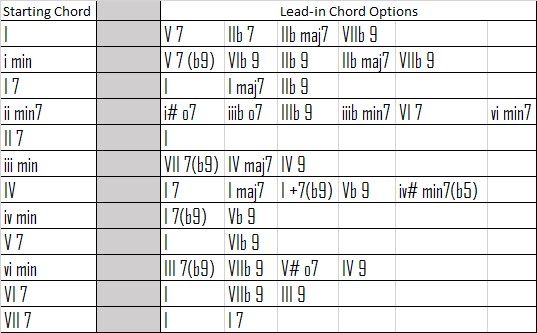
Say that you have a repetitive chord progression in your composition. Everything sounds good, but you want an introduction that is harmonically new… but at the same time leads into the main chord progression harmony.

Below, I have included a condensed “cheat-sheet” of options on what chords you begin a composition with and what are the best lead-ins before it:

Of course, these are just options that I have read about in discussion. They may or may-not work with your composition. Still, it is worth a try.

Thank you so much for taking the time to read! Feel free to comment, share, and subscribe for more daily tips below! Till next time.

Tip #126 – Checklist for a Well-Crafted Introduction

When composing an original composition or adapting a pre-performed piece of music as a new arrangement, the writer must consider how to deal with “free areas,” otherwise known as: the into, the ending, and the turnarounds.

When writing an introduction, there are certain aspects – think of it as a checklist – of things that the introduction should accomplish in order to make it an affective beginning statement for your work.

Some of these aspects would be having the introduction…

  • Be interesting and captivating to the audience
  • Harmonically lead into the first chord of the main structure
  • Function harmonically and stylistically as the main body of work
  • Preview some segment of the composition for thematic continuation

Of course, these are suggestions. None of these have to be followed, but they do pose critical features for making a strong introduction. Regardless, a composition must be deliberate with everything you write – even if conventional rules are not followed.

Thank you so much for taking the time to read! Feel free to comment, share, and subscribe for more daily tips below! Till next time.

How To Beat Writer’s Block – Tip #12

Sometimes, we are tasked with writing a piece of music for a large band/ensemble comprised of many different instruments. That might turn out to be a daunting task – considering all the possibilities of what instruments to use and how.

From there, you might get a sense of writer’s block for not knowing how to proceed forward with all these possibilities.

One thing you can do to alleviate this stress is to focus down to one instrument – the piano. By composing to one instrument, you mind is more focused and more free to be creative within the realms of one instrument.

Once you have sketched out your composition, you have the ability to arrange appropriately by assigning melodic lines to instruments in their “natural register” and harmonic changes to the rhythm section.

There, a huge task made simple!

Thank you so much for taking the time to read! Feel free to comment, share, and subscribe for more daily tips below! Till next time.

Tip #125 – Crossing Voices to Avoid Repetition

Say you had this line written and you wanted to arrange it for three voices:

What would you do? Would you simply gives lines top-to-bottom?

While that is an option, you do run into the danger of sounding monotonous with having some voices continuously repeat notes.

A way to avoid this is by crossing voices!

So, instead of having the bottom two voices stay of the E4 and C4 respectively, they can cross and alter between the two.

Therefore, you would get something similar to this when arranging for three voices:

Thank you so much for taking the time to read! Feel free to comment, share, and subscribe for more daily tips below! Till next time.

Tip #124 – Understanding the Dhenuka Scale

The Carnatic music of South India has 72 scales (melakartas) comprised of seven different notes in either an ascending (arohana) or descending (avarohana) fashion. These scales are used in a kind of India music called rāga and are extremely beautiful. In addition these scales are grouped into different chakras, based on certain similarities.

Today’s melakarta is the Dhenuka scale (meaning “dust”), the third scale from the second chakra.

Below is a representation of the scale as if it was put into Western notation:

Both the first (SA) and fifth (PA) scale degrees are in a placement normal to most scales found in Western music. However, the second scale degree (RI) is lowered, creating a tendency to resolve downward. In addition, the seventh scale degree (NI) is raised to go back to the tonic as well.  While this may sound dissonant or exotic, this scale gives a great amount of opportunity to play with tension and chromatic passing tones.

Try playing around with the scale, possible harmonies, and progressions!

Thank you so much for taking the time to read! Feel free to comment, share, and subscribe for more daily tips below! Till next time.