Tip #149 – Cheat-Sheet for Using Definitive Triads

The concept of definitive triad – while not commonly known – is very easy to understand and master.

It is using two adjacent diatonic triads of piece of music’s scale or mode to harmonize an entire melody.

Each melody note will be harmonized be either one of the two definitive triads in relation to its chord tone. Of course, there will be one remaining pitch that will not have a direct harmonization to one of the two definitive triads. In a simple exemption to the rule: use any diatonic triad containing that note to harmonize.

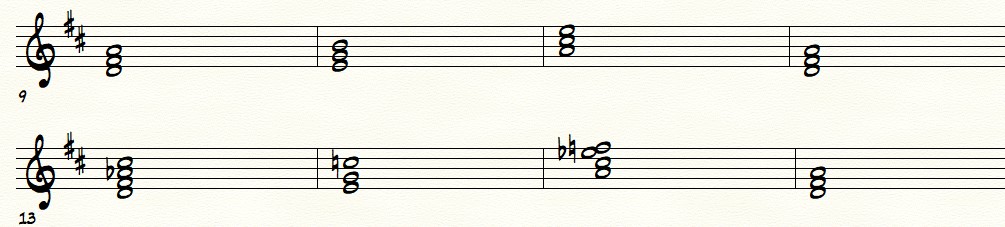
Below is a cheat-sheet on what chords within their respective scales or modes work best as the two definitive triads for harmonization:
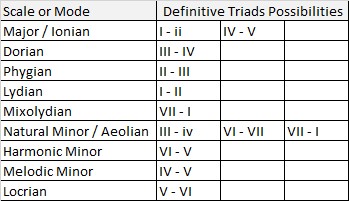
So, a melody based in the mode of B Lydian will use the I and II chords… the B major triad and C# major triad. Because of the combination of those two chords { B , C# , D# , E# , F# , G# }, the A# is the note left-out… and thus, can be harmonized by any triad of your choice that is diatonic to the B Lydian scale.

Thank you so much for taking the time to read! Feel free to comment, share, and subscribe for more daily tips below! Till next time.

Tip #148 – Reducing Dominant Chords to Three-Note Harmonies

Tailgating on the idea of being limited to a three-part harmony; you are going to have to make some choices if you want the sound of a dominant chord, but can only voice three notes.

To remind: a dominant chord is a major triad with a b7 interval above it (and is usually decorated with extra upper extensions as well as tension tones).

So…

Whenever the root, 9, b9, #9, 11, +11, 13, or b13 is in the melody – support it with the 3rd and b7th of the chord underneath it.

Whenever the 3rd or 5th is in the melody of the dominant chord – support it with the b7th, and the remaining 5th or 3rd.

Whenever the b7th is in the melody – support it with the 3rd and 5th underneath it.

Whenever there is an alternation or substitution in the dominant chord – keep it, but make sure the distance between the two upper notes is not a m2.

And more so…

Keep this in mind as you plan how to do a harmonic arrangement and support of your musical work.

Thank you so much for taking the time to read! Feel free to comment, share, and subscribe for more daily tips below! Till next time.

Tip #143 – Evaluating Your Chord Voicings

So you have the chord harmony you want to play, and you have decided which instruments to play it… now what?

Well, here are three things to keep in mind:

  • Density
  • Weight
  • Span

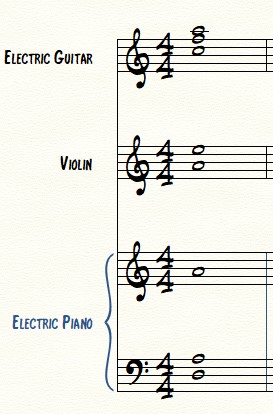
Now, let’s take a look at these three aspects in use with the example below (remember that the guitar is played an octave lower than written):

First, density. That has to deal with how many different pitch classes there are that make the harmony. In the example above, there are 5 different pitch classes {D – F – A – C – E} which form a Dmin9 chord. Relatively, this is more dense than a simple triadic harmony.

Next, weight. What pitch class appears the most? Even though the harmony is structured to be a Dmin9 chord, the A4 pitch is sounded in all three instruments. That means there is less weight on the root of the chord, and more on the 5th.

Finally, span. Span deals with how the dense harmony is spread throughout an octave ore more. From the example above, the range of the harmonic span goes from D3 to E5, which is more than two octaves. So, we can realize that the sound of this will be spacey – and not so condensed.

Keep these in mind as you are consciously thinking about how to voice your chords.

Thank you so much for taking the time to read! Feel free to comment, share, and subscribe for more daily tips below! Till next time.

Tip #138 – Using Random Modulations in Length

Say you wanted to get from one key area to another in a certain amount of measures:

What would you personally do? Keep in mind that there are many different possibilities on filling in those empty measures.

One way is my using any random pairs of chords, moving by root of a fifth or a step in motion – with ending by a fifth or half-step motion in the bass at the key change.

It would look like as such:

Once again, keep in mind that this is simply a tip as well as an option for an interesting way to modulate. Personally, when I first read about this idea, I wasn’t fully convinced. However, it is still worth experimenting with.

Thank you so much for taking the time to read! Feel free to comment, share, and subscribe for more daily tips below! Till next time.
Tip #136 – Plurality in Chord Substitution

In Western classical music theory, there are three groups of “harmonic areas,” that being:

  • Tonic
  • Pre-dominant
  • Dominant

Jazz theory expands upon this by assigning a specific chord/function to each of these harmonic areas:

  • I for Tonic
  • ii for Pre-dominant
  • V for Dominant

Not only do these chords and types word as specific harmonic areas, but they can also be used as diatonic passing chords in certain harmonizing situations.

That being said, it seems a bit boring that music is reduced down to the I, ii, and V chords. What about the other diatonic chords? Do they fit any purpose?

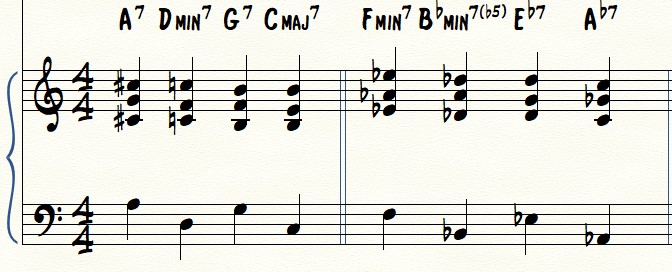
Well, here comes the idea of plurality – that because certain chords share multiple notes with each other, that they can be interchangeable. Take a look below:

See how both the iii and vi chord can function as a tonic I. Plus, the IV works as a pre-dominant because it shares a lot of chord tones with ii. And vii is interchangeable to V.

So now, we can potentially revise this as:

  • I , iii , and vi for Tonic
  • ii and IV for Pre-dominant
  • V and vii for Dominant

Thank you so much for taking the time to read! Feel free to comment, share, and subscribe for more daily tips below! Till next time.
Tip #132 – The 373 or 737 Voice Leading

In situations where you want to use smooth voice leading over progressions that utilize the circle of fifths movement, the 373 (or 737) voice leading can help.

It can be used as a melody or inner voice. Regardless of what you choose, you start by putting the 3rd (or 7th) of the chord in the top voice. From there, place below the 7th (or 3rd), and then repeat the top note.

Usually, the lowest note is the root, and occasionally the 5th or 9th of the chord can be added for extra color.

From there, you resolve the chord into the next harmony within the circle of fifths progression by doing as such:

Try it out and feel how it sounds. This words great for open parallel movements.

Thank you so much for taking the time to read! Feel free to comment, share, and subscribe for more daily tips below! Till next time.

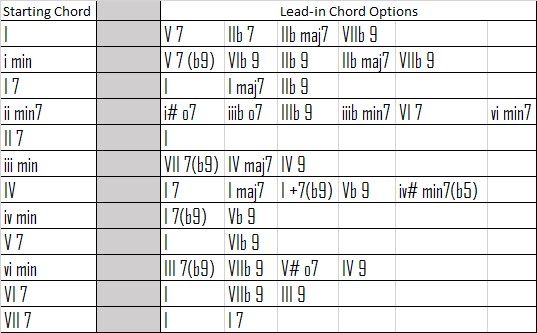
Tip #127 – Cheat-Sheet for Harmonic Lead-Ins

Say that you have a repetitive chord progression in your composition. Everything sounds good, but you want an introduction that is harmonically new… but at the same time leads into the main chord progression harmony.

Below, I have included a condensed “cheat-sheet” of options on what chords you begin a composition with and what are the best lead-ins before it:

Of course, these are just options that I have read about in discussion. They may or may-not work with your composition. Still, it is worth a try.

Thank you so much for taking the time to read! Feel free to comment, share, and subscribe for more daily tips below! Till next time.

Tip #120 – Writing and Building Polychords

Polychords are when multiple chords (particularly triads) are played at the same time. They are used to expend the harmony and offer an interesting blend of acoustic colors.

While there is no limit to the combined chord qualities of the number of chords used to build a polychord, typically people make polychords just out of two triads.

Below is a representation of a poly chord with the proper notation (similar to a fraction sign):

Notice how this polychord above can also be written as a Bb13 chord with no 7th.

That being said, some polychords can ultimately be jazz chords (and this term is used lightly, as no chord belongs exclusively to a genre of music) with upper extensions. So, that is up to you, the composer, to play around with triadic combinations.

Thank you so much for taking the time to read! Feel free to comment, share, and subscribe for more daily tips below! Till next time.
Tip #116 – Key Change with a Predictable Melody

Once you established an “earworm” melody in the listener’s… ears of course, you have the ability to pull out the rug from underneath them and do a key change.

How?

Well, first take a look at the composition below:

Say that the first four measures is the original motif/chorus/theme… whatever you want to call it. We know that on every repeat the second measure of the four measure pattern the melody is an A4.

However, that pitch can be harmonized in a multitude of ways. Looking back at the example above, the pitch is now harmonized with an A major triad instead of an A minor triad. This chord then acts as a IV chord in a IV-V-I progression taking us to the key of E Major.

This sounds smooth to the ear because we were already expecting that A to happen… just not the other notes around it.

Thank you so much for taking the time to read! Feel free to comment, share, and subscribe for more daily tips below! Till next time.

Tip #115 – Altering the Fifth of a Chord

One thing you can do to make a simple harmonic progression more interesting is by altering the fifth of the triad chord.

Most people think adding upper extensions like the 7th, 9th, 11th, and 13th, are the only way to make a chord harmony more interesting, but altering the inner core of the triadic chord itself is a great way.

Take a look at the progression below:

Notice how the simple I-ii-V-I progression was repeated again but with a b5 of a #5 (or both!).

Some alterations way not work, so an in-depth discussion on what is the correct way to alter certain types of chords will be done in the future.

Till then, experiment!

Thank you so much for taking the time to read! Feel free to comment, share, and subscribe for more daily tips below! Till next time.