Tip #35 – Incorporating Double Canons into Works

Before explaining how to build a double canon into a work of music, one needs to know the definition of one.

Simply, it is when two canons (including their own pair of leader and follower) are played at the same time.

Similarly, when there are three different unique canons playing at the same time, it is called a triple canon; and so on, and so on.

Try building one canon. Once that is done, find out what best compliments the two running melodic lines. Next, get creative with the second canon while keeping in mind how each part sound to one another.

Thank you so much for taking the time to read! Feel free to comment, share, and subscribe for more daily tips below! Till next time.

Tip #34 – Finding Creative Counterpoint in Reflection Treatment

Take a look at the example below:

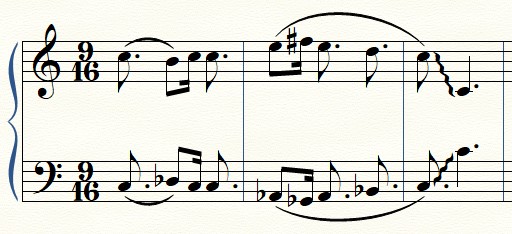
Here we see two melody lines that look different, but are actually very similar. Notice how the rhythm is similar, as well as the size of the intervals in the melody. Plus, there is a retainment of certain degree of pitches. This is called a mirrored reflection treatment in counterpoint.

To write something like this, pick a “point of reflection;” here, middle C was chosen because it happens to be in the middle of the grand staff. Now, any note above the “point of reflection” music be copied down, containing the same interval quality. Vice versa: any note below must be reflected above.

Be sure to be mindful of harmony, as using this process tends to bring out some dissonant intervals.

Thank you so much for taking the time to read! Feel free to comment, share, and subscribe for more daily tips below! Till next time.
How To Beat Writer’s Block – Tip #3

This was taken as inspiration from the Country Music Hall of Fame and Museum down in Nashville, TN.

For this one, take photo clippings printed out online, from a newspaper, magazine. Try to get a variety, possibly of things you like and an equal quantity of things you dislike.

After that, place all the picture facedown, or mixed in a container. From there, randomly select three photos and turn them faceup to use.

Try incorporating those three images creatively somehow into the lyrics or general meaning of the piece of music you want to create.

Thank you so much for taking the time to read! Feel free to comment, share, and subscribe for more daily tips below! Till next time.

Tip #33 – Using Skills to Build a Mensuration Canon

Take a look at the example below and try to find commonalities between each melodic line:

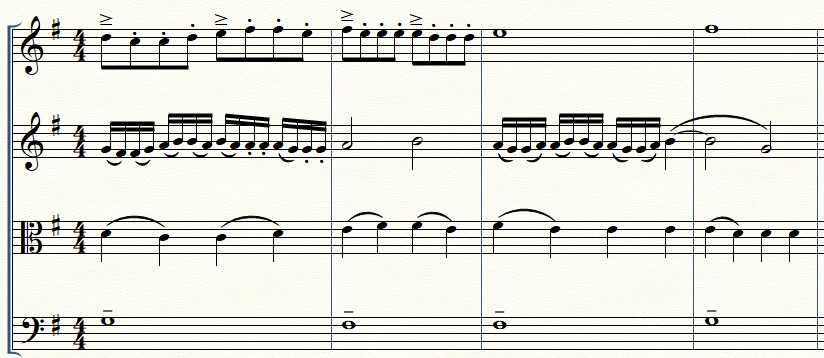
You might have noticed that these melodic lines are augmentations or diminutions of each other in some form. Also, they all start at the same time. This is called a mensuration canon.

To build one, experiment with different rhythmic ratios and intervallic transposition between each voice of the canon. Typically, the voices start on either the tonic or dominant, but that is now always the case.

Thank you so much for taking the time to read! Feel free to comment, share, and subscribe for more daily tips below! Till next time.

Tip #32 – Melody and Counterpoint Help with Diminution

Similar to augmentation where the rhythmic value ratios of a melodic line are uniformly multiplied, they can also be reduced.

This would be the process of diminution. So by reducing every value in half; a whole-note becomes a half-note (duh), a dotted half-note becomes a dotted quarter-note, an eighth-note becomes a sixteenth-note, etc.

Take a look at the example below:

Here you can see a lot of example of diminution. The first half of the second measure is a diminution of the entire first measure. Same goes for the first half of mm. 4 being an octave transposition and diminution of the full mm. 3.


Thank you so much for taking the time to read! Feel free to comment, share, and subscribe for more daily tips below! Till next time.
Tip #31 – Melody and Counterpoint Help with Augmentation

One way to spin out another melodic line that can be used as its own theme, or as a cantus firmus for counterpoint, is the use of augmentation.

Augmentation is the act of multiplying in ratio to the original line, the rhythmic values of the melody. So, a quarter-note would become a half-note, and a dotted eighth-note would become a dotted quarter-note.

Take a look at the example below:

Here at mm. 3-4, there is an augmentation and octave transposition of the first measure. Least to say, possibilities are endless!


Thank you so much for taking the time to read! Feel free to comment, share, and subscribe for more daily tips below! Till next time.

Teach Yourself Music Theory – 7.) Rhythmic Values of Notes and Rests

When someone says that a particular piece of music has a nice rhythm, they are referring to the pattern of durations of pitch and silences. Pitch as to the notes played, and silence as the rests telling the performer not to do anything.

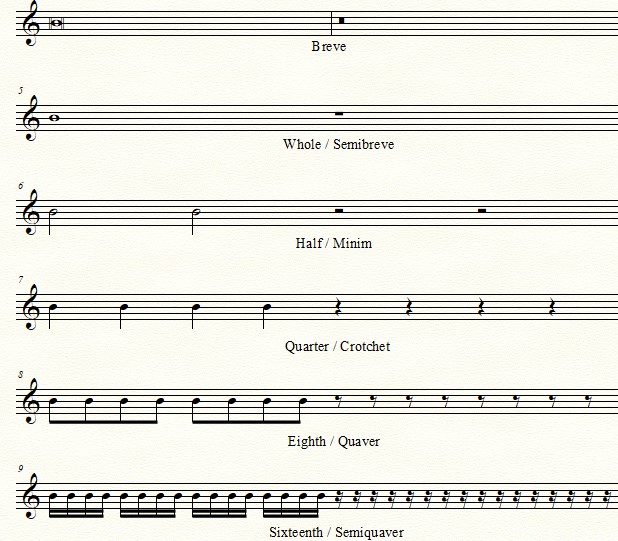
Each note value has a corresponding rest value of the same name as well as duration:

In a simple meter of 4/4, the quarter/crotchet is the basic beat unit. When you combine two together, you get a half/minim duration value of two beat units. That can be combined even further into whole/semibreve value, and EVEN LARGER into a breve. Understand that only the whole/semibreve is the largest unit that can fit within the meter of a 4/4 time signature measure.

Similarly, the durations can be divided into smaller units. Dividing a quarter/crotchet in half gets an eighth/quaver. Further in half gets a sixteenth/semiquaver. And so on, and so on…

Notice how as the duration values of the notes progressively get smaller, the more flags and beams (wavy lines and connecting horizontal bars, respectively) there are attached to the stem (vertical line) of the note.

Finally, take a look at the measure below:

See how that there is a dot next to the note head? The dot tells that the duration is 1.5x times that of the original. A double-dot tells that it 1.75x times in durational length.


Thank you so much for taking the time to read! Feel free to comment, share, and subscribe for more daily tips below! Till next time.
How To Beat Writer’s Block – Tip #2

Have a favorite jazz standard in mind that you like? Try writing a melody over it using the same chord progressions.

After that, erase from the paper and from your mind the original harmonies, and reharmonize the melody into something new and creative. You can even change the harmonic rhythm instead of just replacing each previous chord with a new one.

Thank you so much for taking the time to read! Feel free to comment, share, and subscribe for more daily tips below! Till next time.

Tip #30 – Multiply with a Period Group

Sometimes the best way to get to a form of theme and variation is with a period group. Observe the example below:

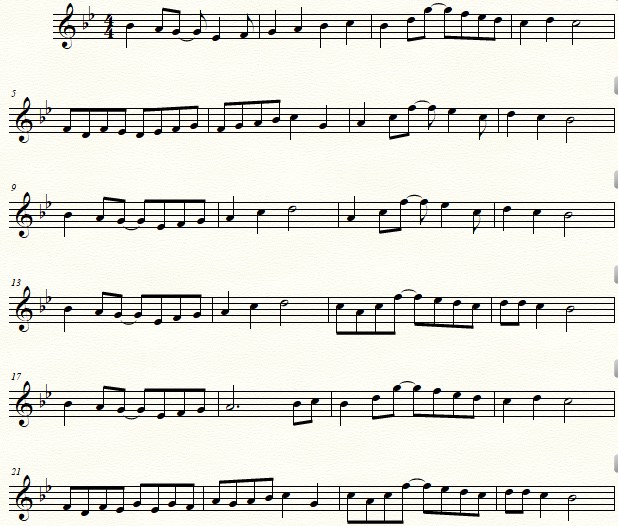
You can tell that the first eight bars make a double period structure. Also, the following sections of eight measures are similar to the original with slight variation.

These strings of different period forms is called a period group and it helps establish a theme to a listener while creating variety over a lengthy amount of time.


Thank you so much for taking the time to read! Feel free to comment, share, and subscribe for more daily tips below! Till next time.

Tip #29 – Building a Double Period

..

Not like that.

A double period consists of 4 phrases with cadential motion at the end of phrases 2 & 4. Typically, the first cadence is weaker than the last, but there are always exceptions.

The idea is to have phrases 1 & 3 flow well into phrases 2 & 4 respectively and not have the motion stop.

Also, phrases 1 & 3 ultimately determine if the double period is parallel or contrasting (former shown above, and the latter as shown below):


Thank you so much for taking the time to read! Feel free to comment, share, and subscribe for more daily tips below! Till next time.