Tip #107 – Dominant Chords Resolving Onto Themselves

I noticed this interesting chord progression idea in some heavy metal riffs.

Usually, a V chord resolves to I – that is something we know happens commonly in music.

However, for today’s tip, we will talk about how the dominant chord can resolve to a minor chord version of itself, containing the same root.

Observe the progression below:
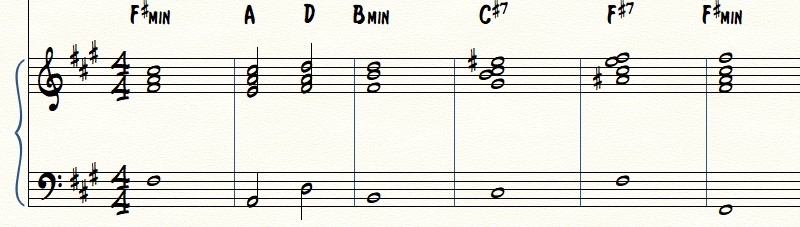
Notice how we set up for a cadence in F# minor with the C#7 chord. However, it resolves to a F#7 chord. We think that we have possibly modulated to B Major/minor, or started a circle of fifths progression – but no! Instead, the F#7 chord resolves to a F# minor triad.

With good voice leading, this can work very smoothly. Most of the chord notes are kept the same – only difference being the change from the major third to a minor third, which is just a half-step.

This creates a “deceptive” resolution (and I use this term loosely because there is already a term for a “deceptive cadence”) while smoothly creating momentum back to the minor tonic area**.

**Note, this progression only works if the tonic is in minor.

Thank you so much for taking the time to read! Feel free to comment, share, and subscribe for more daily tips below! Till next time.

Tip #106 – Understanding the Manavati Scale

The Carnatic music of South India has 72 scales (melakartas) comprised of seven different notes in either an ascending (arohana) or descending (avarohana) fashion. These scales are used in a kind of India music called rāga and are extremely beautiful. In addition these scales are grouped into different chakras, based on certain similarities.

Today’s melakarta is the Manavati (meaning “bride”) scale, the fifth scale from the first chakra.

Below is a representation of the scale as if it was put into Western notation:

Both the first (SA) and fifth (PA) scale degrees are in a placement normal to most scales found in Western music. However, the other scale degrees are lowered as well as clustered in chromatic runs. In addition, the sixth (DHA) and seventh (NI) scale degrees are raised. While this may sound dissonant or exotic, this scale gives a great amount of opportunity to play with tension and chromatic passing tones.

Try playing around with the scale, possible harmonies, and progressions!


Thank you so much for taking the time to read! Feel free to comment, share, and subscribe for more daily tips below! Till next time.
Tip #105 – Weird Minor Chord Substitution

Here is another fun/interesting/odd/useful tip I learned from a professor:

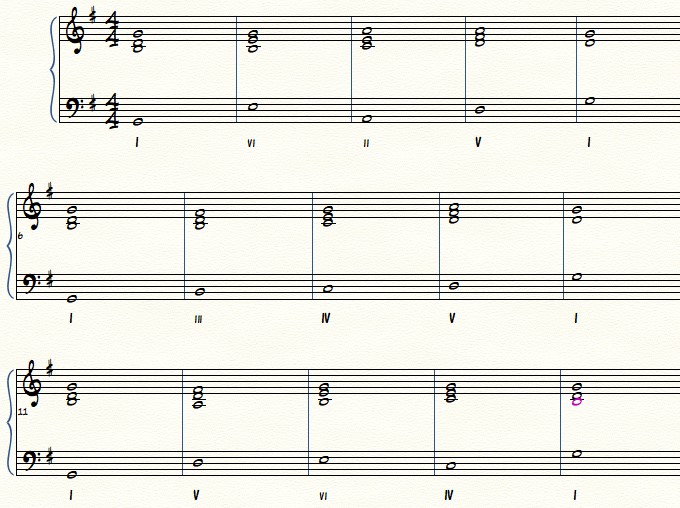
Say you have these chord progressions below:

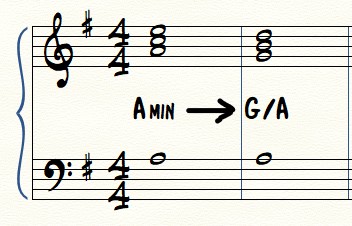
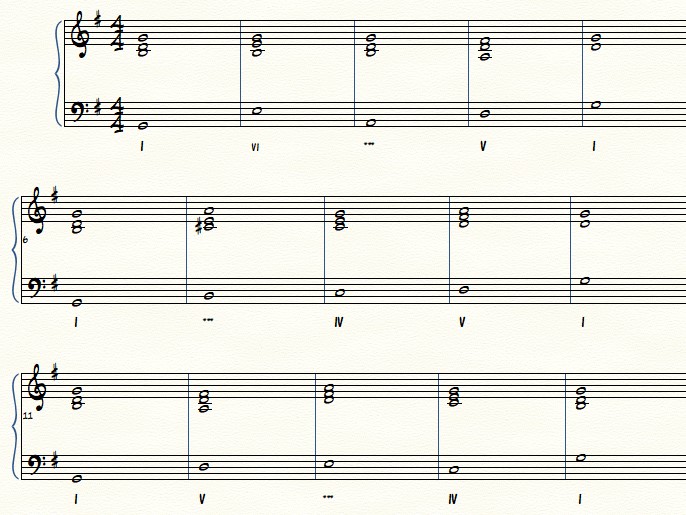
What you can do for minor chords acting as a ii, iii, or vi chord in the progression is replace them as a major chord one whole-step below while keeping the bass. So, the substitution would look like such:

Now, if we were to alter the progression from before – changing the minor chords functioning as a ii, iii, or vi – we would get these new progressions:

Some of them sound odd and funky. Personally, I preferably like the ii substitution better than iii and vi, but that is just my opinion. Feel free to try it yourself and see if it expands your harmonic pallet.

Thank you so much for taking the time to read! Feel free to comment, share, and subscribe for more daily tips below! Till next time.
Tip #104 – Negative Harmony Reflection Over Tritone

This is the second part to the concept introduced the other day about using the idea of negative harmony, but reflecting it over a different way.

In a certain key (major in this case), you will have a tritone distance between the seventh and fourth scale degrees.

By locating the middle focal-point of the tritone (which will be the second scale degree of the major scale), you can use that as a point of reflection for a new kind of negative harmony.

So, as you can see chromatically, the second scale degree fits perfectly in between the raised seventh degree and fourth degree (assuming we are in the C major key):

Using that pitch as the centered point of reflection, we use this pattern as a way to create an alternative negative harmony:

Thank you so much for taking the time to read! Feel free to comment, share, and subscribe for more daily tips below! Till next time.

Tip #103 – Negative Harmony Reflection Over Tonic

Back in the winter, I was told by a professor a different way of doing negative harmony – an alternative, one could say.

In the past, I have talk about the use and understanding of negative harmony, so be sure to read-up on it before diving into this new technique.

Anyways, my proposed two different ideas of this alternative to negative harmony by reflecting pitches over different point of the key/scale/pitch collection.

The first method was to reflect on the tonic. So in a C major key, we have the diatonic and chromatic notes of:

By reflecting the tonic onto itself, we get a formula like this:

Now, we can substitute original pitches in a harmony for new ones to get an negative harmony alternative approach.

Thank you so much for taking the time to read! Feel free to comment, share, and subscribe for more daily tips below! Till next time.

Improve Your Lyrics – Tip #9

What is a qualifying metaphor and how can it be used in a song?

You have probably used it before. It is when

  1. You use an adjective before to qualify a noun
  2. Or when you use an adverb after to qualify a verb

and it create some form of “conflict” because the two ideas don’t exactly belong together.

For example, a “tender knife” where the adjective “tender” qualifies the noun “knife,” have a sense of conflict because those two words don’t regularly go together.

Going back to a previous week’s idea about rain, you can use a qualifying metaphor to say “the clouds where weeping gently” instead of simply “there was a light drizzle outside.” Where “gently” is the adverb qualifying the verb before it.

Play around with them to create vivid and emotional imagery in your lyrics.

Thank you so much for taking the time to read! Feel free to comment, share, and subscribe for more daily tips below! Till next time.

Tip #102 – Ending on a “Wrong” Note

I dislike using the word “wrong” – mostly because a note is wrong only if you don’t like it and you purposely played it. So in that case, anything musically done with purpose is right.

That being said, on with today’s topic:

Sometimes, I find myself ending a phrase, melody, or musical idea on a note that appears in the chord. While that is not necessarily a problem, I do find it predictable. Especially if the harmony is stagnant.

Today is a gentle reminder that you should experiment with ending on melodic tones that are not the tonic or a chord member of the present playing harmony. This can allow a feeling on continuation or mystery. Irresolution that can develop into a new idea.

See how different tension tones work or sound better/worse than each other.

Thank you so much for taking the time to read! Feel free to comment, share, and subscribe for more daily tips below! Till next time.

Tip #101 – Weird Third Interval Substitution

This is an odd tip I received from a professor on a way to do chord substitutions.

First, it involves taking a composed progression. Like this one below:

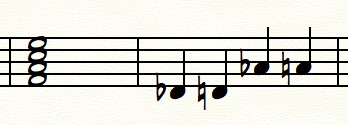
From there, you take a chord you want to substitute (be it in this case the Fmaj7 chord) and change the root to a minor/major third below or above the original. For the pitch F, we get Db, D, Ab, and A.

After that, you change the quality of the chord from the root you choose to a minor chord (either a min7 or a min7(b5), otherwise known as a half-diminished seventh chord).

And there you have it. 8 different substitute possibilities for one chord. However, as I have learned from using this professor’s tip, not all the possibilities work. So, take this as a “last-resort” idea when you are stuck and in need of a more interesting harmonic progression.

Thank you so much for taking the time to read! Feel free to comment, share, and subscribe for more daily tips below! Till next time.

Tip #100 – Score Characters and Themes with Motifs

From Wagner to modern movie scores, motifs (musical ideas) in the form of themes or symbolic gestures are used so often. Often enough that you should be using them yourself.

Ideally, the impact of a motif should be so powerful that I person only needs to listen to the music to know what character is in the shot, or what event is taking place.

Think of motifs as “theme songs” that best represents sonically and acoustically the event that is going on – whether that be a character, a plot point, a mood, an action, etc.

Once things and ideas are assigned motifs, you can do many creative things with them, such as:

  • Combining motifs to create a symbolic union, or conflict
  • Alter motifs to show an undergoing change of a character
  • Play fragments of a motif for foreshadowing or reminding
  • Re-orchestrate motifs to give a new quality
  • Recycling motifs to create continuity

…and much more!

Thank you so much for taking the time to read! Feel free to comment, share, and subscribe for more daily tips below! Till next time.
Tip #99 – Understanding the Vanaspati Scale

The Carnatic music of South India has 72 scales (melakartas) comprised of seven different notes in either an ascending (arohana) or descending (avarohana) fashion. These scales are used in a kind of India music called rāga and are extremely beautiful. In addition these scales are grouped into different chakras, based on certain similarities.

Today’s melakarta is the Vanaspati (meaning “fruit-bearing tree”) scale, the fourth scale from the first chakra.

Below is a representation of the scale as if it was put into Western notation:

Both the first (SA) and fifth (PA) scale degrees are in a placement normal to most scales found in Western music. However, the other scale degrees are lowered as well as clustered in chromatic runs. In addition, the sixth scale degree (DHA) is raised, creating a tendency to resolve upwards. While this may sound dissonant or exotic, this scale gives a great amount of opportunity to play with tension and chromatic passing tones.

Try playing around with the scale, possible harmonies, and progressions!


Thank you so much for taking the time to read! Feel free to comment, share, and subscribe for more daily tips below! Till next time.

