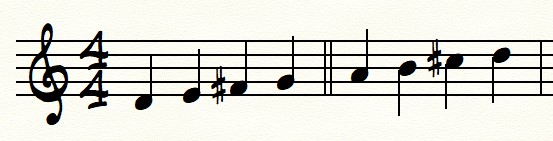
Teach Yourself Music Theory – 20.) Mixing Beat Divisions

To remind: when you are in simple meter (4/4) the beat is easily divided into 2s or 4s, and when you are in compound meter (12/8) the beat is divided into 3s or 6s. Review old posts if you are not familiar with these concepts.

However, just because you are in simple meter doesn’t mean that you can’t incorporate compound meter divisions.

Take an example below:
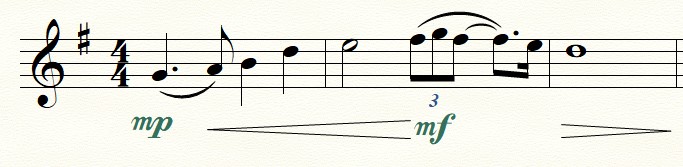
We know that this piece is in duple meter because the time signature is 4/4, but there is a figure notated with a “3.” This is called a triplet, and it appears in duple meter pieces to tell the performer to divide the beat into three eighth notes of even length instead of two – just as you would find in a compound meter.

This can happen in reverse, too…

Thae a look now at this example:

This piece is in compound meter (12/8 and the beat is divided into 3s), but there are two figures – one noted with a “2” and the other with a “4.” They are called duplets and quadruplets respectively, and they divide the beats in compound meter pieces into even divisions.

Practice performing switching between these different divisions.

Thank you so much for taking the time to read! Feel free to comment, share, and subscribe for more daily tips below! Till next time.

Tip #173 – Retrograde Harmony

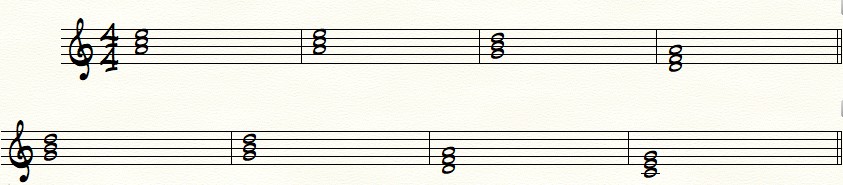
Some of you might recall that retrograde in music involves taking a music figure and playing in backwards. Usually, this is done with a melodic line, but we can use it with harmony and get some interesting progressions!

Take a look at these two phrases below and their harmony:

Play the piece how it is above first. Now: try the retrograde option below:

You will hear that the resolutions are unexpected – which can work to your advantage or not.

Thank you so much for taking the time to read! Feel free to comment, share, and subscribe for more daily tips below! Till next time.

Tip #172 – Understanding the Jhankaradhvani Scale

The Carnatic music of South India has 72 scales (melakartas) comprised of seven different notes in either an ascending (arohana) or descending (avarohana) fashion. These scales are used in a kind of India music called rāga and are extremely beautiful. In addition these scales are grouped into different chakras, based on certain similarities.

Today’s melakarta is the Jhankaradhvani (meaning “chiming sound”) scale, the first scale from the fourth chakra.

Below is a representation of the scale as if it was put into Western notation:

Both the first (SA) and fifth (PA) scale degrees are in a placement normal to most scales found in Western music. In addition, it looks similar to a minor scale, but with a lowered seventh degree (NI).

Try playing around with the scale, possible harmonies, and progressions!

Thank you so much for taking the time to read! Feel free to comment, share, and subscribe for more daily tips below! Till next time.

Tip #171 – Incorporating a Diminished Passing Chord

Say that you have a progression that utilizes two chords (one after the other) a M2 distance apart in the root:

As you can see by the example above, the Eb major triad and the F major triad fit that definition.

What you can do for some added harmonic progression color is insert a diminished passing chord in-between.

Simply, you build a diminished triad on the root of the pitch that falls chromatically in between the two chords:

From there, you would then orchestrate the chords for better voice leading, but the added diminished passing chord gives a little more emphasis to the arrival of the F major triad in the progression.

Thank you so much for taking the time to read! Feel free to comment, share, and subscribe for more daily tips below! Till next time.
Tip #170 – Incorporating a Chromatic Approach/Passing Chord

We are going to be talking about different kinds of passing chords.

Today is about the chromatic passing chord (although I prefer to call it a chromatic approach chord – and you will see why shortly).

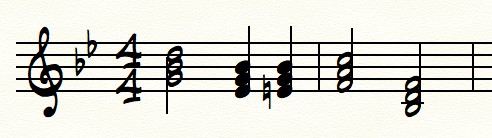
Take a simple pop chord progression like the example below:

To create this passing chord, you approach to destination chord with a chord the same shape/structure/voicing a m2 higher or lower. While you are using to pass in-between two chord, the structure of this passing chord is based on the chord you want to approach onto.

It would look like this, going from above and from below, respectively:

Thank you so much for taking the time to read! Feel free to comment, share, and subscribe for more daily tips below! Till next time.

Tip #169 – Finding Place for the #iv Chord

The #iv chord…

A minor triad (or minor seventh chord if you choose to expand the harmony) built on the #4 scale degree… which is a tritone away from the tonic.

One use for it is as a loose chromatic approach from the IV to the V. For example, take the following harmonic progression:

Now, let’s insert the #iv chord in between the IV and V of the progression. Notice the chromatic lines and how it makes this interesting chord less “out-of-place” with the key:

It does soften the blow of the cadence because the ear is trying to figure out what key we are in, but it can be used for coloristic effect.

On the same idea of chromatics, we can substitute the IV with a #iv chord in a vi-IV-V-I progression with the use of chromatic voice-leading:

Play around with it and see how it sounds!

Thank you so much for taking the time to read! Feel free to comment, share, and subscribe for more daily tips below! Till next time.

Improve Your Lyrics – Tip #27

A surprise is something unexpected – something out of the ordinary. When your lyrics are becoming predictable (AKA expected) you can use a “surprise” to grab the audience’s attention back.

Some examples of “lyrical” surprises are:

  • Delaying the resolution of a thyme with an extra line
  • Placing the stresses on different words
  • Placing the stresses on different beats
  • Changing the rhyme scheme/pattern.
  • Removing or adding lines to the from.

…or anything else that you can think of. Some modern examples are going from a typical rock song structured verse to maybe a rap.

Whatever you do, be confident in it.

Thank you so much for taking the time to read! Feel free to comment, share, and subscribe for more daily tips below! Till next time.
Teach Yourself Music Theory – 19.) Tetrachords and Pentachords

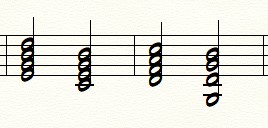
Okay, so we have learned a lot of scales so far. This can become confusing and jumbling trying to remember them all and how different they are from each other.

A way to remember is to break them apart into smaller pieces. This is so you can compare and contrast between the scales – essentially see what makes them similar and different.

We can break them up into different groups.

A tetrachord (tetra – meaning “four”) is not a chord, but a group of 4 consecutive notes.

Take a major scale for example and split it down the halfway. Compare the two different tetrachords:

You will see that they are formed of the same interval pattern of W-W-H (or M2-M2-m2). These are major tetrachords, because they are distinctive of the major scale.

Another way to break scales into smaller groups is into pentachords, groups of 5 consecutive notes.

Once again, this is to help understand and memorize the structure/functions of scales.

Thank you so much for taking the time to read! Feel free to comment, share, and subscribe for more daily tips below! Till next time.
Tip #168 – Having Harmony Never Return Home

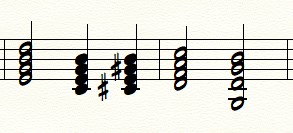
One thing I have noticed to be pretty common in early and classic 80’s heavy metal is a chord progression between the V and the VI.

This use of the progression to alter between tension (the V or V7 harmony) and uncomplete resolution (the VI). The listener wants to hear the tonic, but instead gets the minor triad that governs over the natural minor scale.

It creates a somber and unresolved sound without falling away from the key center. You can still hear this progression in the major key area without over using the I chord:

You can also change the order and have the V chord on the first measures of the phrases, but it might create a poor distribution of tension and resolution according to the hierarchy of the song form:

Thank you so much for taking the time to read! Feel free to comment, share, and subscribe for more daily tips below! Till next time.
Tip #167 – Understanding the Hatakambari Scale

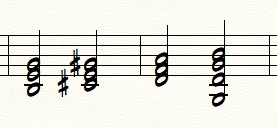
The Carnatic music of South India has 72 scales (melakartas) comprised of seven different notes in either an ascending (arohana) or descending (avarohana) fashion. These scales are used in a kind of India music called rāga and are extremely beautiful. In addition these scales are grouped into different chakras, based on certain similarities.

Today’s melakarta is the Hatakambari scale (which was rough translation to “ring”), the sixth scale from the third chakra.

Below is a representation of the scale as if it was put into Western notation:

Both the first (SA) and fifth (PA) scale degrees are in a placement normal to most scales found in Western music. However, there is an augmented distance between the second (RI) and third (GA) scale degrees.  In addition, the upper sale degrees are clustered together in a chromatic run.  While this may sound dissonant or exotic, this scale gives a great amount of opportunity to play with tension and chromatic passing tones.

Try playing around with the scale, possible harmonies, and progressions!

Thank you so much for taking the time to read! Feel free to comment, share, and subscribe for more daily tips below! Till next time.