Improve Your Lyrics – Tip #31

Unless it is your intention to do so, you usually never want your lyrics to come across as boring.

As you a revising your lyrics, here are some options of edits that you can make in order to make your lyrics become less wordy, or have more variety:

1.) Delete a verse – if you have too many verses, it might sound like a story book more than a song.

2.) Make a verse a bridge – say that you want to keep the lyrics, but want to change how it is performed to make it interesting to the listener.

3.) Add a bridge, refrain, prechorus, etc. – gives a bit more variety to the structure and progression of the song.

4.) Change the inner structure of the verse – instead of the predictable structure, try using one of those “surprises” we have talked about in previous blog posts.

Thank you so much for taking the time to read! Feel free to comment, share, and subscribe for more daily tips below! Till next time.

Tip #178 – Applying What You’ve Learned

Now I know that I’m preaching to the choir as I type up this post, but it is important to remind:

That no matter how much you read of these blog posts, you will not become a better composer/songwriter/arranger/music theorist without actually doing them.

The only tip that I can give is to actually do the tips as you are reading them, or be creative and come up with your own way.

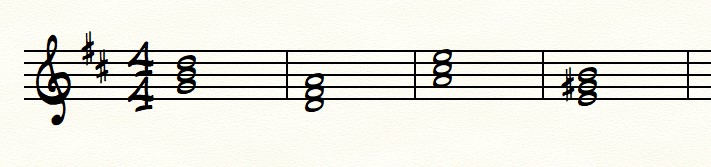
For example: in the past we have talked about chord substitution and the use of the vi – V progression to avoid the tonic. If you remember those topics and have been using them in your writing, then this should look like a no-brainer:

A chord progression of vi – IV – V – vi to substitute the tonic and create an avoidance to resolve back to the home key area.

Basically, the more you practice these tips, the more you will discover and the better your writing will become.

Thank you so much for taking the time to read! Feel free to comment, share, and subscribe for more daily tips below! Till next time.

Improve Your Lyrics – Tip #30

This is going to be a short post.

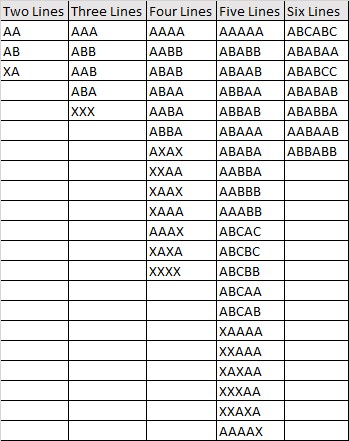
Below, I have attached a photo showing different rhyme schemes and patterns depending on the number of lines in your verse:

To read this “X” is any line that will not rhyme, and “A, B, C…” are lines that will rhyme with their same letter within the same line or in a future verse.

Practice by randomly taking one from the graph above and trying it out.

Thank you so much for taking the time to read! Feel free to comment, share, and subscribe for more daily tips below! Till next time.

Teach Yourself Music Theory – 21.) Polyrhythms and Hemiolas

As you can see from the title, we are going to talk about some new concepts and add new vocabulary into our musical terminology usage.

Polyrhythm, is the juxtaposition of two different beat divisions happening at the same time. This will create an interesting composite rhythm of the combining beat divisions. Let’s take a look:

Above is a piece of music with a lot of beat divisions working together to create one polyrhythm. We can see that the C4 pitch is played on every down beat of the 3/4 measures, but the arpeggiation (breaking apart of a chord) of the C major triad below is in a division pattern similar to a 6/8 time signature. Play it out and you will hear it.

In the melody line, we see four notes in equal length of a dotted eighth-note. Within the 3/4 time signature, we have four notes of even value going against the quarter-note pulses and 6/8 division grouping arpeggiation. So that too is another addition to the overall polyrhythm.

A hemiola, is similar to a polyrhythm in that it goes against the conventional beat division – but it is more defined of when normal groupings of three become groupings of two:

Here is another exaggerated version of a hemiola, going from odd to even groupings:

Thank you so much for taking the time to read! Feel free to comment, share, and subscribe for more daily tips below! Till next time.

Tip #177 – The Backdoor Progression

This is going to be a short post – but nonetheless, an interesting one.

For those that already know this chord progression, feel free to skip this, but here is something new I learned from a while ago.

In a lot of jazz, Broadway, and some rock/pop music, we have the classic ii – V7 – I progression. It is a simple way to set-up a return back to the tonic.

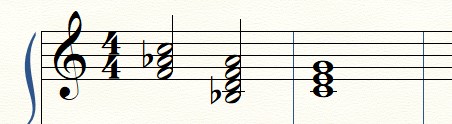
Now, imagine the tonic as the house and we walked the usual path to the front door with the ii – V7. Sounds, good, but what if we wanted a little surprise that still reaches the same destination? We use the backdoor progression:

iv – bVII7 – I

This is constructed in the same way as the ii – V7 – I, as you can see by shared common tones and interval distances.

Try it out and see how you think of it. Maybe it can work well in one of your next compositions.

Thank you so much for taking the time to read! Feel free to comment, share, and subscribe for more daily tips below! Till next time.
Tip #176 – Understanding the Natabhairavi Scale

The Carnatic music of South India has 72 scales (melakartas) comprised of seven different notes in either an ascending (arohana) or descending (avarohana) fashion. These scales are used in a kind of India music called rāga and are extremely beautiful. In addition these scales are grouped into different chakras, based on certain similarities.

Today’s melakarta is the Natabhairavi scale (which roughly translates to “skilled actor”), the second scale from the fourth chakra.

Below is a representation of the scale as if it was put into Western notation:

Both the first (SA) and fifth (PA) scale degrees are in a placement normal to most scales found in Western music. In addition, it looks similar to a natural minor scale.

Try playing around with the scale, possible harmonies, and progressions!

Thank you so much for taking the time to read! Feel free to comment, share, and subscribe for more daily tips below! Till next time.

Improve Your Lyrics – Tip #29

Today we are going to be talking about structure – and more importantly, the inner structure of your lines, stanzas, verses, etc.

When you are writing a song, you want the message to come across as clear as possibly desired to your audience. Having a good structure will make that happen.

So, five main areas of structure within you lines are:

  • Number of lines
  • Length of lines
  • Rhythm of lines
  • Rhyme scheme of the lines
  • Rhyme type to the words in the lines

Let’s briefly talk about them individually.

Number of lines has importance to it. an even number of lines produces stability while an odd number of lines creates tension or a lead-in to something with irresolution.

Length works the same way. Compare a song with each lines of the verse being the same versus ones where they are not.

Does the natural rhythmic flow and accentuation of the words change from line to line? And is that what you want?

With the rhyme scheme, you are basically deciding if the rhyme pattern will be predictable of not (more to come soon).

And finally, will these rhymes be close family or loose rhymes?

Think this stuff over as you are revising and editing your lyrics. Look over the structure and make sure it is what you intended it to be.

Thank you so much for taking the time to read! Feel free to comment, share, and subscribe for more daily tips below! Till next time.
Tip #175 – Harmonizing a Chromatic Scale with Secondary Dominants

Once you see the process to doing this, you aren’t going to forget it.

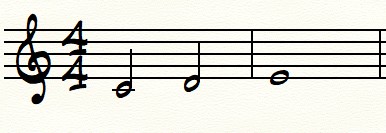
Now, say that you have a diatonic melodic line like the one below with the notes appearing in sequential order:

Between each of the diatonic notes, we are going to approach each with a chromatic note. It should look like this now:

Okay, from here we are going to harmonize the diatonic notes with triads within the key. For the simplicity of this tip, the notes will act as the root of the chords:

Finally, it is time to add the secondary dominants. A secondary dominant is the “V7” chord proceeding before a chord it wants to temporarily tonicize. It just so happens that those chromatic tones are part of the secondary dominants we are going to build:

Our progression is now I – V7/ii – ii – V7/iii – iii , all built on a chromatic line!

Thank you so much for taking the time to read! Feel free to comment, share, and subscribe for more daily tips below! Till next time.

Tip #174 – Reimagining Purpose of a Circle-Of-Fifths Progression

To some people, a circle-of-fifths progression (a sequential chord progression with root movement all done by perfect fifths) is a very artistic way of composing music. Others may find it predictable because you know well in advance where the next chord is going to.

Take a look at this one for example:

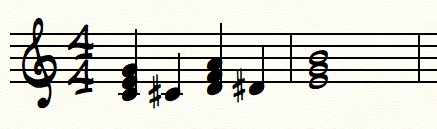
You can view this as a simple circle-of-fifths progression, but how about another way:

You can also reimagine this as an overlay of IV – I – V movements. And now when you are in this mindset, you can control how to get out of the predictable pattern into a set key with the understanding that you have the momentum of a IV – I – V progression.

Thank you so much for taking the time to read! Feel free to comment, share, and subscribe for more daily tips below! Till next time.
Improve Your Lyrics – Tip #28

Prosody – the unity between two or more things. Balance. Connection. Relation.

In music there are three major areas of prosody that should be kept in mind when writing and editing your lyrics. Those are:

  • Prosody between words and the music/key
  • Prosody between syllables and notes
  • Prosody between rhythm and meaning

Let’s take the first one for example. If you are using a minor key and trying to write really ominous music, does it make sense to use “happy” descriptive words?

We’ve talked in the past about aligning stressed syllables with stressed beats, but the rhythm of how you pronounce the words should be natural as well. In addition, if you want to create a frantic meaning – would you use a fast rhythmic pattern or a slow one? Fast because it creates a unity between the rhythmic performance and musical meaning.

Keep in your conscious mind how you can make one part of your song (music and/or lyrics) relate to another.

Thank you so much for taking the time to read! Feel free to comment, share, and subscribe for more daily tips below! Till next time.