Tip #183 – Why the iv o7 Chord Works

A diminished seventh chord built on the fourth scale degree of the key. Think about it for a second.

Now, do you think this chord can resolve to the tonic in a iv o7 – I progression?

Let’s see in comparison to a regular ii 7 – V 7 – I progression:

If you play these chords, you will hear that both of them sound like complete resolutions to the I chord. But why?

Well, first start off by looking at the enharmonics of the iv o7 chord. Notice how there are 3 shared common tones. What’s more, the one note that is different is the b9 of the V chord. So basically, the iv o7 acts as a V 7(b9) chord with the seventh in the bass.

Try it out and see what else you can use it with.

Thank you so much for taking the time to read! Feel free to comment, share, and subscribe for more daily tips below! Till next time.

Tip #182 – Understanding the Kharaharapriya Scale

The Carnatic music of South India has 72 scales (melakartas) comprised of seven different notes in either an ascending (arohana) or descending (avarohana) fashion. These scales are used in a kind of India music called rāga and are extremely beautiful. In addition these scales are grouped into different chakras, based on certain similarities.

Today’s melakarta is the Kharaharapriya scale (which has a rough translation of “to be blessed”), the fourth scale from the fourth chakra.

Below is a representation of the scale as if it was put into Western notation:

Both the first (SA) and fifth (PA) scale degrees are in a placement normal to most scales found in Western music. In addition, it looks similar to a Dorian scale.

Try playing around with the scale, possible harmonies, and progressions!

Thank you so much for taking the time to read! Feel free to comment, share, and subscribe for more daily tips below! Till next time.

Improve Your Lyrics – Tip #33

Continuing with the idea of balanced/unbalanced sections and odd/even lines, here is another thing to keep in mind:

The “standard” structure is that every section of a song (verse, bridge, chorus, etc.) is built upon 4 lines. Because everyone expects that, altering it will have an effect on the listener – and the song flow itself.

By deleting a line, you create an anticipation from the listener causing there the be a stronger lead-in to the next section. And by adding a line, you create a delay. The audience will focus on the unsuspected fifth line and have preparation to the next section.

Write some sections with unbalanced lines and see how the lead (or not) into the next section.

Thank you so much for taking the time to read! Feel free to comment, share, and subscribe for more daily tips below! Till next time.

How To Beat Writer’s Block – Tip #15

This is a very abstract and avant-garde way of composing.

Start by writing on a piece of sheet music a bunch of notes at random – with a variety of note lengths and pitches. Do this without thought. You can even ask a friend to do this and ask them to randomly write stuff on a staff.

Next, rip the piece of sheet music up. How you do that is up to you, but I suggest that each scrap of paper contains at least one note figure of motif.

From there, arrange and piece back together the sheet music. You certainly don’t have to use all the scraps. Also, you can invert the scraps and turn them upside down against the staff to get a new pitch.

Now, play your creation. If you like it, keep it! In the case that you don’t approve of it, edit it or start from the beginning of the process again.

Thank you so much for taking the time to read! Feel free to comment, share, and subscribe for more daily tips below! Till next time.

Tip #181 – Reducing to Power Chords

We have talked about how power chords can create ambiguity in the harmony because you cannot exactly tell if the chord is major or minor. In addition, transforming a diminished triad into a power chord creates a chromatic in the key pitch collection as well as ambiguity in the leading tone.

Besides blurring the lines of major and minor, reducing to power chords can help enforce root movements. Now that the listener cannot rely on whether a major chord moved to a minor chord, vice-verse, or whatever – they have to pay attention to the root movement.

Chords that are a P5 or P4 apart will now have more power in transition. The listener will notice the sol – do pitch movement, even if the chords are not V – I, because the key is not exactly distinguishable due to the power chord harmonization.

This can work to your advantage, or work against it. So, pay attention to where and how you use power chords – especially when you are bouncing between triadic harmony and power chords.

Thank you so much for taking the time to read! Feel free to comment, share, and subscribe for more daily tips below! Till next time.

Improve Your Lyrics – Tip #32

Today we are going to be talking about how changing the form by balancing/unbalancing sections can makes things – pop out.

Think about it. A section that is balanced in a group of unbalanced sections would stick-out in the listener’s mind through this juxtaposition. And this works in vice-versa.

A verse of 4 lines where 3 lines out of the 4 rhyme – the odd one out will get more attention from the listener.

Verses that have an unusual rhyming pattern or odd number of lines will create tension. Making the chorus a place of even resolution will make the chorus stick-out from the verses around it; thus, giving the section more power.

Keep this in mind as you are revising your lyrics.

Thank you so much for taking the time to read! Feel free to comment, share, and subscribe for more daily tips below! Till next time.

Teach Yourself Music Theory – 22.) Metric Accents and Syncopation

An accent (which we will cover more later) is an emphasis on a note during performance. Usually, this is indicated by the composer on the sheet music to tell the performer on which notes to put the accent.

However, accents can also naturally happen. We have talked about this before with metric grouping. Within a measure a specific number of beats are grouped together. Not only is it used for organization, but it helps tell the performer where to put the emphasis when playing.

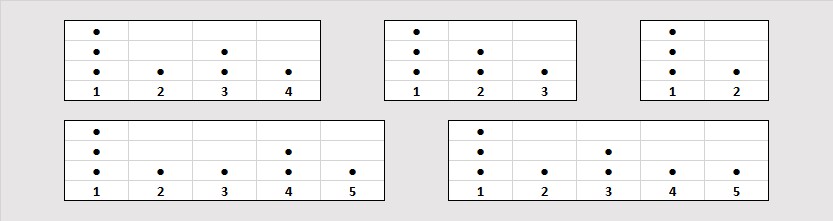
A metric accents is a natural emphasis put on a note due to its placement in the meter. Below is a graph with the level of accentuation put on different beats of various metric groupings:

You have probably already realized this knowing that an upbeat is light, while a downbeat is strong.

Now for a new term:

Syncopation, placing the accent on a weak or unexpected part/division of the beat.

When the emphasis avoids the strong metric accents and is applied to the weaker beats, or to the beat divisions (eighth-notes, etc.), it is called syncopation.

Thank you so much for taking the time to read! Feel free to comment, share, and subscribe for more daily tips below! Till next time.

Tip #180 – Using the Principle of the I 6/4 Chord

This post is NOT a debate on if the I 6/4 chord acts more of a tonic or dominant chord. Instead, we will be talking about the principle behind the chord and how to apply it to other practices.

While the analysis of the I 6/4 chord is up to debate, the function is not – the chord comes before the V chord, and then it usually resolves to the I chord from there. Why so? Well, looking at the shape as well as the voice movement of the I 6/4 chord to the V chord, it is a suspension of higher tones over the shared root resolving to the dominant chord.

Basically, we can learn from this is that by suspending voices over the dominant root, we create a delayed resolution to the V chord and then to I.

Not only can this be done with a I 6/4 chord, but it can also be done with a V sus4 chord, a V chord with upper tension tones, and variations:

Try them out – that by keeping the root the same, but changing the upper structure or voicing, you create a delay in the harmonic movement resolving back to I.

Thank you so much for taking the time to read! Feel free to comment, share, and subscribe for more daily tips below! Till next time.

Tip #179 – Understanding the Keeravani Scale

The Carnatic music of South India has 72 scales (melakartas) comprised of seven different notes in either an ascending (arohana) or descending (avarohana) fashion. These scales are used in a kind of India music called rāga and are extremely beautiful. In addition these scales are grouped into different chakras, based on certain similarities.

Today’s melakarta is the Kiravani scale (translating to “parrot voice”), the third scale from the fourth chakra.

Below is a representation of the scale as if it was put into Western notation:

Both the first (SA) and fifth (PA) scale degrees are in a placement normal to most scales found in Western music. In addition, it looks similar to a harmonic minor scale.

Try playing around with the scale, possible harmonies, and progressions!

Thank you so much for taking the time to read! Feel free to comment, share, and subscribe for more daily tips below! Till next time.

How To Beat Writer’s Block – Tip #14

If you are struggling to come up with the start to your new composition or song – have no worry!

Today we are going to talk about a simple game/exercise that can spark your creative juices.

Start by taking some famous brand commercials – either by obtaining them online or just from pure memory when watching them on television. From there, erase from your memory what the music was in that commercial.

Now, be the composer and write a little musical logo or jingle that would appear at the end of the commercial. Most musical logos are only a few notes long, so this task shouldn’t be exhausting – but it does force you to be creative by making a musical jingle that consumers of the product will remember.

Or, even make up your own product. However, the focus should be on the composing of the motif that can be later recycled as a new musical work.

Thank you so much for taking the time to read! Feel free to comment, share, and subscribe for more daily tips below! Till next time.