Teach Yourself Music Theory – 29.) Identifying Triads

You probably have heard this term before, but maybe haven’t been able to completely define it. Especially as an aspiring musician, composer, producer, etc., you have heard this word before:


A chord.
Which is a group of pitches played at the same time (or played in succession of one another in overlap) to create harmony.


Harmony, which we have talked about before in terms of harmonic intervals, are sounds (two or more) sounding at the same time.


Chords are defined by their collection of pitches, order, arrangement, etc. Today, we are going to talk about the basic kinds of chords in modern music. Those are triads, which are chords comprised of three different pitches, with the notes (from lowest to highest) are a third apart from each other.


That might be a confusing definition, so let’s take it a deferent approach…


Let’s list off the different kinds of musical intervals of thirds. There is the m3 (minor third) and the M3 (Major third). Now, let’s come up with the different interval combinations between the three possible notes:

  • m3 – m3
  • m3 – M3
  • M3 – m3
  • M3 – M3

Great, now let’s actually right them out. Start on middle C, and then write the pitches above with the possible interval combinations above:


These are triads. Three note chords built on thirds. Play them and listen how different they are. They go by these names:

  • m3 – m3, Diminished Triad
  • m3 – M3, Minor Triad
  • M3 – m3, Major Triad
  • M3 – M3, Augmented Triad

When talking about the quality of a triad, we look at the root, which is the lowest note the chord is built upon, and call it by its letter name. Then, we look at the third and fifth (respective pitches above that are a third and fifth apart from the root) to see the intervals to define the quality.


So, if we write D-F-A, we get a D minor triad. That is because the root is D and the interval combination of the thirds are m3 – M3. Try writing triads and seeing what you get!


Thank you so much for taking the time to read! Feel free to comment, share, and subscribe for more daily tips below! Till next time.

Tip #199 – Playing Around with the Harmonic Major Scale

Sounds too good to be true, right? There is the major scale, the natural minor scale, the harmonic minor scale, and the melodic minor scale. Now, there is a harmonic major scale?!?

Appears so – I recently found this out. So don’t patronize me for not knowing; I more appreciate the fact that I am learning something new every day.

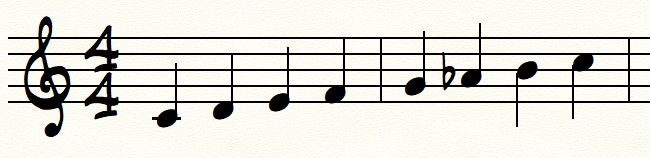
Anyways, the harmonic major scale is a major scale with a b6 scale degree:

Not too exciting, but it offers interesting harmonies and vibrant melodic lines, especially for jazz.

Try it out, play around with it, and see what kind of melodies and harmonies you can form with the harmonic major scale.

Thank you so much for taking the time to read! Feel free to comment, share, and subscribe for more daily tips below! Till next time.
Tip #198 – Understanding the Charukesi Scale

The Carnatic music of South India has 72 scales (melakartas) comprised of seven different notes in either an ascending (arohana) or descending (avarohana) fashion. These scales are used in a kind of India music called rāga and are extremely beautiful. In addition these scales are grouped into different chakras, based on certain similarities.

Today’s melakarta is the Charukesi scale (roughly translating to “elegant”), the second scale from the fifth chakra.

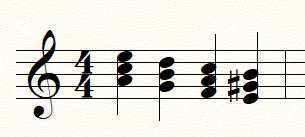
Below is a representation of the scale as if it was put into Western notation:

Both the first (SA) and fifth (PA) scale degrees are in a placement normal to most scales found in Western music. In addition, it contains the major tetrachord in the beginning, but naturals for the rest of the scale.

Try playing around with the scale, possible harmonies, and progressions!

Thank you so much for taking the time to read! Feel free to comment, share, and subscribe for more daily tips below! Till next time.

Teach Yourself Music Theory – 28.) Interval Characteristics

Previously, we have talked about naming and grouping intervals.

Another characteristic we can classify intervals by is if they sound “good” or “bad” to the ear.

Now, this topic is VERY subjective. However, in theory, we have rules to classify the intervals.

An interval (melodic or harmonic) that generally sounds pleasing to the ear and stable is called consonant. Any interval that doesn’t sound “right,” has a need to resolve, classes sonically, or is outside diatonic tonality* is called dissonant.

Within consonance, there are perfect consonances that feature the perfect intervals, and there imperfect consonances that feature everything else.

If this sounds confusing, do not worry. These are labels to help understand the sonic quality of intervals as well as their stability/resolving motion.

Perfect Consonances

  • P1 or Unison
  • P5
  • P8

Imperfect Consonances

  • m3
  • M3
  • m6
  • M6

Dissonances

  • m2
  • M2
  • Tritone
  • m7
  • M7
  • Any diminished interval
  • Any augmented interval

Noticed how the P4 wasn’t included in any of these lists. That is because in the pre-historic times before the Renaissance the P4 was considered a perfect consonance. Then into the Renaissance era, the P4 was regarded as a dissonance. Now, scholars have evaluated the P4 interval again and pretty much made it a wild card.

Listen to the intervals and see if you agree with their classification.

Thank you so much for taking the time to read! Feel free to comment, share, and subscribe for more daily tips below! Till next time.

Tip #197 – Andalusian Cadence

Continuing with the idea of the lament bass, we have the chord progression of the Andalusian cadence.

Built off of the lament bass line in minor, it is harmonized like this:

i – bVII – bVI – V

These chords can also include sevens and other upper extensions for an expanded harmony, but the core triads and bass line motion is what matters.

Not only does the Andalusian cadence appear in classical and pop music, but you can find it in the regional styles of flamenco, Arabian, and Greek music.

Try coming up with a riff based on this progression.

Thank you so much for taking the time to read! Feel free to comment, share, and subscribe for more daily tips below! Till next time.
Tip #196 – Lament Bass

I popular classical music trope that found its way into modern pop music is the lament bass. Before, the lament bass was used in what we regard as Classical and Romantic era music for sorrowful passages. Now, it appears in many different variations in today’s music/

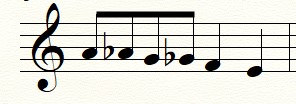
The “original” lament bass is a diatonic walk-down from the root of the minor chord to the fifth in a span of a P4:

Each note in the bass is harmonized, and the descending motion gives the music a grieving feeling. You can hear by the minor tonality the need to resolve down.

Pop music does a similar thing, but with a “major” lament bass:

Compare how these two different, not only in pitch but as well in intervals.

Also, there can be a “chromatic” version of the lament bass, still spaning a P4 in distance travelled:

Thank you so much for taking the time to read! Feel free to comment, share, and subscribe for more daily tips below! Till next time.
Improve Your Lyrics – Tip #38

As you map out the framework of your song, you begin to see everything fall into place. You have you main idea which you can expand upon. There is your title the opening lines that grab the listener’s attention. And there is your body of the song.

Writing the body of your song is like writing the body of a book to some degree. It needs to captivate the attention of the audience through development leading to a climax (and possibly a resolution at the end).

It is best to start by having the “end goal” in mind. Ask yourself “what do I want my listeners to take away from my song?” Do you want them to party, cry, laugh, feel empowered, angry, etc.? Knowing what you want to accomplish will help determine your body of the song.

The bodies of songs boil down into three basic plot ideas:

  • The Attitudinal Plot – where the singer talks solely about an emotion
  • The Situational Plot – where the singer gives perspective and emotion about a situation
  • The Narrative Plot – where the singer solely talks about a situation, but the emotional perspective is implied

You can think of this as emotion, story, or both in terms of choosing how you want the plot of your song to be.

Try coming up with an idea for each of the three different main plots for the body of your song.

Thank you so much for taking the time to read! Feel free to comment, share, and subscribe for more daily tips below! Till next time.

Teach Yourself Music Theory – 27.) Digging Deeper Into Intervals

If you are still not comfortable with the topic of intervals, I suggest reviewing previous posts. Otherwise, let’s go for a quick refresher:

An interval is the distance between two different pitches/notes. The two different notes can either occur at the same time (called a harmonic interval) or consecutively one after another (called a melodic interval).

Another way to classify intervals is by the span. Simple intervals are those that span an octave or less in length between any two pitches. Those that are of a greater distance than an octave are called compound intervals.

Previously, we have only named up to an octave. To name compound intervals, do the following:

  • Take out the octave(s) distance apart
  • Decide what is the leftover simple interval quality
  • Name it (i.e. M2 )
  • Then at a 7 to the value ( M2 +7 = M9 )

Intervals can also be classified by being grouped into their inversion relation; meaning, that when you take two notes and invert them by either having the lower note go above the higher note… or having the higher note go below the lower note, you produce another interval.

Let’s practice this concept. Start by writing middle C on a staff followed by the E4 pitch above it. Notice that this interval makes a M3. Now, take the middle C and move it up an octave to C5. You have now inverted the pitches, creating a m6 interval. So, M3 and m6 are inversionally related.

Practice writing two different pitches and naming the interval. Then, invert them and find the new interval.

Thank you so much for taking the time to read! Feel free to comment, share, and subscribe for more daily tips below! Till next time.

Tip #195 – Dorian Vamp

This will be a short tip.

Say that you want a jazz or funk groove but don’t know where to start when it comes to harmonic progressions.

Well, a typical progression used in these styles is the Dorian vamp, which is a repetition of the progression:

i – IV7

Of course, these chords can be altered with upper extensions and sus4, but the root motion is the same.

Both of these chords are naturally found in the Dorian mode (in the example above it would be E Dorian), so it fits right with the tonality you want to be in.

Try it out and feel free to experiment.

Thank you so much for taking the time to read! Feel free to comment, share, and subscribe for more daily tips below! Till next time.

Tip #194 – Understanding the Mararanjani Scale

The Carnatic music of South India has 72 scales (melakartas) comprised of seven different notes in either an ascending (arohana) or descending (avarohana) fashion. These scales are used in a kind of India music called rāga and are extremely beautiful. In addition these scales are grouped into different chakras, based on certain similarities.

Today’s melakarta is the Mararanjani scale (roughly translating to “killing”), the first scale from the fifth chakra.

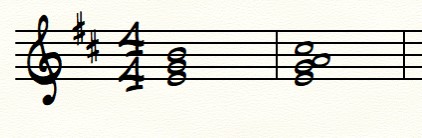
Below is a representation of the scale as if it was put into Western notation:

Both the first (SA) and fifth (PA) scale degrees are in a placement normal to most scales found in Western music. In addition, it contains the major tetrachord in the beginning.  With that, there is the lowered seventh degree (NI).

Try playing around with the scale, possible harmonies, and progressions!

Thank you so much for taking the time to read! Feel free to comment, share, and subscribe for more daily tips below! Till next time.