Looking Back at the Old… and Looking Forward to the New!

It has been a year since this website started! And just like its name, a new post about music was posted daily.

That means there are around 365 posts! And for people who are just discovering this website, that means there is a lot to look back at while keeping up with the new tips in the upcoming days.

To help, I have created an “Archives” link at the top so any one can look back at all the old tips… just incase they need a refresher.

The page is still in the works, so please pardon the messiness with the format and missing contents.

Thank you for such a great first year! I wish 2020 treats you well!
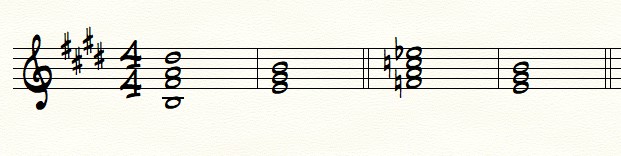
Tip #235 – Neo-Soul Progressions

This is a generalization – so that means that there are certainly more chord progressions found in the music of neo-soul than just this, but this is a good place to start.

Also, keep in mind that the chords in these examples are just the basic triads and seventh-chords, and not the expanded voices we talked about in a previous post. We will just be talking about root movement today.

What I have found interesting about neo-soul music, is that instead of where most pop music starts in the I chord and uses the V7 chord at the end of a repeated section to get back to the I chord in the beginning, neo-soul does the opposite:

Starting on the V7 or its variants give an instability to then resolve on the I chord on the weaker measure of the vamp. This keeps the motion rolling.

Then, there is the use of parallel motions (especially by minor chords) where the chord quality doesn’t change, but the root does:

Finally, a common neo-soul chord progression is movement by thirds. Music tends to follow the common circle-of-fifth, where the roots move by descending fifths. Moving by either ascending or descending thirds can give a neo-soul feel to your music:

Thank you so much for taking the time to read! Feel free to comment, share, and subscribe for more daily tips below! Till next time.

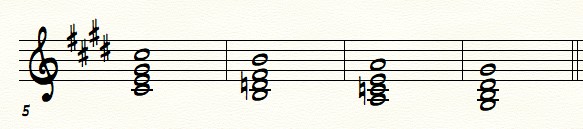
Tip #234 – Understanding the Chalanata Scale

The Carnatic music of South India has 72 scales (melakartas) comprised of seven different notes in either an ascending (arohana) or descending (avarohana) fashion. These scales are used in a kind of India music called rāga and are extremely beautiful. In addition these scales are grouped into different chakras, based on certain similarities.

Today’s melakarta is the Chalanata scale, the sixth scale from the sixth chakra.

Below is a representation of the scale as if it was put into Western notation:

Both the first (SA) and fifth (PA) scale degrees are in a placement normal to most scales found in Western music, but now you have a raised second degree (RI) acting as an augmented second from the root.  In addition, there is a chromatic run at the top of the scale.

Try playing around with the scale, possible harmonies, and progressions!

Thank you so much for taking the time to read! Feel free to comment, share, and subscribe for more daily tips below! Till next time.

Tip #233 – Expanding to Give a Neo-Soul Sound

There are many aspects that define a music genre. The kinds of harmonies, rhythms, lyrics, chord progressions, fashion, etc. all help classify a piece of music.

Before we get into a debate of whether labels are good or bad, it is skill for composers to know what makes a genre to draw direct inspirations from.

We are going to talk about how simply expanding the harmony of your chord choices and voicings can give your piece of music an interesting neo-soul feel.

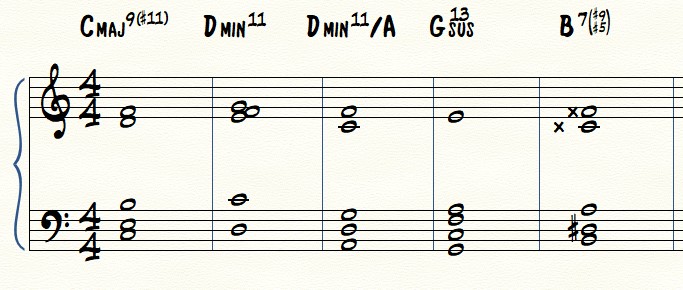
Take a look below at some common chord types (never mind the key):

Typically, you would use some major chords, minor chords, dominant seventh, and diminished chords to write a song. To give it a neo-soul flavor, try expanding the harmonies this way:

  • Major Triad -> Major Ninth Sharp Eleventh
  • Minor Triad -> Minor Eleventh
  • Dominant Seventh -> Dominant Thirteenth Sus 4
  • Diminished Triad -> Altered Dominants

Also, taking inspiration from modal harmonies are re-voicing in quartal harmonies (of stacked fourth), can give your piece a neo-soul sound. Basically, jazz harmonies will be your best friend in this.

Thank you so much for taking the time to read! Feel free to comment, share, and subscribe for more daily tips below! Till next time.

Thinking Out Loud – A Break from Similar Minded People

Recently, I had the pleasure of catching-up with a friend I haven’t seen since… gosh, maybe high school or further. We took different paths, but we both were in the realms of art (visual, performance, acoustic, etc.).

During our moments talking to each other, we expressed the similar need to take breaks from people who shared the same interest as ours. That while going to school, being in the same company working, or chilling with people that were in the same artistic field at you is a dream… it can be very exhausting.

Exhausting, and even annoying to be constantly bombarded by the constant stimuli of talking about one simple topic?

Why is that? Why did we need to take a break from art and like-minded artists to pursue art?

Could it be because of the expression “great minds think alike, but fools rarely differ,” where being with similar people can limit your perspectives? Or a forewarning that “jack of all trades, master of none; but better than a master of one,” where staying on one path also limits artistic growth?

Does anyone else have the need to take breaks from people of your field to grow more? Or, am I…

Just thinking out loud.

Tip #232 – Root-less Chords

By default, when you eliminate the root from being at the bottom of a chord, it becomes an inversion of itself.

This can become a useful tool when constructing a bass line by avoiding the root in order to give an unstable feeling or imply a different harmony.

So, now the question is, how does the bass move?

Before, we talked about the root of one chord harmony move to the root of the next. What does one do when it is either the third, sixth, or seventh in the bass.

Above anything else: experiment. However, it might be wise to connect similar notes or move stepwise. Meaning, if the third of one chord harmony is the same as the seventh of the next, keep on that note.

Play with these ideas and see how they can improve with building bass lines.

Thank you so much for taking the time to read! Feel free to comment, share, and subscribe for more daily tips below! Till next time.

Improve Your Lyrics – Tip #48

Another lyric form you can try experimenting with is the ABAB form.  While it is not so common today, it can be found in many hits from country, to adult contemporary, to jazz, to funk, and broadway music.

While the ABAB form may look visually similar to that of the AABA form, the ABAB is more two different sections than three sections connected with a bridge.

The purpose of the A section is to embody the main music idea and theme while the B section is used to develop the material as well as serve as a platform to prepare the listener for returning back to the A section.  So, the B in the ABAB form is more fluid and transitional than the B in the AABA form which is contrasting.

Even though the ABAB form is typically 32-bars long with each AB section containing 16-bars, it can be changed.  In some cases, a songwriter might add a little extra at the end, making the form ABABB or ABABAB.

Titles, or main hooks are placed at the beginning of the A sections, or at the end of the B sections.

Try writing a song that calls for development of the main idea in a ABAB structure format.

Thank you so much for taking the time to read! Feel free to comment, share, and subscribe for more daily tips below! Till next time.

Teach Yourself Music Theory – 34.) Inverting Seventh-Chords

If you remember all there is to inverting triads, inverting seventh-chords should be no problem at all. On the other hand, if you still have trouble with inversions – I suggest you look over past posts before starting with this one.

As mentioned in the past, inverting a chord is like reordering the chord members… but this time, a note besides the root is in the bass.

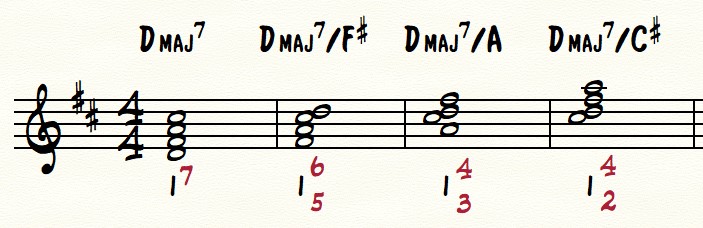
Whereas a triad had three different inversions (one for each chord member), a seventh-chord will have four different inversions:

  • Root Position – where the root is in the bass; noted with a “7” symbol
  • First Inversion – where the third is in the bass; noted with a “6/5” symbol
  • Second Inversion – where the fifth is in the bass; noted with a “4/3” symbol
  • Third Inversion – where the seventh is in the bass; noted with a “4/2” symbol

These inversions can be noted with Roman numerals (below the staff) or in lead-sheet notation (above the staff):

Try writing various seventh-chords, identifying them, and then inverting them. Also, listen to how each of the inversions sound.

Thank you so much for taking the time to read! Feel free to comment, share, and subscribe for more daily tips below! Till next time.

Tip #231 – Reducing to the Essentials

If you could only play two notes to suggest the harmony, which ones would you choose? How can you choose the right night to imply the right harmony without making it ambiguous?

Previously, we have talked about making harmonic accompaniment ambiguous by playing only octaves and fifths. What if we want to do the opposite.

Well, instead of the fifth, what other notes of the chord impact its quality? That would be the third (telling us if it is major of minor), the seventh (tell us what kind of seventh chord it is), and sixth (for extra color).

Some people have been known to call this “shell voicing” when you limit your harmonic voicings down to two notes: the root/bass and a tone that tells us the quality of the chord.

NOTE: if the chord was diminished, playing the flat fifth would be more of a priority, but not when it is a perfect fifth.

Try it out. When building a bass line, an accompaniment, or whatever, challenge yourself by only playing 2 notes.

Thank you so much for taking the time to read! Feel free to comment, share, and subscribe for more daily tips below! Till next time.

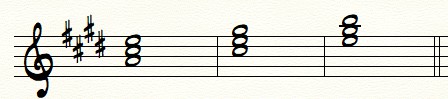
Tip #230 – Understanding the Sulini Scale

The Carnatic music of South India has 72 scales (melakartas) comprised of seven different notes in either an ascending (arohana) or descending (avarohana) fashion. These scales are used in a kind of India music called rāga and are extremely beautiful. In addition these scales are grouped into different chakras, based on certain similarities.

Today’s melakarta is the Sulini scale, the fifth scale from the sixth chakra.

Below is a representation of the scale as if it was put into Western notation:

Both the first (SA) and fifth (PA) scale degrees are in a placement normal to most scales found in Western music, but now you have a raised second degree (RI) acting as an augmented second from the root.  Think of it as a major scale with a raised second.

Try playing around with the scale, possible harmonies, and progressions!

Thank you so much for taking the time to read! Feel free to comment, share, and subscribe for more daily tips below! Till next time.