Tip #239 – Nobody Likes a Bad Fingering Musically

While growing your skill as a composing (if that is what you want to be) is a good thing and should be a priority – there should be some time put to practicing an instrument.

Reason being is so you know the capabilities of an instruments… as to what it can and cannot do, or what is physically impossible for a musician to play.

As you are composing and writing notes down on paper or in a DAW, keep in find how it can be performed. Can you play it? Can you write down what fingers the musician should use, and does require a lot of dexterity?

Not only will this help a musician when playing your music, but it will make you look more competent for knowing about their instrument.

Thank you so much for taking the time to read! Feel free to comment, share, and subscribe for more daily tips below! Till next time.
Thinking Out Loud – Musical Culture

I recently read a chapter of a book in where a man describes his musical cultural background to be that of Western European classical music. And while he grew up with it, he has distaste for it. What’s more interesting is that this person was actually born in the 20th Century in London – which is certainly not the classical era of music.

This got me thinking, “can a person’s musical culture be that of what is not going around them,” and “is this culturally appropriate to say?”

For example: if you are Polish and were born to Polish parents, but spent your youth listening to music from Kenya, is this African music you cultural background?

For me, this is where it gets tough. While I cannot deny the individual with their personal experience to what they grew up listening to, it is difficult to define it as “cultural” because the definition refers to a group of people. Also, in this example, the listener is isolated from the culture of people that made the music.

On the other hand, music is a form of expression and communication used the share costumes across cultures. So there are arguments for either side.

Just thinking out loud.

Improve Your Lyrics – Tip #50

Another form that you can use for your lyric writing is the through-composed form. The structure is represented as the ABCD form where each section is a new melody (or a development of the original). Thus, constantly being new and not repeating any material.


While melodic change is the most important distinction between each section in a through-composed song, other aspects such as number of lines or rhyming scheme can also change.


A through-composed structure works best when the lyrics you have written are a linear narrative, that itself will develop just as the music does.


So how can a songwriter and lyricist make a through-composed piece sound like one song instead a mishmash of many? Just like the lyrics should all be on the same topic, each section (ABCD…) should have a harmonic, melodic, and/or rhythmic variation of a motif to tie everything together.

Thank you so much for taking the time to read! Feel free to comment, share, and subscribe for more daily tips below! Till next time.

Teach Yourself Music Theory – 36.) Church Modes

As we begin entering the realm of counterpoint, we need to touch upon some music history. Renaissance counterpoint will be the first destination.

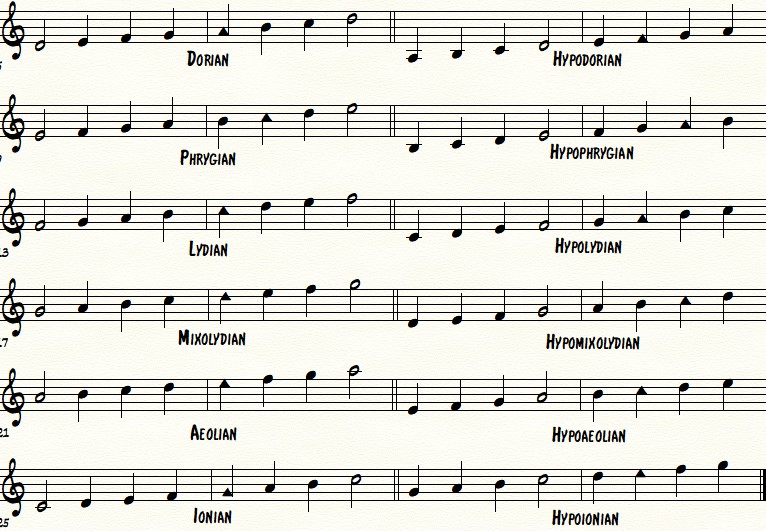
Early chant, called plainsong, were composed using 8 different modes. Modes, as we have previously talked about, are scales the encompass the same pitches as a key area, but are not technically our known major or natural minor. By the 16th Century into the Renaissance era, it expanded with a few more.

These Ecclesiastical Modes, or Church Modes, define which notes are more important than others in contrapuntal musical pieces. Each modes are built off of different species of whole and half-note combinations.

There are authentic church modes, which are the “main” modes than cover a range of an octave (but can go a step out from each end of the mode). And there are a plagal church modes which are derived from the “main” modes by starting on the fifth degree above the tonic.

Church modes have their own special characteristic notes of finals (the literal “final” note of a melodic line), and dominant (the recitation tone which is held during chant).

In the picture above, the half-notes denote finals within a mode while the triangles denote dominants.

When composing, is a person uses way more than the range of the mode – it is called excessive. If the melody of the contrapuntal piece covers both the range of the authentic and plagal church modes – it is called mixed. And for those melodies that never cover the range of an octave – it is called incomplete.

Before wrapping up this post, it should be mentioned that certain scale degrees can be flattened to avoid the tritone interval, and other scale degrees can be raised for cadential purposes.

Thank you so much for taking the time to read! Feel free to comment, share, and subscribe for more daily tips below! Till next time.

Tip #238 – Sliding Into Home Base

Just like a baseball player sliding into home base is unnecessary in compared to just running home – so can sliding into certain “home” notes of a chord. Yes, this extra accented passing tone is note needed, but it can give some cool flavor as well as style to your music.

As you are playing a chord progression, try using these accented passing tones in relationship to the chord:

  • Seventh goes to the root
  • Second goes to the third
  • Sixth goes to the fifth

…and with sliding motion if your instrument allows you to!

Thank you so much for taking the time to read! Feel free to comment, share, and subscribe for more daily tips below! Till next time.

Tip #237 – Understanding the Salagam Scale

The Carnatic music of South India has 72 scales (melakartas) comprised of seven different notes in either an ascending (arohana) or descending (avarohana) fashion. These scales are used in a kind of India music called rāga and are extremely beautiful. In addition these scales are grouped into different chakras, based on certain similarities.

Today’s melakarta is the Salagam scale, the first scale from the seventh chakra.

Below is a representation of the scale as if it was put into Western notation:

Both the first (SA) and fifth (PA) scale degrees are in a placement normal to most scales found in Western music.  However, the lowered second (RI) and third (GA) scale degrees create a chromatic line.  So do the raised fourth (MA) and lowered seventh (NI) scale degrees create a chromatic line.

Try playing around with the scale, possible harmonies, and progressions!

Thank you so much for taking the time to read! Feel free to comment, share, and subscribe for more daily tips below! Till next time.
Tip #236 – Squishing Down Voicing Possibilities

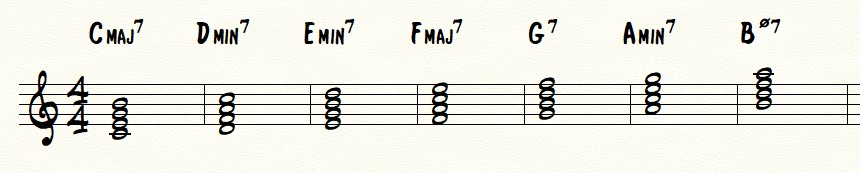
Say you have a harmonic progression like this:

There is an unlimited amount of possibilities in regards to how you can voice them to have good voice leading.

A quick two rule for harmonic voicings is to determine the bottom and the top by:

  1. Keeping the root/bass note at the bottom
  2. Make a roughly stagnant melodic line at the top.

This is because the chord voicings are to give harmony and nothing else; not to give a counter melody that will interfere.

Thank you so much for taking the time to read! Feel free to comment, share, and subscribe for more daily tips below! Till next time.
How To Beat Writer’s Block – Tip #20

Can it be possible to bore yourself into creativity?

When things are so mind-numbingly boring, people usually tend to do something about it to make it more exciting (unless they are content with it or just plain lazy).

Try this exercise: start by playing the simplest rhythm you can think of (possibly quarter-notes) on a single pitch. Play it over and over again. More and more until the natural urge to change it comes out.

You will probably start by changing the rhythm, getting bored with the constant quarter-notes. Then, you’ll probably start varying the pitch – creating a melody.

And there you go! A start of a piece born from plain boredom!

Thank you so much for taking the time to read! Feel free to comment, share, and subscribe for more daily tips below! Till next time.

Improve Your Lyrics – Tip #49

Another lyrical form you should consider on using is the ABAC form.  While it is not conventual or popular, many great hits in the past have used this form.

Similar to the ABAB form, the A section contains the main musical theme/motif/idea.  The B section is the development while also serving as the catapult to return back to the A section.  Length for each lettered section is typically 8-bars long, but it can vary.

The C section is new…

Well, the C lyrics section is new, it that it is only performed once in the entire structure of the song.  It can contain a bit of thematic material found in the B section (acting as B’) or being completely new.

Titles usually appear (that is, if you want to incorporate the title into the lyrics) at the beginning or at the end of the AB or AC sections.

Try playing around with this form; especially if the structure of your lyrics is to create an emotional climax.

Thank you so much for taking the time to read! Feel free to comment, share, and subscribe for more daily tips below! Till next time.
Teach Yourself Music Theory – 35.) Building Seventh-Chords from Scales

Now, we are going to be covering where all of these different kinds of seventh-chords appear within a key by building them off of different scale degrees.

First, we will take the major scale:

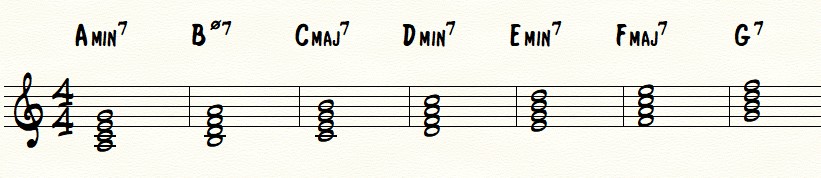
Notice how there are only four different seventh chord possibilities: the major seventh, minor seventh, half-diminished seventh, and dominant seventh. This should be pretty easy to memorize.

As for the natural minor scale, it is just a reordering of the major scale:

Now, we add the leading tone for the harmonic minor scale:

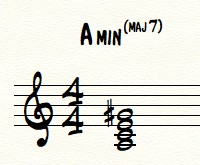
The harmonic minor scale, because of the raised leading tone, creates an augmented seventh as well as a fully-diminished seventh. Also, we have a seventh-chord we have never discussed before… the minor-major seventh which is a minor triad with a M7 interval from the root on top:

Finally, the melodic minor scale:

Thank you so much for taking the time to read! Feel free to comment, share, and subscribe for more daily tips below! Till next time.
