Tip #218 – Spicing-Up the Middle to your 12-Bar Blues

The typical 12-Bar blues format is, of course, made up of 12 measures.  In addition, it features predominantly only three chords: the I7 , IV7 , and V7.

You can also divide the format into different sections (or as I call “rows” when visually represented on a graph or piece of sheet music) based on when the emphasis is, as well as where you begin a new lyric line to the verses:

Today, I am going to be giving you a list of examples to ways you can alter the middle section of a 12-Bar blues:
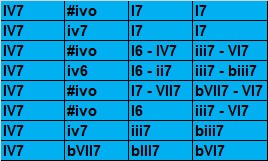
Notice the similarities and differences between them. In addition, see how the last chord of the “row” leads into the last 4 measures. Some of them might work well together while others may not.

Thank you so much for taking the time to read! Feel free to comment, share, and subscribe for more daily tips below! Till next time.
Tip #217 – Spicing-Up the End to your 12-Bar Blues

The typical 12-Bar blues format is, of course, made up of 12 measures.  In addition, it features predominantly only three chords: the I7 , IV7 , and V7.

You can also divide the format into different sections (or as I call “rows” when visually represented on a graph or piece of sheet music) based on when the emphasis is, as well as where you begin a new lyric line to the verses:

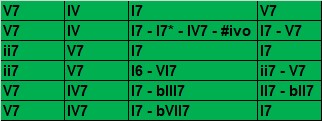
Today, I am going to be giving you a list of examples to ways you can alter the closing section of a 12-Bar blues:

Notice the similarities and differences between them, as well as how each of them have a unique turnaround.

Thank you so much for taking the time to read! Feel free to comment, share, and subscribe for more daily tips below! Till next time.

Improve Your Lyrics – Tip #44

A thing to consider as you write you lyrics is how you want the song to “live on,” in many forms or otherwise.  This comes from the fact that while you can have great lyrics, it won’t have any strength without good melodic writing or rhythmic phrasing/flow.

NOTE: this is no insult to hip/hop music or any musical genres that contain rap-style singing.  I enjoy that kind of music.  This is just to explain the limitations.

But say that you wrote a song that you hope people will enjoy so much that they’ll cover it.  In addition, you hope that people will do the cover versions in a variety of genres.  Instrumental, jazz, rock, folk, etc.

Unfortunately, that will be difficult if the lyrics do not have a proper melody.  If the lyrics just live on a single pitch, it will be hard to make the music “live on” without the lyrics.

Unless you are aiming for a hip-hop song, I suggest that as you are writing your lyrics you keep a melody in mind.

Thank you so much for taking the time to read! Feel free to comment, share, and subscribe for more daily tips below! Till next time.
Tip #216 – Spicing-Up the Beginning to your 12-Bar Blues

The typical 12-Bar blues format is, of course, made up of 12 measures.  In addition, it features predominantly only three chords: the I7 , IV7 , and V7.

You can also divide the format into different sections (or as I call “rows” when visually represented on a graph or piece of sheet music) based on when the emphasis is, as well as where you begin a new lyric line to the verses:

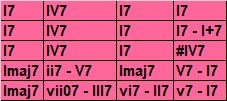
Today, I am going to be giving you a list of examples to ways you can alter the beginning section of a 12-Bar blues:

Notice the similarities and differences between them, as well as how each of them have a unique motion to getting to the second row starting with the IV7

Thank you so much for taking the time to read! Feel free to comment, share, and subscribe for more daily tips below! Till next time.

Tip #215 – Understanding the Yagapriya Scale

The Carnatic music of South India has 72 scales (melakartas) comprised of seven different notes in either an ascending (arohana) or descending (avarohana) fashion. These scales are used in a kind of India music called rāga and are extremely beautiful. In addition these scales are grouped into different chakras, based on certain similarities.

Today’s melakarta is the Yagapriya scale, the first scale from the sixth chakra.

Below is a representation of the scale as if it was put into Western notation:

Both the first (SA) and fifth (PA) scale degrees are in a placement normal to most scales found in Western music, but now you have a raised second degree (RI) acting as an augmented second from the root.  In addition, you have the lowered seventh degree (NI) acting as a augmented second beck to the root above.

Try playing around with the scale, possible harmonies, and progressions!

Thank you so much for taking the time to read! Feel free to comment, share, and subscribe for more daily tips below! Till next time.

Tip #214 – Using the Blues Arpeggio

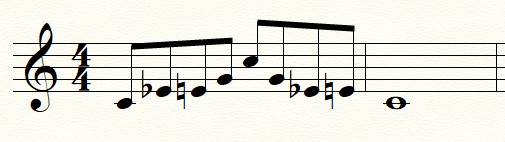
An interesting topic that I found from other composers is the use of the blues arpeggio. It looks something like this:

Just like how you can arpeggiate the chord harmony, the blues arpeggio works great over dominant-seventh chords in the blues format.

Notice that even as you are going down in the arpeggio, the lowered-third comes before the raised-third. This is so you can obtain that classic blues slide sound as well as the microtonal blue note in-between. Of course, this is a preference, not a strict rule.

In addition, just as the chords change in the 12-bar blues format, so will the arpeggiation. It does not stay strictly to the key signature; more so, it is determined by the root of the dominant-seventh chord.

Try practicing with them!

Thank you so much for taking the time to read! Feel free to comment, share, and subscribe for more daily tips below! Till next time.

Tip #213 – Getting from an Inversion to Another

Say you wanted to go from your tonic chord (or any other) to an inversion of itself. But, you wanted something in the middle because the root movement is a bit too boring, or you just don’t like the jump of the P5. You want it a bit smoother:

Well, a progression that works well for this comes from many jazz and gospel tunes:

Notice how this is very similar to the I – Imaj7 – I7 – IV – iv progression talked about earlier. Now, the iv chord is replaced with the #ivo chord to give it more motion to the fifth scale degree.

Thank you so much for taking the time to read! Feel free to comment, share, and subscribe for more daily tips below! Till next time.

Improve Your Lyrics – Tip #43

Another song form style that you can use is the AAA form (of course, it can be longer with AAAA…)

The AAA form is not exactly common today, but it has a lot of potential.  It is great for more single storytelling, or telling a collection of tales that are strung by a common theme.  That common theme can be the title being placed at the top of the verses or at the end.  In addition, a refrain section can be added to the end of each.

Refrains in the AAA form can be ironic or conflicting with the rest of the verse, almost for showing two sides of the coin.  But, because the refrain is held at the end which is a “power spot,” it carries more weight in the meaning/message to the song.

Thank you so much for taking the time to read! Feel free to comment, share, and subscribe for more daily tips below! Till next time.

Tip #212 – Building a Jazzy Progression from a Chromatic Line

Say that you have a chromatic lead-line like this below:

How would you harmonize this line? Write down all the possibilities.

Well, one way you can do so is with a frequently used chord progression amongst blues/jazz artists (as well as Stevie Wonder):

I – Imaj7 – I7 – IV – iv

Another variation is to substitute the iv chord with the bVII7 chord. It would look something like this:

Try it out and see how many songs you know use them!

Thank you so much for taking the time to read! Feel free to comment, share, and subscribe for more daily tips below! Till next time.

Tip #211 – Understanding the Naganandini Scale

The Carnatic music of South India has 72 scales (melakartas) comprised of seven different notes in either an ascending (arohana) or descending (avarohana) fashion. These scales are used in a kind of India music called rāga and are extremely beautiful. In addition these scales are grouped into different chakras, based on certain similarities.

Today’s melakarta is the Naganandini scale (translating to “mountain born”), the sixth scale from the fifth chakra.

Below is a representation of the scale as if it was put into Western notation:

Both the first (SA) and fifth (PA) scale degrees are in a placement normal to most scales found in Western music. In addition, it contains the major tetrachord in the beginning with a chromatic run at the top of the scale.

Try playing around with the scale, possible harmonies, and progressions!

Thank you so much for taking the time to read! Feel free to comment, share, and subscribe for more daily tips below! Till next time.