Tip #94 – Understanding the Ratnangi Scale

The Carnatic music of South India has 72 scales (melakartas) comprised of seven different notes in either an ascending (arohana) or descending (avarohana) fashion. These scales are used in a kind of India music called rāga and are extremely beautiful. In addition these scales are grouped into different chakras, based on certain similarities.

Today’s melakarta is the Ratnangi (meaning “gem bodied”) scale, the second scale from the first chakra.

Below is a representation of the scale as if it was put into Western notation:

Both the first (SA) and fifth (PA) scale degrees are in a placement normal to most scales found in Western music. However, the other scale degrees are lowered as well as clustered in chromatic runs. While this may sound dissonant or exotic, this scale gives a great amount of opportunity to play with tension and chromatic passing tones.

Try playing around with the scale, possible harmonies, and progressions!


Thank you so much for taking the time to read! Feel free to comment, share, and subscribe for more daily tips below! Till next time.

Tip #93 – Negative Harmony

Some of you may have already been familiar with the concept. Others might still be yearning for a better explanation. And some might not have heard of this concept (like myself back in the summer of this previous year).

While this concept is not “new” in any form, I do what to introduce it as a new topic on this website.

Basically, negative harmony is the application of changing notes in a chords for new ones, but still have the same active and passive tendencies and the original chord. Meaning, if the original harmony had a tensional pull to resolve, so will this new chord based on negative harmony.

So, how does one get negative harmony?

First, establish the key that your harmonic progression is in. For this example, we will be in C Major. Now, find the two most-stable pitches: the tonic and dominant.

After that, find the pitch that meets in the middle. This will be the axis of our soon-to-be, point of reflection:

As you notice, there is no defined pitch in the middle of the tonic and dominant. That is not a problem, as it will work to our advantage as we make the point between the mediants the point of reflection:

And now you can see that we reflect the rest of the notes around the point between the mediants. This chart then shows what notes of the original harmony become in order to achieve negative harmony.

So, a F major chord of F – A – C , become D – Bb – G (or a G minor triad).

Play around with it, and experiment in different keys with different points of reflection.

Thank you so much for taking the time to read! Feel free to comment, share, and subscribe for more daily tips below! Till next time.

Tip #92 – Common-Tone Pad Moods

When scoring a film scene or just writing a legato section in your piece that calls for sublime changes in mood, it might be a good idea to try and use a pad built on common-tone relations to achieve this. Not only does it make transitions between chords sound smoother, but it offers a new pallet of harmonic progression possibilities that best fit the feelings you are going after.

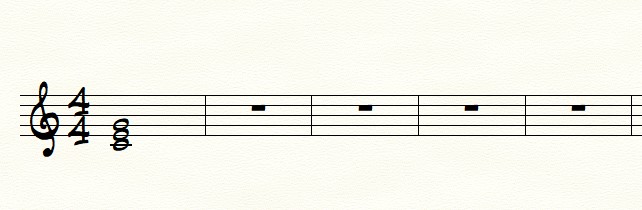
To do so, start off with any chord in mind:

Then, take a note from the preceding chord:

And make it the root of the following chord. (For this example, we are making it the root of the triad, but it can be any chord tone – even the seventh if you want to get experimental!)

Continue this process, and don’t be afraid to change up the chord qualities or adjust the inversions of the chords to best fit.

Thank you so much for taking the time to read! Feel free to comment, share, and subscribe for more daily tips below! Till next time.
How To Beat Writer’s Block – Tip #9

I have recently been doing a new daily activity where I would watch videos about the “inside tricks” to using a plugin or synth from my favorite DAW.

Once I got a general understanding of it, I would try to first mimic what the video was showing so that I could get a better grasp at the concepts. Then, I would go off on my own, using the momentum I got from becoming more proficient with the DAW’s tools since watching the video.

Conclusion being:

Sometimes, you may not know how to do something, and that could be the wall that is blocking you from creating that awesome piece of music you want to write. By doing research in a library, reading blogs, watching videos, or asking professionals, you gain more knowledge as well as confidence to take on your artistic pursuit!

Don’t ever be ashamed for not knowing; instead, be ashamed for not taking the steps to learn.

Use the momentum and excitement you gain when watching an instructional video to create your own – simply that!

Thank you so much for taking the time to read! Feel free to comment, share, and subscribe for more daily tips below! Till next time.

Improve Your Lyrics – Tip #6

If you have either the joy or pleasure of remembering your days in kindergarten (I don’t so much), you will probably recall the activity of “Show & Tell”

The idea is that you first show the class the really cool object that you have, and then you tell the story behind it.

Doing this in your lyrics when songwriting can help a lot!

While we may be tempted to “tell” first in our lyrics by coming strait out of the canon by saying how we feel, what happened, etc., but it is wiser to “show” first in order to enhance the depth of what you eventually will tell the audience.

So, in summation, use descriptive and creative imagery before hitting with you “punchline” of tell the audience what you are trying to get at.


Thank you so much for taking the time to read! Feel free to comment, share, and subscribe for more daily tips below! Till next time.

Teach Yourself Music Theory – 9.) Counting Rhythms in Simple Meter

You might have heard musicians joke about counting, one way or another. Saying that they only know how to count up to 4, or that counting is their life as they wait several measures before hitting a single note.

That brings us to today’s topic about music theory. While it is great that we can read a score and identify rhythms – how do we know what they sound like?

Let’s start off by looking at a piece of music in common time. The meter type is simple quadruple, so we know that beats are grouped into four within each measure.

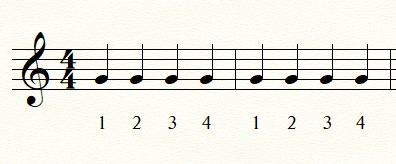
First, establish a tempo (speed) for your basic pulse/beat. Your beat will match that of the quarter-notes; just as a rule of thumb. Now, count the quarter-notes in a repeating “1, 2, 3, 4, 1, 2, 3, 4, 1, 2, 3, 4, 1…” pattern as shown below.

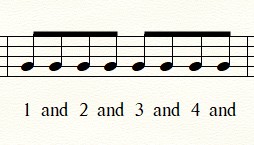
Great! Now let’s try eighth-notes at the same tempo. Remember that eighth-notes are shorter in value and are in-between the quarter-notes. Count these at “1, and, 2, and, 3, and, 4, and, 1…” just like the example below.

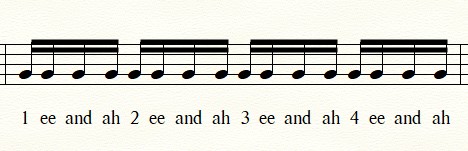
Sixteenth-notes are even shorter and will be counted as “1, ee, and, ah, 2, ee, and, ah, 3, ee, and, ah, 4, ee, and, ah, 1…” just like the example below, too.

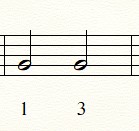
Now, what about notes longer than a quarter note? Essentially, you will hold the count of the longer note and omit saying the beats that occur during it. For example, a measure of two half-notes would count “1… 3…” while omitting counts on 2 and 4 because the notes are held over those beats.

Thank you so much for taking the time to read! Feel free to comment, share, and subscribe for more daily tips below! Till next time.

Tip #91 – Understanding the Kanakangi Scale

The Carnatic music of South India has 72 scales (melakartas) comprised of seven different notes in either an ascending (arohana) or descending (avarohana) fashion. These scales are used in a kind of India music called rāga and are extremely beautiful. In addition these scales are grouped into different chakras, based on certain similarities.

Today’s melakarta is the Kanakangi (meaning “golden bodied”) scale, the first scale from the first chakra.

Below is a representation of the scale as if it was put into Western notation:

Both the first (SA) and fifth (PA) scale degrees are in a placement normal to most scales found in Western music. However, the other scale degrees are lowered as well as clustered in chromatic runs. While this may sound dissonant or exotic, this scale gives a great amount of opportunity to play with tension and chromatic passing tones.

Try playing around with the scale, possible harmonies, and progressions!


Thank you so much for taking the time to read! Feel free to comment, share, and subscribe for more daily tips below! Till next time.
Tip #90 – Carousel-ing Harmonic Progressions

Sometimes, it seems that popular music stays with the same chord progression and all the radio-hits are born the same way. Times, you may feel like your harmonic progressions falls into the “norm” category.

One way to break free as well as find something new and exciting is to treat your progression like a carousel.

When looking at a carousel, you see the painted ponies chasing each other in a circle. But which pony is the first? Who is ahead of this race.

Point being taken here: nothing in a cyclical pattern can be defined as being “first” or “last,” so everything can be adjusted in framework to appear as first of last.

Now, let’s take this into practice. Take this common repeated progression below:

So, like the painted ponies on a carousel, let’s imagine that a different church of the cyclical progression is really the start. We would get possibilities from the original like this:

Out of one common chord progression, we have just created three new ones to experiment with and see how they can work with your song. Play around and see what else you can come up with!


Thank you so much for taking the time to read! Feel free to comment, share, and subscribe for more daily tips below! Till next time.
Tip #89 – Crafting Modal Interchange from a Tone Drone

Going back to an early topic of borrowed chords and altering a harmony by changing a chord quality to its parallel major/minor – here is another way on how to view it:

Say you have a melody that you want to craft around a single note drone. In this example, the tone used will be E.

So, E what?? E major? E minor? E Dorian mode? E Mixolydian mode?

Well… why not all give them a shot?

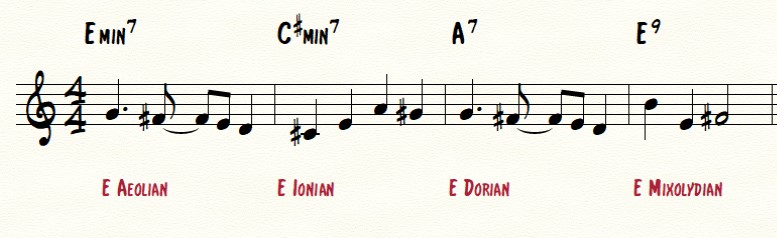
With keeping the tone drone constant in the harmonies (either as a chord tone or upper structure tension), try changing each section of the melody to be in a different mode. Below is the example with every measure changing to a different mode corresponding to E as the center tone.


Thank you so much for taking the time to read! Feel free to comment, share, and subscribe for more daily tips below! Till next time.
Improve Your Lyrics – Tip #5

Talking to some songwriters, some say that they want their lyrics to tell a story – to be almost cinematic. To be so descriptive that a person can easily understand the meaning of the song.

In the case where you want to make your lyrics absolute – meaning, without confusion as to what it is about – and story-like, don’t forget to add words to describe:

  • Who
  • What
  • When
  • Where
  • Why
  • How

We take these for granted, associating them with what your elementary literature teacher repeated nonstop. However, these points are critical when trying to convey an absolute story-like lyrics nature.

As you are revising your lyrics, look and see if you (or someone else) can easily tell the who, what, when, where, why, and how.


Thank you so much for taking the time to read! Feel free to comment, share, and subscribe for more daily tips below! Till next time.