Teach Yourself Music Theory – 25.) Modes of the Harmonic Minor Scale

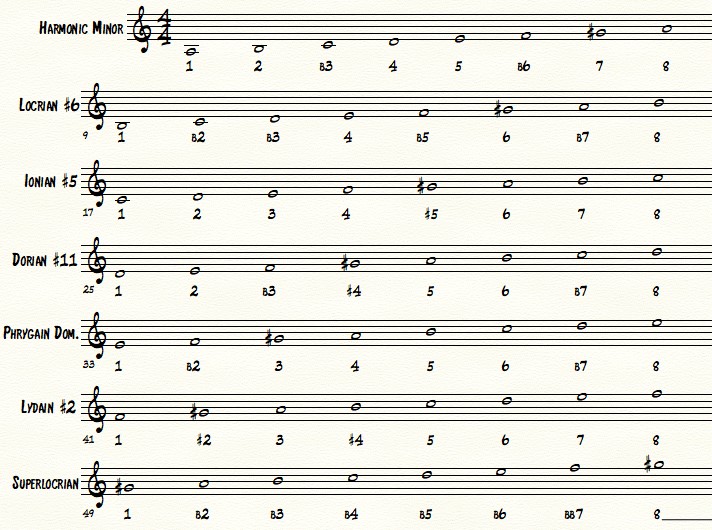
Not only are there modes built from the diatonic scales of Major and natural minor, but there are modes of the harmonic minor.


Similarly, they are constructed with the same pitch-class collections, but starting on different pitches and spanning an octave from there.


Below are the different modes and names built from the A harmonic minor scale in the key of C:


NOTE: these are the names I use for the modes. You will encounter multiple names for the same scale, so always be open to change.

Practice building the modes, playing them, and memorizing the names.

Thank you so much for taking the time to read! Feel free to comment, share, and subscribe for more daily tips below! Till next time.

Tip #190 – Understanding the Varunapriya Scale

The Carnatic music of South India has 72 scales (melakartas) comprised of seven different notes in either an ascending (arohana) or descending (avarohana) fashion. These scales are used in a kind of India music called rāga and are extremely beautiful. In addition these scales are grouped into different chakras, based on certain similarities.

Today’s melakarta is the Varunapriya scale (loosely meaning “the ocean’s wife”), the sixth scale from the fourth chakra.

Below is a representation of the scale as if it was put into Western notation:

Both the first (SA) and fifth (PA) scale degrees are in a placement normal to most scales found in Western music. In addition, it has both the sixth (DHA) and seventh (NI) scale degrees raised in a chromatic cluster.

Try playing around with the scale, possible harmonies, and progressions!

Thank you so much for taking the time to read! Feel free to comment, share, and subscribe for more daily tips below! Till next time.

Tip #189 – Adding Chromatics into your Scalar Line

By default, use any chromatics that are included in said scale that you are using (such as blues, bebop scale, etc.)

However, in the case that you are using any regular major, natural minor, or modal scale – here are some times and where and how to throw in chromatics:

Typically, chromatics between the notes of the scale are used as neighboring tones, passing tones, or enclosures.

That being said, in any job their focus in to bring emphasis the arrival note.

So, as you are using a chromatic line, or just inserting chromatic pitches into a scale, think about the following:

  • Are they going in the direction of the note that needs the most attention?
  • Is it used for enclosing/neighboring effect?
  • Does the chromatics sound sublime or out-of-nature to the key?

From this assessment, you can add the right chromatic notes to the line.

Thank you so much for taking the time to read! Feel free to comment, share, and subscribe for more daily tips below! Till next time.

Teach Yourself Music Theory – 24.) Diatonic Modes

Now, there are more scales in music than just the major, natural minor, harmonic minor, and melodic minor. In fact, I have came across a reference book that listed over 2,000 different scales. That being said, we are not going to cover all those (just yet), but we do want to cover a new way to look and build scales.


Modes are scales the encompass the same pitches as a key area, but are not technically our known major or natural minor. Their “tonic” and tonal sense of gravity is elsewhere away from the accepted tonic. Diatonic modes are ones constructed from the diatonic pitches of a key – we will go over this shortly.


There are 7 diatonic modes (6 to some people that do not include Locrian), with one scale built on each pitch of a key. Taking the key of C Major for example, here are the modes with their names:


Notice that each mode is a scale that travels an octave length in distance; basically C major scales starting on different pitches. However, they are all obvious different scales even though the contain the same pitch-class collection because of the intervals in the scale.

NOTE: the major scale is the Ionian Mode, and the natural minor scale is the Aeolian Mode.


To build a diatonic modal scale, you can do one of two things:


Say you wanted to build E Dorian. Dorian is the second mode – so, we know that Dorian comes from D Major, just keep the accidentals and start a scale on the second pitch. Or, you can memorize that Dorian is | 1 – 2 – b3 – 4 – 5 – 6 – b7 – 8 | and construct it from there.


Practice building the modes, playing them, and memorizing the names.

Thank you so much for taking the time to read! Feel free to comment, share, and subscribe for more daily tips below! Till next time.

Tip #186 – Understanding the Gaurimanohari Scale

The Carnatic music of South India has 72 scales (melakartas) comprised of seven different notes in either an ascending (arohana) or descending (avarohana) fashion. These scales are used in a kind of India music called rāga and are extremely beautiful. In addition these scales are grouped into different chakras, based on certain similarities.

Today’s melakarta is the Gaurimanohari scale (meaning “steals the heart”), the fifth scale from the fourth chakra.

Below is a representation of the scale as if it was put into Western notation:

Both the first (SA) and fifth (PA) scale degrees are in a placement normal to most scales found in Western music. In addition, it looks similar to a melodic minor scale.

Try playing around with the scale, possible harmonies, and progressions!

Thank you so much for taking the time to read! Feel free to comment, share, and subscribe for more daily tips below! Till next time.

Tip #182 – Understanding the Kharaharapriya Scale

The Carnatic music of South India has 72 scales (melakartas) comprised of seven different notes in either an ascending (arohana) or descending (avarohana) fashion. These scales are used in a kind of India music called rāga and are extremely beautiful. In addition these scales are grouped into different chakras, based on certain similarities.

Today’s melakarta is the Kharaharapriya scale (which has a rough translation of “to be blessed”), the fourth scale from the fourth chakra.

Below is a representation of the scale as if it was put into Western notation:

Both the first (SA) and fifth (PA) scale degrees are in a placement normal to most scales found in Western music. In addition, it looks similar to a Dorian scale.

Try playing around with the scale, possible harmonies, and progressions!

Thank you so much for taking the time to read! Feel free to comment, share, and subscribe for more daily tips below! Till next time.

Tip #179 – Understanding the Keeravani Scale

The Carnatic music of South India has 72 scales (melakartas) comprised of seven different notes in either an ascending (arohana) or descending (avarohana) fashion. These scales are used in a kind of India music called rāga and are extremely beautiful. In addition these scales are grouped into different chakras, based on certain similarities.

Today’s melakarta is the Kiravani scale (translating to “parrot voice”), the third scale from the fourth chakra.

Below is a representation of the scale as if it was put into Western notation:

Both the first (SA) and fifth (PA) scale degrees are in a placement normal to most scales found in Western music. In addition, it looks similar to a harmonic minor scale.

Try playing around with the scale, possible harmonies, and progressions!

Thank you so much for taking the time to read! Feel free to comment, share, and subscribe for more daily tips below! Till next time.

Tip #176 – Understanding the Natabhairavi Scale

The Carnatic music of South India has 72 scales (melakartas) comprised of seven different notes in either an ascending (arohana) or descending (avarohana) fashion. These scales are used in a kind of India music called rāga and are extremely beautiful. In addition these scales are grouped into different chakras, based on certain similarities.

Today’s melakarta is the Natabhairavi scale (which roughly translates to “skilled actor”), the second scale from the fourth chakra.

Below is a representation of the scale as if it was put into Western notation:

Both the first (SA) and fifth (PA) scale degrees are in a placement normal to most scales found in Western music. In addition, it looks similar to a natural minor scale.

Try playing around with the scale, possible harmonies, and progressions!

Thank you so much for taking the time to read! Feel free to comment, share, and subscribe for more daily tips below! Till next time.
Tip #172 – Understanding the Jhankaradhvani Scale

The Carnatic music of South India has 72 scales (melakartas) comprised of seven different notes in either an ascending (arohana) or descending (avarohana) fashion. These scales are used in a kind of India music called rāga and are extremely beautiful. In addition these scales are grouped into different chakras, based on certain similarities.

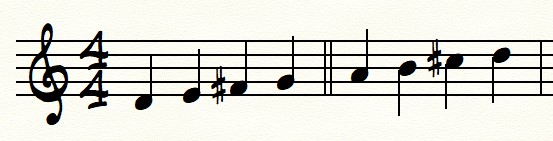
Today’s melakarta is the Jhankaradhvani (meaning “chiming sound”) scale, the first scale from the fourth chakra.

Below is a representation of the scale as if it was put into Western notation:

Both the first (SA) and fifth (PA) scale degrees are in a placement normal to most scales found in Western music. In addition, it looks similar to a minor scale, but with a lowered seventh degree (NI).

Try playing around with the scale, possible harmonies, and progressions!

Thank you so much for taking the time to read! Feel free to comment, share, and subscribe for more daily tips below! Till next time.

Teach Yourself Music Theory – 19.) Tetrachords and Pentachords

Okay, so we have learned a lot of scales so far. This can become confusing and jumbling trying to remember them all and how different they are from each other.

A way to remember is to break them apart into smaller pieces. This is so you can compare and contrast between the scales – essentially see what makes them similar and different.

We can break them up into different groups.

A tetrachord (tetra – meaning “four”) is not a chord, but a group of 4 consecutive notes.

Take a major scale for example and split it down the halfway. Compare the two different tetrachords:

You will see that they are formed of the same interval pattern of W-W-H (or M2-M2-m2). These are major tetrachords, because they are distinctive of the major scale.

Another way to break scales into smaller groups is into pentachords, groups of 5 consecutive notes.

Once again, this is to help understand and memorize the structure/functions of scales.

Thank you so much for taking the time to read! Feel free to comment, share, and subscribe for more daily tips below! Till next time.