Tip #74 – Harmonizing an Appoggiatura Over a Diminished Chord

In the very rare case that you will ever need to do such a thing, let’s dive in a take a look at the steps you would take to actually make a “good” 4-way close harmonization of a melody that exhibits an appoggiatura over a diminished chord.
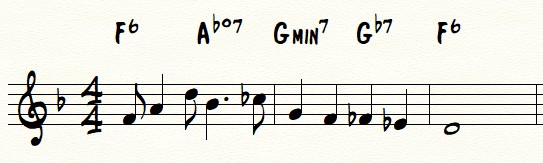
In the example above, we see that the Bb is an appoggiatura. It is a dissonance on a strong beat caused by a leap in one direction, and resolved in the opposite.

In four-part writing harmonization, the appoggiatura over the diminished chord will replace the next lowest chord member. It that case, the Bb‘s nearest close chord member from below is the Ab:
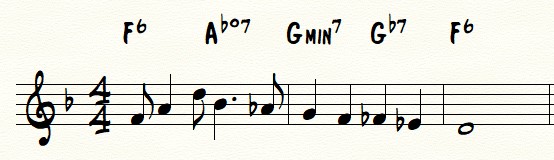
Also, take notice that it is a whole-step away, too. Next, you would harmonize using the tones of the Ab diminished chord, but omitting the Ab pitch.

From there, you can harmonize the rest of your passage in 4-way close, drop voicing, etc.


Thank you so much for taking the time to read! Feel free to comment, share, and subscribe for more daily tips below! Till next time.


Tip #73 – A Reminder for Subtle Influences

Over the past few months, I have detailed of aspects of certain genres and styles, from their unique scales to chord progressions, form, treatment of melody, motifs, rhythm, etc.

While you as the composer can certain take these bits of advice to compose something uniform – say, like in the style of an “authentic” delta blues song for example – there is nothing forcing you to.

You very much can Frankenstein your piece by having subtle influences to a composition, but not let it be overbearing. For example: your entire composition could be classical in nature, but have a blues based melody. A country song you are writing could have a Latin percussion beat in the backing rhythm for some spicy flavor. Or your next electronic club hit could sample some passages from Renaissance era vocal counterpoint.

Be creative, but keep in mind that a little goes a long way!


Thank you so much for taking the time to read! Feel free to comment, share, and subscribe for more daily tips below! Till next time.

Tip #72 – Adjusting Tempo

Today is going to be a short tip that might sound obvious, but could be the helpful reminder in your compositional processes.

Before sending a score to print, exporting stems, or formatting a sound file of your composition – play around with the tempo.

You might be thinking about this and go: “that’s stupid.” However, you might be able to find a new and interesting feel for your composition just by increasing/decreasing the bpm by a noticeable amount of notches.

If you are making demos of songs that fit I the EDM style, you can make multiple copies of your song in different tempi to get a variety to consider before an official release.


Thank you so much for taking the time to read! Feel free to comment, share, and subscribe for more daily tips below! Till next time.

Tip #70 – Crafting with Asymmetrical Timelined Phrases

Take a look at the example below and figure out of there are any patterns:

You may have noticed that the middle staff if a 2-bar phrase that is repeated over and over again. Also, you may have realized that the staff at the bottom is a 1-bar figure played like an ostinato.

Everything looks even enough in the typical grouping you would expect for any composition until we look at the top staff. Surprisingly, it is at 5-bar phrase that doesn’t match-up as neatly as the other grouping.

These different lengths of repeated phrases within a structure create an asymmetric timeline for when everything will repeat and land back in sync.

Experiment with different phrase lengths that don’t match exactly with one another. Also, you can use some cool phasing techniques to develop lines!


Thank you so much for taking the time to read! Feel free to comment, share, and subscribe for more daily tips below! Till next time.

Tip #69 – Interpolation of Quotes

From music of the Renaissance era, to the prime-time of jazz, and all the way to now in present-day, musicians have been using other famous works as “quotes” within their music.

Obviously, one does run into the problem of plagiarism or lack of originality depending on how the quote is used. Using music in the public domain is a safe way to get around the act of plagiarism, and your own creativity will solve the remaining problem.

The main goal of quoting a well-known theme embedded into your piece is to reinvent it. in some way, shape, or form. People have taken a theme and used it as a cantus firmus, bass-line, fragmented motif, etc. before. If you are expecting to use it as a primary melodic idea, here is a checklist of tips:

  • Context – Is the theme “well-known” for your intended audience? Does it fit the composition (thematically, harmonically, melodically, motifically, fluidly)? Can the quote be paraphrased in some way? How about restated?
  • Reconfiguration – Will you be able to adjust the pitches and rhythms without losing the premise of the quote? Can the quote be developed into later themes used? What about broken fragments?
  • Inflection – what emotional, symbolic, ironic, personal, or associative meaning does this new and reworked quote provide to your composition? Is it worth it?


Thank you so much for taking the time to read! Feel free to comment, share, and subscribe for more daily tips below! Till next time.


Tip #67 – Dead Thumb Influences in Part Writing

In the past I have been very vocal about many things; in particular, advising that people should not write music to their own performance ability.  I caution against this because it places creativity in a limited space, it doesn’t challenge the composer/performer to grow, and it boarders the high probability of regurgitation of common predictable themes.

That being said (in all irony), I will be talking about taking influence from different blues fingerstyles of guitar playing to inspire part writing for compositional purposes.  While this will limit the compositional ability as to what can be done using the physical limitations of the described guitar style, I do encourage people who are reading this to “think outside the box” and experiment to how these style can transverse over into new creative applications.

Today, I will be talking about the “dead thumb” playing of blues music that is predominantly found in the Texas and deep Southern areas of the United States.

Dead thumb may seem boring, but it provides the important drone of the tonic found in blues music.  Basically, it is hitting the root (and only the root) every beat, or in the swing rhythm.  Occasionally, there might be a pattern of alternating between the power chord and M6 voicing of the root.

In this tip, imagine yourself playing in that style and understand what is physically possible as well as typically normal.  Mentally practice this, and then write/play/annotate/record it.

Remember, always be creative above everything else.  While keeping to rules and limitation can help focus on certain aspects on your composition, never go for less than what you are capable of.


Thank you so much for taking the time to read! Feel free to comment, share, and subscribe for more daily tips below! Till next time.

Tip #66 – Utility Thumb Influences in Part Writing

In the past I have been very vocal about many things; in particular, advising that people should not write music to their own performance ability.  I caution against this because it places creativity in a limited space, it doesn’t challenge the composer/performer to grow, and it boarders the high probability of regurgitation of common predictable themes.

That being said (in all irony), I will be talking about taking influence from different blues fingerstyles of guitar playing to inspire part writing for compositional purposes.  While this will limit the compositional ability as to what can be done using the physical limitations of the described guitar style, I do encourage people who are reading this to “think outside the box” and experiment to how these style can transverse over into new creative applications.

Today, I will be talking about the “utility thumb” playing of blues music that is predominantly found in the Delta area of the United States.

Utility thumb means that the bass note, provided by the thumb hitting the lowest note of the harmony on the guitar, is done on occasion.  It is approximately needed at least once a measure, and usually hits on an offbeat.  So, it is very reserved and only played when needed.

In this tip, imagine yourself playing in that style and understand what is physically possible as well as typically normal.  Mentally practice this, and then write/play/annotate/record it.

Remember, always be creative above everything else.  While keeping to rules and limitation can help focus on certain aspects on your composition, never go for less than what you are capable of.


Thank you so much for taking the time to read! Feel free to comment, share, and subscribe for more daily tips below! Till next time.

Tip #65 – Alternating Thumb Influences in Part Writing

In the past I have been very vocal about many things; in particular, advising that people should not write music to their own performance ability.  I caution against this because it places creativity in a limited space, it doesn’t challenge the composer/performer to grow, and it boarders the high probability of regurgitation of common predictable themes.

That being said (in all irony), I will be talking about taking influence from different blues fingerstyles of guitar playing to inspire part writing for compositional purposes.  While this will limit the compositional ability as to what can be done using the physical limitations of the described guitar style, I do encourage people who are reading this to “think outside the box” and experiment to how these style can transverse over into new creative applications.

Today, I will be talking about the “alternating thumb” playing of blues music that is predominantly found in the “Piedmont” area of the United States (east of Appalachian Mountains).

Alternating thumb is pretty much as the name goes.  The thumb alternates playing different bass notes on the guitar (usually in a pattern from low to high) while the index and middle finger play syncopated lines in the treble area.  This occurs on every primary beat, or in a “slower” equivalent of every other beat.  Counterpoint can be made with the division between what the bass is playing and what the other fingers are.  Plus, the thumb can alternate with the fingers to form a conjunct melodic line in moving motion to another harmony.

In this tip, imagine yourself playing in that style and understand what is physically possible as well as typically normal.  Mentally practice this, and then write/play/annotate/record it.

Remember, always be creative above everything else.  While keeping to rules and limitation can help focus on certain aspects on your composition, never go for less than what you are capable of.


Thank you so much for taking the time to read! Feel free to comment, share, and subscribe for more daily tips below! Till next time.
Tip #64 – Natural Influences from the Harmonic Series

Sometimes, musical influence can come from nature, natural phenomenon, events, science, math, etc.

How about basing a piece, a scale, a harmonic progression… whatever you can think of, around the Harmonic Series of overtones.

The harmonic series comes from the production of sounded overtones which each fractional division of a vibrating string’s wavelength. It is an infinitely divergent series of wavelengths, pitches, and corresponding notes produced. Below is a small account of the first 12 overtones:

It should be noted that mathematically, some of the overtones do not fit exactly to what is should be in the tempered 12-tone system of Western notation. Those with extreme and noticeable deviations from the Western “norm” have been marked with a downwards-arrow symbol above the designated pitch of interest.

Regardless, one could take this phenomenon and use it as a scale, the underlining harmony to a progression, a start to a 12-tone row, etc. Be creative and have fun with it!


Thank you so much for taking the time to read! Feel free to comment, share, and subscribe for more daily tips below! Till next time.

Tip #63 – Taking Influence from Kwela Music

What is Kwela music?

It is pennywhistle-based folk music played in the streets of South Africa, playing decorated jazzy/blues-y melodic lines over a cyclical harmonic progression.

The name, “Kwela” has nothing to do with any music aspect. In fact, it is a verb from the Isizulu and African Bantu languages meaning “to climb.” Prior to this become an established music genre, it was used as jargon and also as code among kids to warn when the police was coming by. If they couldn’t hide, they would act innocent by taking out their pennywhistles and playing this lively skiffle music.

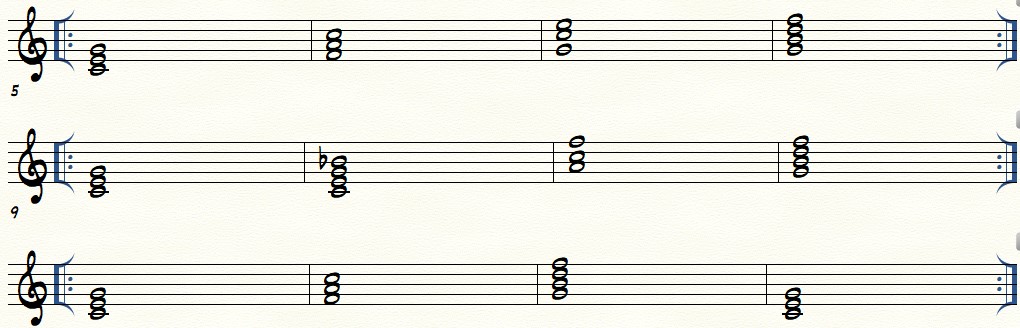
While the melody was improvised using select pitches from the blues scale, the harmonic progression was always a recurring variation of one of these three:

Play around with these chord progressions by having yourself record or use a DAW to playback as you improves a melody line over it.

Historically, these progressions then influenced the blues because so many South Africans had their ears tuned to the Kwela music harmonic predictability. Thus, the common 12-bar blues were adapted into these variations:

Once again, play around with these progressions to feel where and how the harmonic forces are different from the “original.”


Thank you so much for taking the time to read! Feel free to comment, share, and subscribe for more daily tips below! Till next time.