Tip #194 – Understanding the Mararanjani Scale

The Carnatic music of South India has 72 scales (melakartas) comprised of seven different notes in either an ascending (arohana) or descending (avarohana) fashion. These scales are used in a kind of India music called rāga and are extremely beautiful. In addition these scales are grouped into different chakras, based on certain similarities.

Today’s melakarta is the Mararanjani scale (roughly translating to “killing”), the first scale from the fifth chakra.

Below is a representation of the scale as if it was put into Western notation:

Both the first (SA) and fifth (PA) scale degrees are in a placement normal to most scales found in Western music. In addition, it contains the major tetrachord in the beginning.  With that, there is the lowered seventh degree (NI).

Try playing around with the scale, possible harmonies, and progressions!

Thank you so much for taking the time to read! Feel free to comment, share, and subscribe for more daily tips below! Till next time.
Teach Yourself Music Theory – 26.) Modes of the Melodic Minor Scale

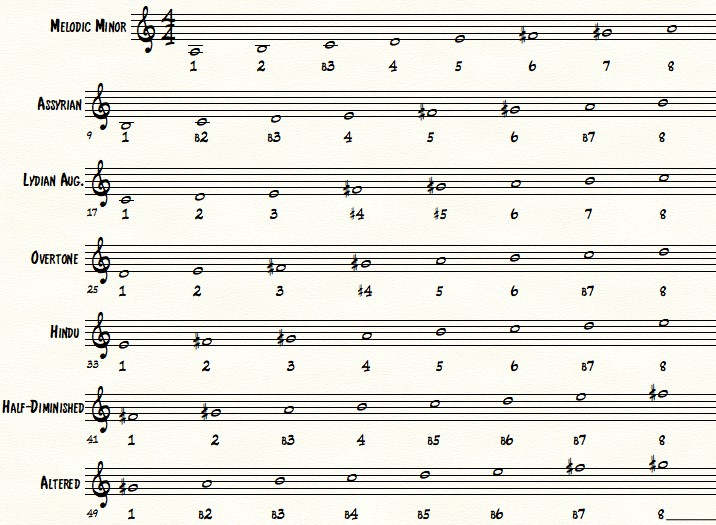
Not only are there modes built from the diatonic scales of Major and natural minor, but there are modes of the melodic minor, too.


Similarly, they are constructed with the same pitch-class collections, but starting on different pitches and spanning an octave from there.


Below are the different modes and names built from the A melodic minor scale in the key of C:


NOTE:
these are the names I use for the modes. You will encounter multiple names for the same scale, so always be open to change.

Further NOTE: it should be a b6 in the Hindu Scale, my apologies.


Practice building the modes, playing them, and memorizing the names.

Thank you so much for taking the time to read! Feel free to comment, share, and subscribe for more daily tips below! Till next time.
Tip #193 – Using Lightness of a Scale

You might have heard the term the “brightness” or “darkness” of a scale/mode. Typically they are referring to how scales/modes containing a lot of sharp or raised scale degrees from the tonic are referred to as “bright” while those that have flattened scale degrees from the tonic are “dark”.

This is not to say that flat keys are “dark.” We are saying that the intervals that make up the scale that are flattened in comparison to the major scale tend to be more “dark” in tonality.

Can you change a scale to make it more “bright” or “dark?”

Essentially yes by either raising or lowering pitches in the scale (usually done in a circle of fifths pattern of selecting which pitch to alter).

This is good to keep in mind as you are writing and trying to find the right emotion and color to express your musical ideas. That might mean using an unconventional sale/mode or building one from scratch.

Thank you so much for taking the time to read! Feel free to comment, share, and subscribe for more daily tips below! Till next time.

Tip #192 – Understanding a Cliché Blues Ending

While it might be wise to avoid clichés, you can certainly learn a lot from them. Musical clichés are what helps group the idioms of certain genres/styles together. Trying to emulate a particular style might mean using a musical cliché – but adding your own unique twist.

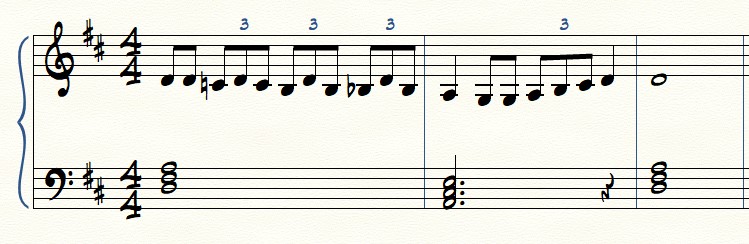
Take for example this bluesy melodic ending over a I7 – V7 – I progression:

Let’s dissect into this.

One thing that pops out in an instance is the use of a chromatic line against the upper tonic drone that leads down towards the fifth of the V chord.

Try that for yourself. Build a chromatic line that alternates in pitch between a drone. Now, lead the chromatic line toward the next chord, and after that to the following chord. Listen to how the contour and dissonances shape the forward moving motion towards a cadence.

Thank you so much for taking the time to read! Feel free to comment, share, and subscribe for more daily tips below! Till next time.

Teach Yourself Music Theory – 25.) Modes of the Harmonic Minor Scale

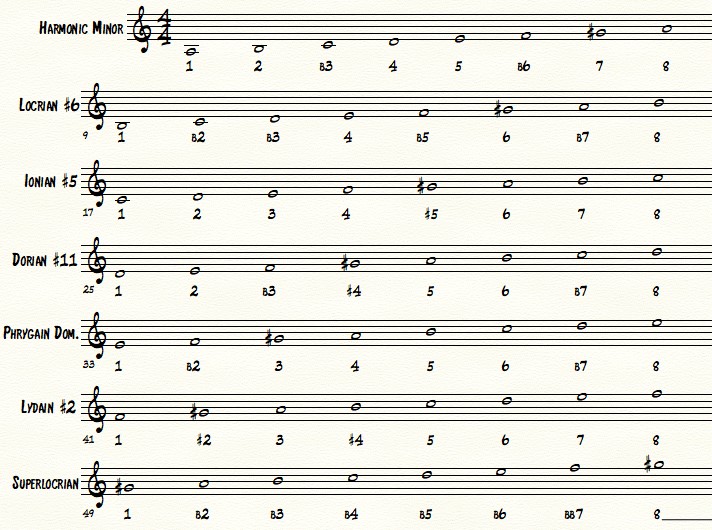
Not only are there modes built from the diatonic scales of Major and natural minor, but there are modes of the harmonic minor.


Similarly, they are constructed with the same pitch-class collections, but starting on different pitches and spanning an octave from there.


Below are the different modes and names built from the A harmonic minor scale in the key of C:


NOTE: these are the names I use for the modes. You will encounter multiple names for the same scale, so always be open to change.

Practice building the modes, playing them, and memorizing the names.

Thank you so much for taking the time to read! Feel free to comment, share, and subscribe for more daily tips below! Till next time.

Tip #191 – Changing the Tools

Percussion is usually played with a stick/mallet/beater. Guitars are usually played with a pick. Violins are usually played by bows. Etcetera, etcetera.

You don’t actually have to limit yourself to this.

When you are performing, recording, or writing notes into your score for the performers – you can change things up.

Think of all the times Eddie Van Halen used a drill on his guitar strings. Or the many times classical composers have used a prepared piano. Violins playing with the back of their bows or with pencils. Using a glass bottle or slider.

Be creative and play around with how you can achieve the sound you imagine with unconventional tools.

Thank you so much for taking the time to read! Feel free to comment, share, and subscribe for more daily tips below! Till next time.

Tip #190 – Understanding the Varunapriya Scale

The Carnatic music of South India has 72 scales (melakartas) comprised of seven different notes in either an ascending (arohana) or descending (avarohana) fashion. These scales are used in a kind of India music called rāga and are extremely beautiful. In addition these scales are grouped into different chakras, based on certain similarities.

Today’s melakarta is the Varunapriya scale (loosely meaning “the ocean’s wife”), the sixth scale from the fourth chakra.

Below is a representation of the scale as if it was put into Western notation:

Both the first (SA) and fifth (PA) scale degrees are in a placement normal to most scales found in Western music. In addition, it has both the sixth (DHA) and seventh (NI) scale degrees raised in a chromatic cluster.

Try playing around with the scale, possible harmonies, and progressions!

Thank you so much for taking the time to read! Feel free to comment, share, and subscribe for more daily tips below! Till next time.

Tip #189 – Adding Chromatics into your Scalar Line

By default, use any chromatics that are included in said scale that you are using (such as blues, bebop scale, etc.)

However, in the case that you are using any regular major, natural minor, or modal scale – here are some times and where and how to throw in chromatics:

Typically, chromatics between the notes of the scale are used as neighboring tones, passing tones, or enclosures.

That being said, in any job their focus in to bring emphasis the arrival note.

So, as you are using a chromatic line, or just inserting chromatic pitches into a scale, think about the following:

  • Are they going in the direction of the note that needs the most attention?
  • Is it used for enclosing/neighboring effect?
  • Does the chromatics sound sublime or out-of-nature to the key?

From this assessment, you can add the right chromatic notes to the line.

Thank you so much for taking the time to read! Feel free to comment, share, and subscribe for more daily tips below! Till next time.

Tip #188 – Doubling a Pitch on a Single Instrument

For most instruments, you can only play one note at a time. Hence, being a melodic instrument. Others, like keyboard instruments allow you to play two or more notes at the same time. However, they must be different pitches as keyboard instruments have one key for each respective pitch.

Guitars on the other hand have the ability to play two of the same pitch at the same time. For example, the open high E string can be played with the B string fretted at the 5th fret – producing an E in the same octave as well.

While they be noted the same, they will slightly differ by a few frequencies in pitch causing an interesting harmony.

Consider this as you are writing for instruments like the guitar where you are able to double the same pitch using different strings.

Thank you so much for taking the time to read! Feel free to comment, share, and subscribe for more daily tips below! Till next time.

Teach Yourself Music Theory – 24.) Diatonic Modes

Now, there are more scales in music than just the major, natural minor, harmonic minor, and melodic minor. In fact, I have came across a reference book that listed over 2,000 different scales. That being said, we are not going to cover all those (just yet), but we do want to cover a new way to look and build scales.


Modes are scales the encompass the same pitches as a key area, but are not technically our known major or natural minor. Their “tonic” and tonal sense of gravity is elsewhere away from the accepted tonic. Diatonic modes are ones constructed from the diatonic pitches of a key – we will go over this shortly.


There are 7 diatonic modes (6 to some people that do not include Locrian), with one scale built on each pitch of a key. Taking the key of C Major for example, here are the modes with their names:


Notice that each mode is a scale that travels an octave length in distance; basically C major scales starting on different pitches. However, they are all obvious different scales even though the contain the same pitch-class collection because of the intervals in the scale.

NOTE: the major scale is the Ionian Mode, and the natural minor scale is the Aeolian Mode.


To build a diatonic modal scale, you can do one of two things:


Say you wanted to build E Dorian. Dorian is the second mode – so, we know that Dorian comes from D Major, just keep the accidentals and start a scale on the second pitch. Or, you can memorize that Dorian is | 1 – 2 – b3 – 4 – 5 – 6 – b7 – 8 | and construct it from there.


Practice building the modes, playing them, and memorizing the names.

Thank you so much for taking the time to read! Feel free to comment, share, and subscribe for more daily tips below! Till next time.