Tip #90 – Carousel-ing Harmonic Progressions

Sometimes, it seems that popular music stays with the same chord progression and all the radio-hits are born the same way. Times, you may feel like your harmonic progressions falls into the “norm” category.

One way to break free as well as find something new and exciting is to treat your progression like a carousel.

When looking at a carousel, you see the painted ponies chasing each other in a circle. But which pony is the first? Who is ahead of this race.

Point being taken here: nothing in a cyclical pattern can be defined as being “first” or “last,” so everything can be adjusted in framework to appear as first of last.

Now, let’s take this into practice. Take this common repeated progression below:

So, like the painted ponies on a carousel, let’s imagine that a different church of the cyclical progression is really the start. We would get possibilities from the original like this:

Out of one common chord progression, we have just created three new ones to experiment with and see how they can work with your song. Play around and see what else you can come up with!


Thank you so much for taking the time to read! Feel free to comment, share, and subscribe for more daily tips below! Till next time.
Tip #89 – Crafting Modal Interchange from a Tone Drone

Going back to an early topic of borrowed chords and altering a harmony by changing a chord quality to its parallel major/minor – here is another way on how to view it:

Say you have a melody that you want to craft around a single note drone. In this example, the tone used will be E.

So, E what?? E major? E minor? E Dorian mode? E Mixolydian mode?

Well… why not all give them a shot?

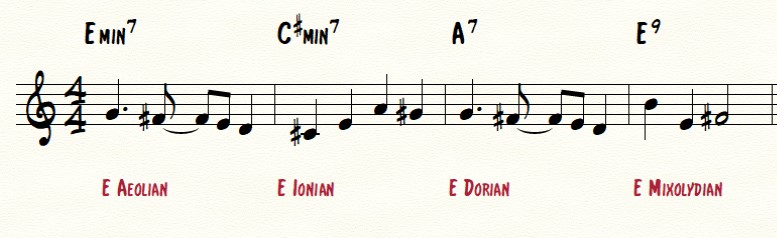
With keeping the tone drone constant in the harmonies (either as a chord tone or upper structure tension), try changing each section of the melody to be in a different mode. Below is the example with every measure changing to a different mode corresponding to E as the center tone.


Thank you so much for taking the time to read! Feel free to comment, share, and subscribe for more daily tips below! Till next time.

Tip #88 – Breaking a Chord Rhythmically

Say you have a chord and a really good voicing too for a measure. It sounds great… but it is lacking a sense of motion that you desire.

Without disrupting the harmony, how do you accomplish it?

One way is by breaking apart the chord so that each of the chord members sound at different times within a period of length. You see this already in stuff like “boom-chuck” guitar accompaniment, Travis picking, arpeggiating, etc.

Besides breaking it apart, try to come up with a pattern as well for it. Below is a common pattern found in ragtime music used to break-apart a chord:

Notice that there are a few arpeggiations of single notes, and broken parts of group chords as well.


Thank you so much for taking the time to read! Feel free to comment, share, and subscribe for more daily tips below! Till next time.
Tip #85 – Basic Cheat Sheet to Jazz Style Harmonic Substitution

“It’s just a ii-V-I”

I heard that phrase a lot whenever I took a class in jazz or played with a jazz group. And rightfully so, as there are a lot of ii-V-I chord progressions found in jazz standards.

That being said, would jazz music get boring over time if it uses this progression over and over again? Maybe “predictable” is a better word, but the great jazz composer’s & arrangers new how to use harmonic substitutions to create interesting progressions that still resembled the original.

In the famous ii-V-I progression, the ii is the pre-dominant area. The V is the dominant area. And that leads into the I that is the tonic area.

A crash course in harmonic substitutions:

The I tonic chord can be replaced by bIII , III , IV , bVI , and VI since they all share a common tone on the tonic scale degree. In addition, minor and diminished versions of the I chord can work as well.

As for the dominant chord, they can be replaced by the dominant or major chord versions of the bII harmony. Also, they can be the dominants or tritone substitutes of the tonic area’s substitutions acting on the original.

Pre-dominant areas are more open, being the ii, iv, and tritone substitute in relation to the dominant area harmony.

Below is a compromised (but still relatively large) sheet of various combinations of the harmonic substitutions mentioned above with a few extras, based in a starting key of C:


Thank you so much for taking the time to read! Feel free to comment, share, and subscribe for more daily tips below! Till next time.
Tip #84 – New Paths with Multiple Harmonic Functions

You can probably recall a bunch of stories, television shows, movies, etc. where some character is on a journey. And on that journey, they come across a fork in the road that seems to lead into multiple directions. That one spot the character is in – the center of it all – branches into different pathways on where to go.

The same thing appears in music, as chords have multiple functions and various chord quality overlaps in different keys.

For example: If I play a C major triad chord, what would come next? Or better question; what key are we in? Because, a C major triad appears in multiple keys – all with different harmonic functions.

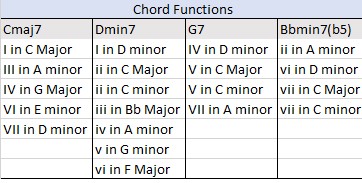
Below is a “cheat-sheet” of common chords found in music and the possible diatonic harmonic functions found in various keys:

Experiment, and see where it leads you to!


Thank you so much for taking the time to read! Feel free to comment, share, and subscribe for more daily tips below! Till next time.
Tip #82 – Pros of Stagnant Harmony

This will be a short & sweet tip for today; but nonetheless, an effective tip.

Composition does not always have to be about finding original harmonic progressions and innovative uses of harmony. Are they good things to do every now and then? Yes, but it is not the end-all-be-all of writing music.

Remember, using stagnant harmony (say, like a piece just using one chord) is a fair option when composing.

By writing music according to a single harmony – it allows you the composer to explore the other variable aspects of music, such as rhythms, phrasing, performance, melodic movement, lyrics, etc.

Also, it is an effective technique to convey certain emotions as well! So don’t be afraid of trying it every now and then.


Thank you so much for taking the time to read! Feel free to comment, share, and subscribe for more daily tips below! Till next time.

Tip #79 – Cheat-Sheet to Movable Inner Voices under a Stagnant Melody

This long title may seem intimidating as to what I’m going to explain – but it is some common sense that you were probably aware of.

Say you have a composition with a beautiful legato melody and lush harmonies to accompany it. However, it lacks in motion and you feel that some of the inner voices need to move. At the same time, you don’t want to take away focus from the melody or change the harmony too much.

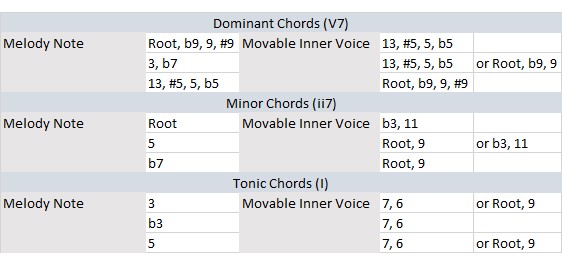
Below, I have provided a cheat-sheet on inner voice movement possibilities:

To read and assess this, first find what chord quality you have. Then, determine from your composition what is your melody note in relationship to the chord harmony. That will be on the left-hand side of the cheat-sheet. From there, look horizontally across to see the advised subtle inner voices that can be moved chromatically or diatonically.

Play around and see what best fits your musical work.


Thank you so much for taking the time to read! Feel free to comment, share, and subscribe for more daily tips below! Till next time.

Tip #78 – Trying Some Chromatic Approach in Harmonization

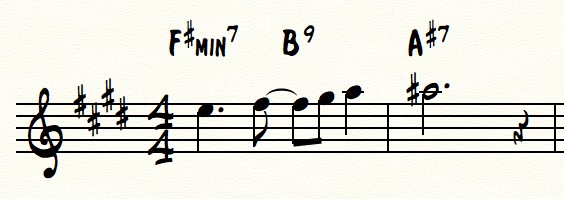
How would you harmonize the melody below?:

It can most certainly be done it a multitude of ways, but for today’s tip, let’s talk about using 4-way close harmonization. That would look like as such for the chord tones:

However, we have one note left out. The non-chord tone in a passing motion.

Because this non-chord tone is approaching the next note (which is a chord tone) by a half-step, we can consider using a chromatic approach technique to the harmonization.

Simply, have the entire harmonization be an approach by half-step to the landing chord tones. It would look like as such:

Sure, this may go against some principles of avoiding parallel harmony, but…

  1. It sounds good.
  2. You are the composer; so do what YOU want


Thank you so much for taking the time to read! Feel free to comment, share, and subscribe for more daily tips below! Till next time.

Tip #77 – Borrowing Chords from Parallel Keys

Take a look at this diatonic progression and harmony below:

How can we spice this up a bit and make it more interesting?

One way is by borrowing chords from its parallel major or minor key. Simply, if it is a major triad – make it a minor. And vice versa.

Note: it doesn’t have to be done to every chord. Be tasteful about where you want to add a borrowed chord. Also, in some cases too, you might need to alter the melody to fit more in-tune with the harmony around it.


Thank you so much for taking the time to read! Feel free to comment, share, and subscribe for more daily tips below! Till next time.

Tip #75 – Doing Some Diatonic Harmonization on Passing Tones

For the instance that you want to harmonize a non-harmonic passing tone in a jazz/commercial style 4-way close, here is a tip for you:

Using a process of diatonic harmonization, you can make some smooth and boldly beautiful harmonized lines without interfering with the harmonic make-up, or relying on dissonance.

First, analyze the passage. Does the non-harmonic passing tone occur between two chord tones? It should.

Next, analyze the harmony. Is the melody taking place over an acting I, ii, or V chord?

If so, harmonize the chord tones properly with the passing tone remaining.

To harmonize the passing tone, choose from one of the remaining chords (I, ii, or V) and do so. Meaning, if it was a I chord, harmonize the passing tone with a ii or V. If it was a ii chord, harmonize the passing tone with a I or V chord. And if it was a V chord, harmonize the passing tone with a I (more common) or a ii (rare).

Below are some examples with some rough and basic harmonization:


Thank you so much for taking the time to read! Feel free to comment, share, and subscribe for more daily tips below! Till next time.