Tip #109 – Key Change with Chromaticism

In the past, we have talked about using a key change by transposing an entire section of the song by an interval. This interval can usually range from a m2 to a m3.

Today we will go more in-depth with the similar idea of using chromaticism to create a key change.

Study the example below:

As we get to the V chord of the composition, we get a pull back to the tonic. However, that pull is “redirected” an is instead used in a chromatic pull towards a new chord outside of the original key – that also become the new tonic as well.

So for today’s tip, experiment with the resolving tendencies of the V chord and how with chromatic motion a composition can get to a new key.

Thank you so much for taking the time to read! Feel free to comment, share, and subscribe for more daily tips below! Till next time.


Tip #108 – Innate Pulls of Dominant Modulations

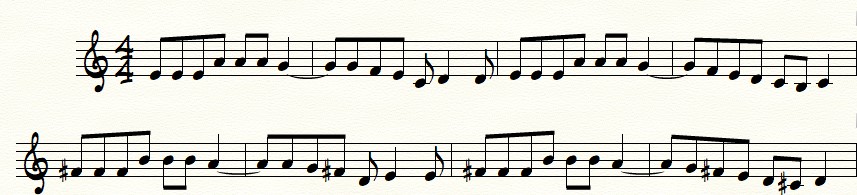
Take a look at the melody below and analyze it the best you can:

Notice how the melody seems to be for the most part centered in an E Mixolydian mode.

However, you have those two measures highlighted in blue that hint at a temporary modulation to B Mixolydian. Then, it returns back to E Mixolydian.

If you play this melody, the transition works so smoothly. Why?

Well, think about the B Mixolydian mode. The mode itself is built around a B7 chord. In common music theory practice, the B7 chord will resolve (typically) to a chord with a root in E.

Thus, that is why the modulation from B Mixolydian is smooth, because it has the innate pull to resolve back to a centered tone of E anyways.

So, for this tip’s overall lesson: when using temporary modulations, consider the resolution of the scale/mode as well as the chords built on it for a seamless transition.

Thank you so much for taking the time to read! Feel free to comment, share, and subscribe for more daily tips below! Till next time.
Tip #107 – Dominant Chords Resolving Onto Themselves

I noticed this interesting chord progression idea in some heavy metal riffs.

Usually, a V chord resolves to I – that is something we know happens commonly in music.

However, for today’s tip, we will talk about how the dominant chord can resolve to a minor chord version of itself, containing the same root.

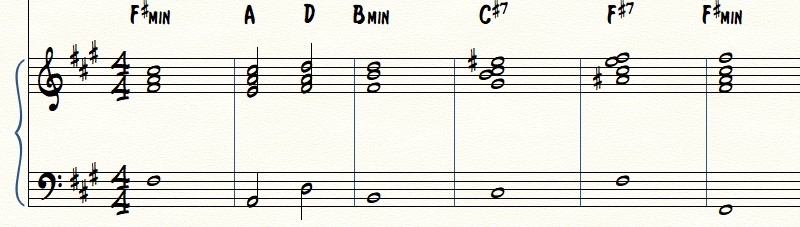
Observe the progression below:

Notice how we set up for a cadence in F# minor with the C#7 chord. However, it resolves to a F#7 chord. We think that we have possibly modulated to B Major/minor, or started a circle of fifths progression – but no! Instead, the F#7 chord resolves to a F# minor triad.

With good voice leading, this can work very smoothly. Most of the chord notes are kept the same – only difference being the change from the major third to a minor third, which is just a half-step.

This creates a “deceptive” resolution (and I use this term loosely because there is already a term for a “deceptive cadence”) while smoothly creating momentum back to the minor tonic area**.

**Note, this progression only works if the tonic is in minor.

Thank you so much for taking the time to read! Feel free to comment, share, and subscribe for more daily tips below! Till next time.
Tip #105 – Weird Minor Chord Substitution

Here is another fun/interesting/odd/useful tip I learned from a professor:

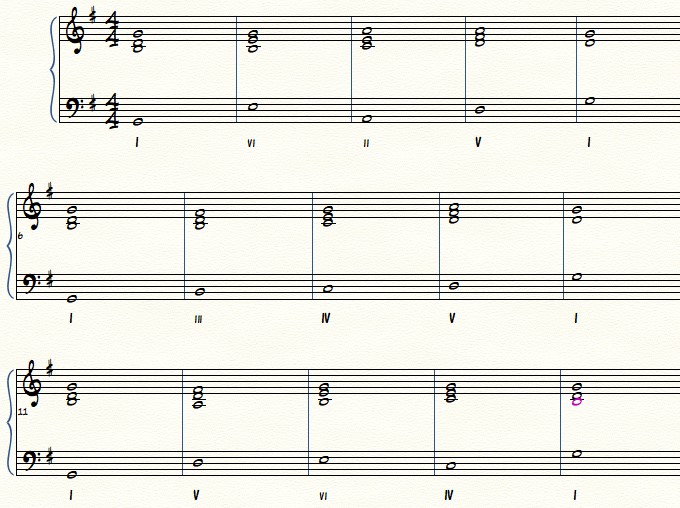
Say you have these chord progressions below:

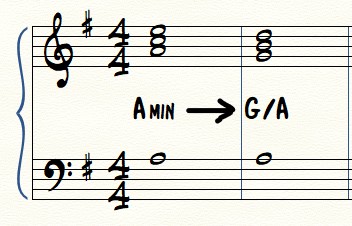
What you can do for minor chords acting as a ii, iii, or vi chord in the progression is replace them as a major chord one whole-step below while keeping the bass. So, the substitution would look like such:

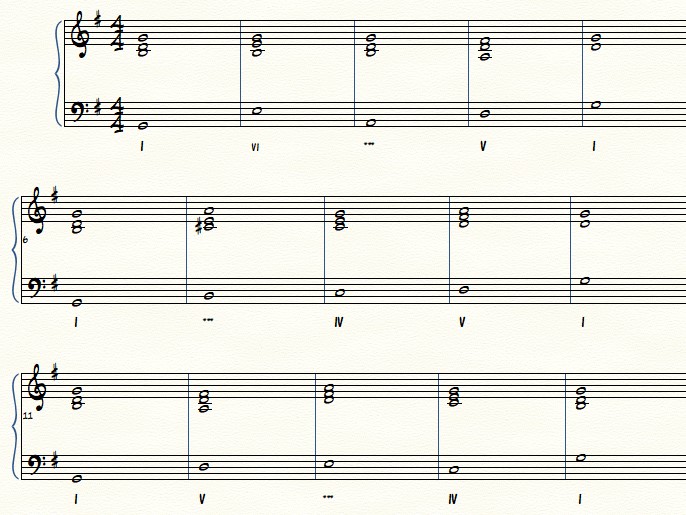
Now, if we were to alter the progression from before – changing the minor chords functioning as a ii, iii, or vi – we would get these new progressions:

Some of them sound odd and funky. Personally, I preferably like the ii substitution better than iii and vi, but that is just my opinion. Feel free to try it yourself and see if it expands your harmonic pallet.

Thank you so much for taking the time to read! Feel free to comment, share, and subscribe for more daily tips below! Till next time.
Tip #104 – Negative Harmony Reflection Over Tritone

This is the second part to the concept introduced the other day about using the idea of negative harmony, but reflecting it over a different way.

In a certain key (major in this case), you will have a tritone distance between the seventh and fourth scale degrees.

By locating the middle focal-point of the tritone (which will be the second scale degree of the major scale), you can use that as a point of reflection for a new kind of negative harmony.

So, as you can see chromatically, the second scale degree fits perfectly in between the raised seventh degree and fourth degree (assuming we are in the C major key):

Using that pitch as the centered point of reflection, we use this pattern as a way to create an alternative negative harmony:

Thank you so much for taking the time to read! Feel free to comment, share, and subscribe for more daily tips below! Till next time.
Tip #103 – Negative Harmony Reflection Over Tonic

Back in the winter, I was told by a professor a different way of doing negative harmony – an alternative, one could say.

In the past, I have talk about the use and understanding of negative harmony, so be sure to read-up on it before diving into this new technique.

Anyways, my proposed two different ideas of this alternative to negative harmony by reflecting pitches over different point of the key/scale/pitch collection.

The first method was to reflect on the tonic. So in a C major key, we have the diatonic and chromatic notes of:

By reflecting the tonic onto itself, we get a formula like this:

Now, we can substitute original pitches in a harmony for new ones to get an negative harmony alternative approach.

Thank you so much for taking the time to read! Feel free to comment, share, and subscribe for more daily tips below! Till next time.

Tip #101 – Weird Third Interval Substitution

This is an odd tip I received from a professor on a way to do chord substitutions.

First, it involves taking a composed progression. Like this one below:

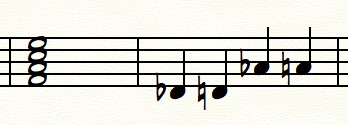
From there, you take a chord you want to substitute (be it in this case the Fmaj7 chord) and change the root to a minor/major third below or above the original. For the pitch F, we get Db, D, Ab, and A.

After that, you change the quality of the chord from the root you choose to a minor chord (either a min7 or a min7(b5), otherwise known as a half-diminished seventh chord).

And there you have it. 8 different substitute possibilities for one chord. However, as I have learned from using this professor’s tip, not all the possibilities work. So, take this as a “last-resort” idea when you are stuck and in need of a more interesting harmonic progression.

Thank you so much for taking the time to read! Feel free to comment, share, and subscribe for more daily tips below! Till next time.

Tip #96- Last-Minute Chorus Key Change

You might have already heard this in a song on the radio or on your playlist today. Nonetheless, it is a cool topic to cover.

Even with an awesome chorus in your song or exciting exposition in your composition, you might want to spice it up.

Take this mock-chorus below:

One thing that we can do is repeat the chorus, but transpose the section up an entire interval – creating a key change last minute to surprise the audience. The most commonly used intervals are the minor second (m2):

Major second (M2):

And minor third (m3):

Experiment with all three, or try a rarely used interval!

Thank you so much for taking the time to read! Feel free to comment, share, and subscribe for more daily tips below! Till next time.

Tip #93 – Negative Harmony

Some of you may have already been familiar with the concept. Others might still be yearning for a better explanation. And some might not have heard of this concept (like myself back in the summer of this previous year).

While this concept is not “new” in any form, I do what to introduce it as a new topic on this website.

Basically, negative harmony is the application of changing notes in a chords for new ones, but still have the same active and passive tendencies and the original chord. Meaning, if the original harmony had a tensional pull to resolve, so will this new chord based on negative harmony.

So, how does one get negative harmony?

First, establish the key that your harmonic progression is in. For this example, we will be in C Major. Now, find the two most-stable pitches: the tonic and dominant.

After that, find the pitch that meets in the middle. This will be the axis of our soon-to-be, point of reflection:

As you notice, there is no defined pitch in the middle of the tonic and dominant. That is not a problem, as it will work to our advantage as we make the point between the mediants the point of reflection:

And now you can see that we reflect the rest of the notes around the point between the mediants. This chart then shows what notes of the original harmony become in order to achieve negative harmony.

So, a F major chord of F – A – C , become D – Bb – G (or a G minor triad).

Play around with it, and experiment in different keys with different points of reflection.

Thank you so much for taking the time to read! Feel free to comment, share, and subscribe for more daily tips below! Till next time.

Tip #92 – Common-Tone Pad Moods

When scoring a film scene or just writing a legato section in your piece that calls for sublime changes in mood, it might be a good idea to try and use a pad built on common-tone relations to achieve this. Not only does it make transitions between chords sound smoother, but it offers a new pallet of harmonic progression possibilities that best fit the feelings you are going after.

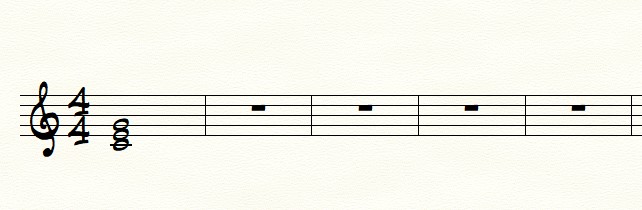
To do so, start off with any chord in mind:

Then, take a note from the preceding chord:

And make it the root of the following chord. (For this example, we are making it the root of the triad, but it can be any chord tone – even the seventh if you want to get experimental!)

Continue this process, and don’t be afraid to change up the chord qualities or adjust the inversions of the chords to best fit.

Thank you so much for taking the time to read! Feel free to comment, share, and subscribe for more daily tips below! Till next time.