What do you do in the case where a phrase stands alone by itself; that it doesn’t need an antecedent or consequent paring? Or how about a bunch of flowing phrases that are different from each other?
There are no rules saying you can’t put them together. Sometimes what you need is a phrases group of similar variants or highly contrasting phrases that lock into one another.
Just keep in mind ebb and flow with the directions, patterns, contour, cadential feeling, motion, figures, etc. as you are piecing these similar or highly contrasting phrases together.
Thank you so much for taking the time to read! Feel free to comment, share, and subscribe for more daily tips below! Till next time.
For a forest to grow, it needs to start with a seed. So let’s say we have a musical seed made of different figures and motifs to form a phrase as such:
From there, decide if that phrase is either the antecedent or consequent phrase within an ideal period structure. Write the missing complement to the original phrase:
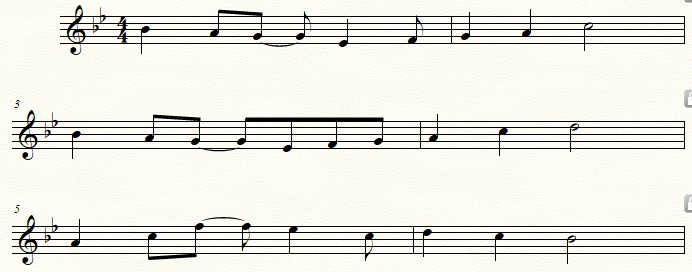
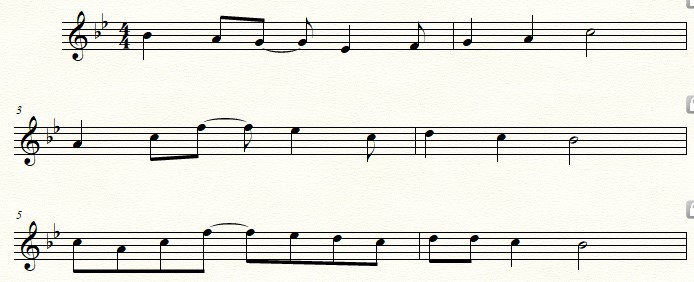
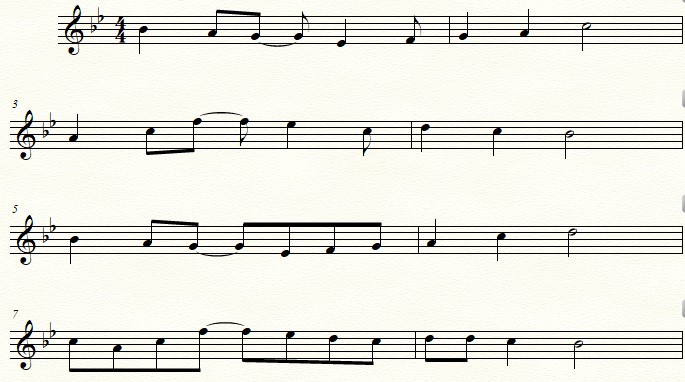
Now, here are five options in mind of expanding the period form with the simple use of repetition with slight variation:
A period with a repeated antecedent.
A period with a repeated consequent.
A period with a repeated antecedent followed by a repeated consequent.
A repeated period.
A three-part period (ABA)
Try them all out and experiment as to how you seed will grow!
Thank you so much for taking the time to read! Feel free to comment, share, and subscribe for more daily tips below! Till next time.
If you tie a piece of candy to a string and hold it 10-feet above a young child, do you expect that if the child jumps to reach it everyday that they will gain the incredible skill of jumping five times their height by the end of the season? Golly, if it was that easy, we could build star basketball players while they are still in diapers.
How about you put a boulder in front of a person and ask them to punch it till it breaks. Do you think that within the timespan of after a few months they will have the capability of shattering anything in their path? More likely: their own shattered fist and a shattered bank account paying medical expenses.
Now, take this different scenario: having a person come into a gym and starting with exercises within the capability, following with more challenging exercises overtime at a gradual rate. Do you think that that after a good length period of time this person can have the strength to life 200lbs?
Absolutely. Because here was have a logical, gradual progression stemming from increasing skills over a long period of time with no rush.
Why hasn’t this simple logic reached the minds of music professors? “Because that’s how we’ve done it in the past, and that’s how it will continue?” With what, all the faulty results it does now?
To inform those that don’t know about what I am getting at: in college, a student majoring in music will more than likely have to take a music theory & aural skills that involves sight-singing… which is the task of reading a piece of sheet music at first glance and performing correctly on the spot by singing.
All is well till after a month, the repertoire every student will be asked to perform will be utterly impossible. Impossible to the point that even trained opera singers have trouble performing these vocal melody lines after ample time of rehearsal. Rhythms are technically difficult, vocal range is two wide to the point that it might strain one’s vocal chords, and stress is high because you are under the pressure of getting it perfect or you will fail out of the music program – kiss those thousands of dollars invested into your education goodbye! And yet, we grade these vocal gymnastics as if they are commonplace.
Most – that’s right MOST – will receive a barely passing grade unless they are 1) trained vocalists and 2) have perfect pitch. Those that don’t possess those skills leave the class discourage about pursuing music. Athletes train for years and years to get at the legacy level; why do we have this stupid concept of forcing student to do the impossible and expecting improvement within the few months of a semester?
And yes, while I am speaking from my own biased perspective of having trouble with these sight-singing exercises in college, I do know that there are a lot of people out there having trouble out there as well; and furthermore, I do know that there is a better way of strengthening a student’s sight-singing skills. What I don’t know, is the person within an educational system that will question this faulty standard in order to better their students.
Being in the music industry, I find too often people trying to make a living by selling “beats,” implying that the word is synonymous to their cool groove they spent hours on with their laptop program for upcoming rap artists that are so fire. Let’s make this clear…
A beat is the pulse in a piece of music. That’s it. When you are listening to your favorite song, you are more than likely tapping your foot or nodding your head in-time to the beat. Of course, you might be hearing some notes that appear on the beat – or within the beat. In the grand hierarchy scheme of things, the notes that appear between the main pulse are part of the beat divisions or subdivisions.
But now we need a framework; so we incorporate meter, which is how beats are divided and grouped into larger recurring units giving emphasis to certain beats. You have already seen this in place on a score with the use of measures grouping notes together and having the bar lines on the staff separate the measures from one another.
The first beat of a measure is called a downbeat and gets the most power. On the opposite end of the spectrum, we have the upbeat which is the lightest and appears before the downbeat on the last beat of the previous measure. So just before the bar line.
So the first way to categorize meter is by how the primary beat is divided. If the beat is easily divided in two, then it is a simple meter. On the other hand, if the beat is divided into three, then it is called a compound meter.
Groups of two or groups of three essentially. Now, the next way to categorize is by how many groups there are. If there are two groups of two/three, then it is called duple meter. Three groups mean it is triple meter, and four groups is quadruple meter. So, if we have three groups of beats that are easily divided into two, we should call it: simple triple meter.
In the examples shown, you’ve probably seen two numbers that somewhat look like a fraction found in math. These “fractions” are your meter/time signatures that tell you the meter type. The top number tells how many primary pulses are within a measure, and the bottom tells the beat unit — more on that to come next time!
Thank you so much for taking the time to read! Feel free to comment, share, and subscribe for more daily tips below! Till next time.
For those that have a composition featuring a parallel period where the beginning section of the antecedent phrase mirrors exactly that of the start of the consequent phrase; this is your intervention. You don’t have to continue like this and repeat measures just to tell your listener that you are crafting a parallel period.
Whiling deriving the consequent phrase by exact identity to that of the antecedent is a sure way of getting a parallel period, there are other ways. Try transposing the opening subject and motifs up/down in transposition.
Another way is by extra embellishment to the lines.
Finally, the notes as well as the intervals of the figures can change, but keep the same contour, shape, and rhythm. The listener will still be able to tell the similarity from these kept variable aspects of the melodic line.
Thank you so much for taking the time to read! Feel free to comment, share, and subscribe for more daily tips below! Till next time.
To remind, an escape tone is a nonharmonic tone that creates dissonance on a weak beat by moving stepwise, and resolving my skip to a chord tone on the next strongest beat.
This nonharmonic motion can also by applied to the chordal resolution of a cadential phrase to delay the resolution as well as introduce new harmonic motion to lessen the impact of a direct V – I ending. Also, by simply introducing dissonant tones one degree lower/higher than the intended triadic chord tone, it can result in the same effect.
Thank you so much for taking the time to read! Feel free to comment, share, and subscribe for more daily tips below! Till next time.
Remember newspapers? Those things that you would get every morning and trust on accurate news coverage, but because it was a process to sit down an read an article, we’ve transcended into using whatever trending topic appears on our phone as reliable information?
Yeah, those newspapers.
Well, they don’t have to be a fossil anymore. To first installment of beating writer’s block is to take a news article headline and sing it. Craft a melody that would fit the words of the title – so make sure that it is relatively long in length, possibly a sentence.
Once a version is created, make a variation or a new version of a melody singing the headline. Along the way; be a little bit critical and make edits to they rhythm, flow, intervals, and contour of it.
Finally, erase the words you were using. Now, you can take the melody elsewhere and use it as an individual theme, or put new lyrics on top of it. Possibilities are endless!
Thank you so much for taking the time to read! Feel free to comment, share, and subscribe for more daily tips below! Till next time.
They say two heads are better than one, so why not two tonalities/modalities?
This works well when there are two performers (or one that can be divided into two voices – like left & right hand piano) that can individually create their own tonal center.
Not only is it writing a cadential phrase for each, but it writing a cadence in which they sonically sound good with each other… or not, if that is what you want to go for.
Experiment around, and see which pitch collections work well with each other.
Thank you so much for taking the time to read! Feel free to comment, share, and subscribe for more daily tips below! Till next time.
Today is a small tip on how to use your ears and basic knowledge of voice-leading when it comes to building a cadential sound when in a tonal mode – or using a synthetic scale.
First, know where is your tonal center, or I chord. This will obviously be your home base.
Now, find scale degrees that can act as sol/5 or ti/7 to the root of the scale.
Next, find other leading tones and see if they can be added to the previous incomplete V structure.
Finally, experiment with these tones, adding and subtracting, to build a cadential chord that has a strong pull back to your I chord with an unresolved sound. Easier said than done, for sure, but this exercise will certainly train your ears more to know how your compositions flows within a mode or synthetic scale.
Thank you so much for taking the time to read! Feel free to comment, share, and subscribe for more daily tips below! Till next time.
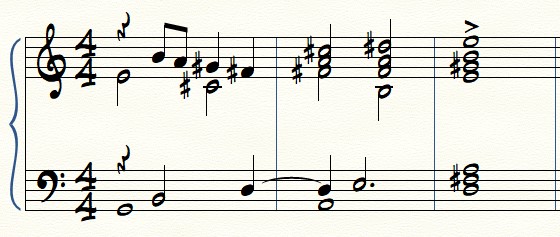
In music, a lot or harmony is made up of chords built on pitches with intervals of stacked thirds to each other – hence, that is why they are called “triads.”
In the world of triads, you get chord types like major, minor, augmented, and diminished depending on the combination of thirds between pitches.
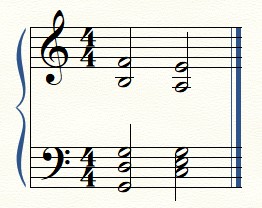
Now, what would happen if we were to change the rules of building chords? Instead of stacking thirds… how about we try one interval up: a fourth? Quartal chords.
A lot of listening and experimenting will be involved to find out sonically which chords built on fourths within the key sound like the I – IV – V etc. Also, you can play around with stacking other intervals.
Thank you so much for taking the time to read! Feel free to comment, share, and subscribe for more daily tips below! Till next time.






 Daily Music Writing Tips - Blog by Bryan M. Waring