How To Beat Writer’s Block – Tip #7

When writing music or lyrics, people sometimes are afraid of putting something down – as if they expect the first thing they write to be perfect, so they are petrified to be anything less than that.

We as composers have this belief of this fake phenomenon of hit songwriters sitting down and instantly writing a hit. Let me tell you;

  1. It took them a LONG time to get up to that skill.
  2. If they did write a hit song, it was probably there only one.

So my tip to you, is to write something – even if it is bad (in that case you can reflect on what you wrote and learn from it) – everyday. Set yourself 10-minutes in the morning as soon as you wake up for a creative free-write.

Think of it like this, the more you wait for a “hit” to come to you, the more your song writing will get constipated. However, the more you continuously write, the easier it will be to get those creative ideas out of the body and into the world.

Thank you so much for taking the time to read! Feel free to comment, share, and subscribe for more daily tips below! Till next time.
Tip #82 – Pros of Stagnant Harmony

This will be a short & sweet tip for today; but nonetheless, an effective tip.

Composition does not always have to be about finding original harmonic progressions and innovative uses of harmony. Are they good things to do every now and then? Yes, but it is not the end-all-be-all of writing music.

Remember, using stagnant harmony (say, like a piece just using one chord) is a fair option when composing.

By writing music according to a single harmony – it allows you the composer to explore the other variable aspects of music, such as rhythms, phrasing, performance, melodic movement, lyrics, etc.

Also, it is an effective technique to convey certain emotions as well! So don’t be afraid of trying it every now and then.


Thank you so much for taking the time to read! Feel free to comment, share, and subscribe for more daily tips below! Till next time.
Tip #81 – Compose like a Fashion Purchasing Agent

When composing, you might have come across the mental struggle of liking something that you wrote… but constantly thinking about other possibilities, as if that your amazing composition needs to be edited in some way.

One way to get around this is pretend you are a fashion purchasing agent… hear me out.

A purchasing agent goes to a runway show or department and looks at all the season’s upcoming looks. The agent then considers all possibilities and then makes the executive decision as to purchase what for a company.

You can do as such the same by writing all these possible variation and edits out. From there – look at them, play them out, listen to them – and decide which ones you like. This helps declutter the head and boasts the ego into settling as to finalizing your composition with confidence in what you wrote.


Thank you so much for taking the time to read! Feel free to comment, share, and subscribe for more daily tips below! Till next time.

Tip #80 – Variation with Anticipation

“I see you shiver with an-ti-ci…

pation!”

Enough Rocky Horror Picture Show for now. Onto today’s tip:

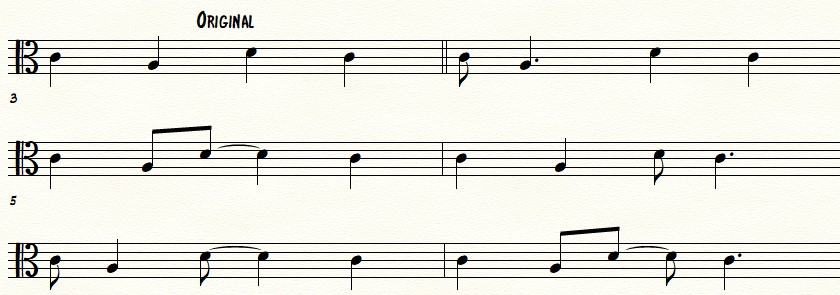
Say you have a simple melody with all of the melodic notes appearing on the downbeats of the measure. But what if you wanted to make it more interesting?

One option is to take the original melody and adjust the rhythm with the use of anticipations. For a quick reminder: an anticipation is music is when a note is played BEFORE the beat.

Below is an example of variations using anticipatory melodic rhythm that you can take inspiration from:


Thank you so much for taking the time to read! Feel free to comment, share, and subscribe for more daily tips below! Till next time.

Tip #79 – Cheat-Sheet to Movable Inner Voices under a Stagnant Melody

This long title may seem intimidating as to what I’m going to explain – but it is some common sense that you were probably aware of.

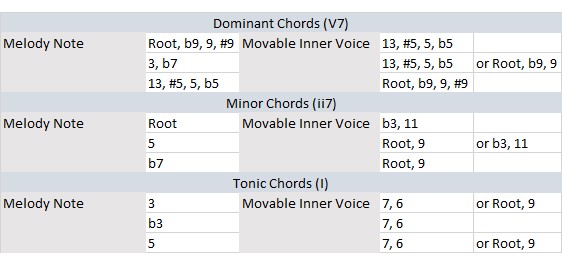
Say you have a composition with a beautiful legato melody and lush harmonies to accompany it. However, it lacks in motion and you feel that some of the inner voices need to move. At the same time, you don’t want to take away focus from the melody or change the harmony too much.

Below, I have provided a cheat-sheet on inner voice movement possibilities:

To read and assess this, first find what chord quality you have. Then, determine from your composition what is your melody note in relationship to the chord harmony. That will be on the left-hand side of the cheat-sheet. From there, look horizontally across to see the advised subtle inner voices that can be moved chromatically or diatonically.

Play around and see what best fits your musical work.


Thank you so much for taking the time to read! Feel free to comment, share, and subscribe for more daily tips below! Till next time.

Tip #78 – Trying Some Chromatic Approach in Harmonization

How would you harmonize the melody below?:

It can most certainly be done it a multitude of ways, but for today’s tip, let’s talk about using 4-way close harmonization. That would look like as such for the chord tones:

However, we have one note left out. The non-chord tone in a passing motion.

Because this non-chord tone is approaching the next note (which is a chord tone) by a half-step, we can consider using a chromatic approach technique to the harmonization.

Simply, have the entire harmonization be an approach by half-step to the landing chord tones. It would look like as such:

Sure, this may go against some principles of avoiding parallel harmony, but…

  1. It sounds good.
  2. You are the composer; so do what YOU want


Thank you so much for taking the time to read! Feel free to comment, share, and subscribe for more daily tips below! Till next time.

Tip #77 – Borrowing Chords from Parallel Keys

Take a look at this diatonic progression and harmony below:

How can we spice this up a bit and make it more interesting?

One way is by borrowing chords from its parallel major or minor key. Simply, if it is a major triad – make it a minor. And vice versa.

Note: it doesn’t have to be done to every chord. Be tasteful about where you want to add a borrowed chord. Also, in some cases too, you might need to alter the melody to fit more in-tune with the harmony around it.


Thank you so much for taking the time to read! Feel free to comment, share, and subscribe for more daily tips below! Till next time.

Thinking Out Loud – Appropriation of Jazz Music

Forewarning: I am not here to go in-depth on the cultural appropriation of jazz music. Mostly, because jazz – like any form of music – is a shared musical experience for EVERYONE to enjoy.

However, I do want to use this time to speak my mind about how in some cases we have taken the jazz idiom and chained it in shackles to the normality of Western European musical standards.

When people learn a jazz tune for the first time, it might go in one of two ways:

  1. Out of the Real Book, with a fake sheet giving the lead lines and approximated chord changes. From there, the jazz ensemble would follow the typical form of playing the head (once or twice), followed by everyone taking a solo, and ending with the top of the head again.
  2. From an arrangement, usually intended for a school jazz band. This gives the ensemble “training wheels” for learning the typical form of the jazz tune while predicating how the “improvisational” part will sound.

But at some point, the training wheels do need to come off.

While abnormous amount of annotation (including notation of the chord structures, melody, repeat signs, markings, structure, accents, etc.) might be needed if the composition is a lengthy/complex jazz tunes that need these confinements in order to maintain sense of unity, it is truly superfluous to the roots of jazz.

If a performer cannot read from a lead sheet and talk to the band about the structure of who while take the first rounds of soloing, then this is a shame to how literal jazz has become – being reduced from the previous art form it was to now a commodity in the lenses of Western European music.

Just thinking out loud.

Bryan Waring
Bryan M. Waring

Tip #76 – Reminder For Simplicity in Interlocking Parts

A little goes a long way, and sometimes that’s exactly what is needed to forming a nice groove.

While it may be tempting to use an abundance of complex rhythms in every separate parts, it can conversely turn to be too cluttered and lack in “groove.”

For today’s tip: opt for having each separate part being simplistic, but also uniquely different from the rest. Then, when combined together, it will create a complex and driving groove they you are searching after. The sum of the parts equals the whole, so make the parts work well with each other before working as a complete unit.


Thank you so much for taking the time to read! Feel free to comment, share, and subscribe for more daily tips below! Till next time.

Improve Your Lyrics – Tip #4

Use a non-lyrical vocal hook!

“What is that?” you ask.

You’ve probably have heard it a million of times in songs on the radio. It is when the lyrics (or lack-there-of) resorts to a sound. Like: ah, oo, oh, yeah, eh, ay, hey, etc. And perform that catchy repeated melody to those non-lyrical vocal sounds.

This helps a song writer by not only making the melody catchy and easy to sing, but breaks the language barrier allowing anyone that can make those sounds sing along.

You probably don’t want to include it on every song you write, but it is a great tool when you are in a pinch to make some ear-candy.


Thank you so much for taking the time to read! Feel free to comment, share, and subscribe for more daily tips below! Till next time.