Tip #111 – Key Change with a Pivot Chord

Simple reminder: a pivot chord is a chord shared amongst two separate keys that is used as a connecting bridge to get from one key to another in a key change.

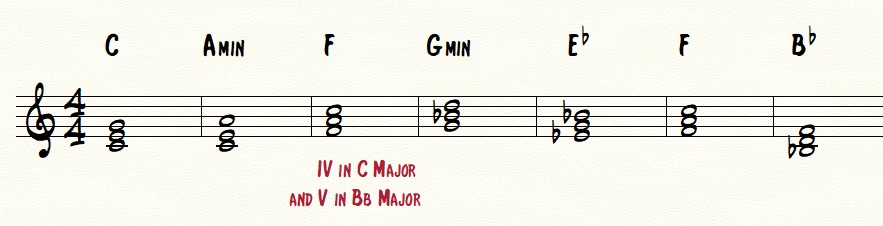
Take a look at the example below:

Notice how the F major triad is a chord in two keys: C Major and Bb Major. With the F major triad having multiple functions, we can direct the harmonic progression into a new key area.

Thank you so much for taking the time to read! Feel free to comment, share, and subscribe for more daily tips below! Till next time.
Improve Your Lyrics – Tip #11

Sometimes, before starting a song a band might say that they are going to play in the key of something. This is so everyone is in the same realm of pitches and everyone can play together cohesively.

That being said, a lyricist should attempt to do the same idea by writing in the “key of a word,” to create cohesiveness.

Now, what exactly does that mean? Well, when writing a song, try picking one overarching word or message – and then make a word bank that directly or similarly relate to the main idea.

So, if your main idea is “how tough work is,” you would probably see words like “sweat,” “tired,” “exhausting,” instead of “fluffy.”

One helpful way to organize ideas and process them is to use a spider-chart, and how all the connecting words branch-off from each other.

Thank you so much for taking the time to read! Feel free to comment, share, and subscribe for more daily tips below! Till next time.

Teach Yourself Music Theory – 12.) Pitch-Class Collections and Major Scales

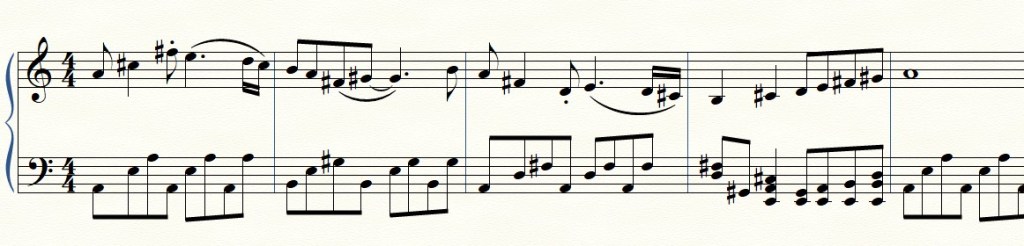
Read, analyze, play, and/or listen to this compositional segment below:

Now, write out all of the note letter-names that you see where used in this small composition.

You should get (in order of appearance): { A, C#, E, F#, D, B, G#}

What we have written above is the composition’s pitch-class collection, or a collection of all the pitches listed by their letter-names used.

Time to introduce a new concept. A scale, which is a pitch-class collection but organized in a ascending/descending manner in an alphabetized way.

Which… using the same example above, if we put the pitch-class collection in an alphabetical order, it would be: {A, B, C#, D, E, F#, G#}

So, what kind of scale is this? Well, to spoil the answer – this is a major scale. But how can we tell? Just look at the intervallic distances between the notes.

A major scale is made up of a pattern of notes set apart from each other in an ascending manner of whole-step, whole-step, half-step, whole-step, whole-step, whole-step, half-step (which returns to the starting pitch). You can also think of this as M2-M2-m2-M2-M2-M2-m2.

So now, let’s take a look back at our pitch-class collection:

Does it match the pattern of the major scale interval formula? Yes it does!

Try now for an exercise by taking any starting pitch and see if you can build a major scale of your own!

Thank you so much for taking the time to read! Feel free to comment, share, and subscribe for more daily tips below! Till next time.
How To Compose – a Gavotte

This post will discuss approaches to writing a gavotte.

First of all, a gavotte is a dance commonly found in the Baroque era suite.  The origin of the dance is French and features dance partners facing each other in a line or circle with everyone taking alternative steps to either side.  In addition, there is account of men kissing all the women at the end and reciprocated with the women to all the men.  Regardless of if this is true or not, the motions of how the dancer move are factors should be considered for when witting an appropriate melody for the gavotte.

Here are some critical features that are characteristic of a gavotte:

  • Meter: 4/4,
  • Tempo: fast
  • Phrase-period structure
  • Begins with an upbeat on the third beat.
  • Flowing pastoral melody; fun and light-hearted
  • Often followed by a musette with a drone bass, that then proceeds to a da capo repetition
  • Polyphonic; however, can be written for a solo instrument
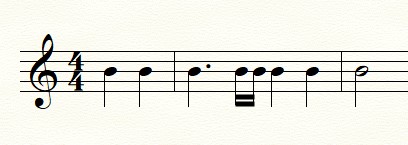
  • Composed based on these rhythm:

Be sure to familiarize yourself with the style before attempting to compose one!  Look into pieces of your favorite composers for inspiration and understanding or direction on how to approach a new work.

Thank you so much for taking the time to read! Feel free to comment, share, and subscribe for more daily tips below! Till next time.

Tip #110 – Understanding the Tanarupi Scale

The Carnatic music of South India has 72 scales (melakartas) comprised of seven different notes in either an ascending (arohana) or descending (avarohana) fashion. These scales are used in a kind of India music called rāga and are extremely beautiful. In addition these scales are grouped into different chakras, based on certain similarities.

Today’s melakarta is the Ratnangi (meaning “the one that embodies improvisation”) scale, the sixth scale from the first chakra.

Below is a representation of the scale as if it was put into Western notation:

Both the first (SA) and fifth (PA) scale degrees are in a placement normal to most scales found in Western music. However, the other scale degrees are lowered as well as clustered in chromatic runs. In addition, the upper notes of the scale are clustered as well into a chromatic run, creating symmetry. While this may sound dissonant or exotic, this scale gives a great amount of opportunity to play with tension and chromatic passing tones.

Try playing around with the scale, possible harmonies, and progressions!


Thank you so much for taking the time to read! Feel free to comment, share, and subscribe for more daily tips below! Till next time.

How To Compose – a Galliard

This post will discuss approaches to writing a galliard.

First of all, a galliard is a dance of the Renaissance era that was developed and now commonly found in the Baroque era suite structure.  The origin of the dance is French and features dance partners doing a fashion of leaps, jumps, and kicks in an alternating left-right pattern.  These factors should be considered for when witting an appropriate melody for the galliard.

Here are some critical features that are characteristic of a galliard:

  • Meter: 3/4 or 6/4, but strong pulse pattern of 3 regardless
  • Tempo: moderate, but happily brisk
  • Theme and variation form of AA’BB’CC’
  • Jumpy, dotted, and syncopated rhythms.
  • Begins on the beat
  • Linear, stepwise motion with occasional leaps
  • Varies between homophonic and polyphonic
  • Composed based on this rhythm:

Be sure to familiarize yourself with the style before attempting to compose one!  Look into pieces of your favorite composers for inspiration and understanding or direction on how to approach a new work.

Thank you so much for taking the time to read! Feel free to comment, share, and subscribe for more daily tips below! Till next time.

Tip #109 – Key Change with Chromaticism

In the past, we have talked about using a key change by transposing an entire section of the song by an interval. This interval can usually range from a m2 to a m3.

Today we will go more in-depth with the similar idea of using chromaticism to create a key change.

Study the example below:

As we get to the V chord of the composition, we get a pull back to the tonic. However, that pull is “redirected” an is instead used in a chromatic pull towards a new chord outside of the original key – that also become the new tonic as well.

So for today’s tip, experiment with the resolving tendencies of the V chord and how with chromatic motion a composition can get to a new key.

Thank you so much for taking the time to read! Feel free to comment, share, and subscribe for more daily tips below! Till next time.

How To Beat Writer’s Block – Tip #11

There are sounds and inspirations all around you, I grantee it – but you need to be conscious of it first.

Close your eyes, disconnect from the internet, and attempt to remove all senses from your mind momentarily.

Did you hear silence?

Probably not. Maybe there was the hum of a machine, the talking of people, the singing of birds, etc.

Regardless, you can use these sounds as inspirations. Try transcribing the melodic pitches of a songbird or of a windchime. Use the rhythm of natural speech as the source of your next beat. Sample live audio sounds from a household appliance. Be creative!

There are so many sounds and so many possibilities to utilize them. Go at it!

Thank you so much for taking the time to read! Feel free to comment, share, and subscribe for more daily tips below! Till next time.

Improve Your Lyrics – Tip #10

What’s a verbal metaphor and how can it be used in a song?

Take a look at the stanzas below:

My heart reaches out, clinging to you

Waiting for these shackles to be loose

Can you spot the verbal metaphor?

It is when the song says that the heart reaches and clings to another person. We all know that the heart’s function is to pump blood through the body, so the conflict of giving this personification to the heart is what creates this beautiful verbal metaphor to describe the longing of another.

Basically, the verbal metaphor is the conflict between the verb and its object/subject that it is associated with.

Thank you so much for taking the time to read! Feel free to comment, share, and subscribe for more daily tips below! Till next time.

Tip #108 – Innate Pulls of Dominant Modulations

Take a look at the melody below and analyze it the best you can:

Notice how the melody seems to be for the most part centered in an E Mixolydian mode.

However, you have those two measures highlighted in blue that hint at a temporary modulation to B Mixolydian. Then, it returns back to E Mixolydian.

If you play this melody, the transition works so smoothly. Why?

Well, think about the B Mixolydian mode. The mode itself is built around a B7 chord. In common music theory practice, the B7 chord will resolve (typically) to a chord with a root in E.

Thus, that is why the modulation from B Mixolydian is smooth, because it has the innate pull to resolve back to a centered tone of E anyways.

So, for this tip’s overall lesson: when using temporary modulations, consider the resolution of the scale/mode as well as the chords built on it for a seamless transition.

Thank you so much for taking the time to read! Feel free to comment, share, and subscribe for more daily tips below! Till next time.