Tip #149 – Cheat-Sheet for Using Definitive Triads

The concept of definitive triad – while not commonly known – is very easy to understand and master.

It is using two adjacent diatonic triads of piece of music’s scale or mode to harmonize an entire melody.

Each melody note will be harmonized be either one of the two definitive triads in relation to its chord tone. Of course, there will be one remaining pitch that will not have a direct harmonization to one of the two definitive triads. In a simple exemption to the rule: use any diatonic triad containing that note to harmonize.

Below is a cheat-sheet on what chords within their respective scales or modes work best as the two definitive triads for harmonization:
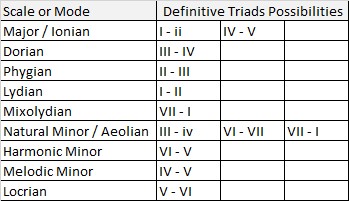
So, a melody based in the mode of B Lydian will use the I and II chords… the B major triad and C# major triad. Because of the combination of those two chords { B , C# , D# , E# , F# , G# }, the A# is the note left-out… and thus, can be harmonized by any triad of your choice that is diatonic to the B Lydian scale.

Thank you so much for taking the time to read! Feel free to comment, share, and subscribe for more daily tips below! Till next time.
Improve Your Lyrics – Tip #19

Another quick instalment on how to revise and edit your lyrics:

Objectively, you want your verses and choruses/refrains to be different from another.

Verses are designed to the show the details of the story while choruses/refrains should tell the overall meaning of the story.

Because the chorus is used as a “home-base” to reiterate the meaning to the listener, the verses should have the job to add color.

Basically, ask yourself, “What is the meaning of the song?” and “Does the chorus/refrain alone get the message across?”

If you need the verses as crutches to support the meaning of the song, it means you have a weak chorus. So refine and edit the chorus till the point you have no doubt about it.

As for the verses, they should be connected and related to the overall meaning of the song, but should also be used to express the details.

Thank you so much for taking the time to read! Feel free to comment, share, and subscribe for more daily tips below! Till next time.
Improve Your Lyrics – Tip #18

This is going to be a short piece of advice:

When you a building a bridge to connect two areas together, should the bridge contain a lot of material, a balanced amount, or a bare amount?

Obviously, the answer is a balanced amount.

That is the same mentality you need when writing verses in your song.

Verses, while should be unique from each section, should also have some connection between each. You don’t want a laundry-list of things talked about in your verses that runs on-and-on. Pick a strong theme and stick to it with development.

You don’t a single thread of an idea to be the thing holding the verses together in relation to one another, and you certainly don’t always want to repeat the same things (that can lead to boredom). You want there to be fluidity and strong connectivity from one verse to another.

Thank you so much for taking the time to read! Feel free to comment, share, and subscribe for more daily tips below! Till next time.
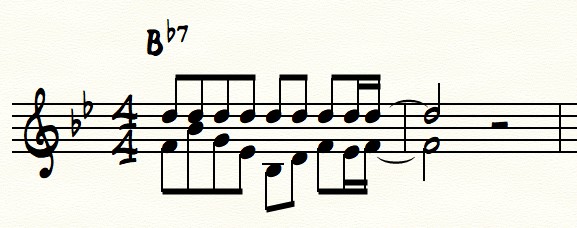
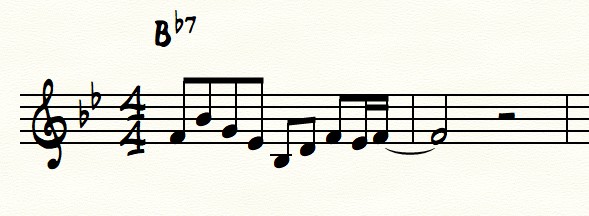
Tip #148 – Reducing Dominant Chords to Three-Note Harmonies

Tailgating on the idea of being limited to a three-part harmony; you are going to have to make some choices if you want the sound of a dominant chord, but can only voice three notes.

To remind: a dominant chord is a major triad with a b7 interval above it (and is usually decorated with extra upper extensions as well as tension tones).

So…

Whenever the root, 9, b9, #9, 11, +11, 13, or b13 is in the melody – support it with the 3rd and b7th of the chord underneath it.

Whenever the 3rd or 5th is in the melody of the dominant chord – support it with the b7th, and the remaining 5th or 3rd.

Whenever the b7th is in the melody – support it with the 3rd and 5th underneath it.

Whenever there is an alternation or substitution in the dominant chord – keep it, but make sure the distance between the two upper notes is not a m2.

And more so…

Keep this in mind as you plan how to do a harmonic arrangement and support of your musical work.

Thank you so much for taking the time to read! Feel free to comment, share, and subscribe for more daily tips below! Till next time.

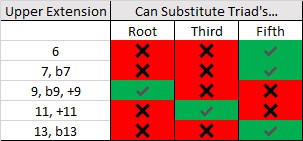
Tip #147 – Cheat-Sheet on How to Substitute in Extensions into Triads

Say that you only have three melodic instruments – so only three notes for are harmony are possible. However, you want the harmony to be more than just a triad.

What do you do?

Below, I have created a cheat-sheet on what note of the triad to drop-out and substitute in an upper extension to create a feeling of a larger harmony:

This works best when the substituted note is the highest note in the melody, but you are free to experiment.

Thank you so much for taking the time to read! Feel free to comment, share, and subscribe for more daily tips below! Till next time.

Tip #146 – Understanding the Gayakapriya Scale

The Carnatic music of South India has 72 scales (melakartas) comprised of seven different notes in either an ascending (arohana) or descending (avarohana) fashion. These scales are used in a kind of India music called rāga and are extremely beautiful. In addition these scales are grouped into different chakras, based on certain similarities.

Today’s melakarta is the Gayakapriya scale (meaning “beautiful singer”), the first scale from the third chakra.

Below is a representation of the scale as if it was put into Western notation:

Both the first (SA) and fifth (PA) scale degrees are in a placement normal to most scales found in Western music. However, there is an augmented distance between the second (RI) and third (GA) scale degrees.  In addition, the seventh scale degree (NI) is lowered.  While this may sound dissonant or exotic, this scale gives a great amount of opportunity to play with tension and chromatic passing tones.

Try playing around with the scale, possible harmonies, and progressions!

Thank you so much for taking the time to read! Feel free to comment, share, and subscribe for more daily tips below! Till next time.

Tip #145 – The Seesaw of Acoustic Balance in Counterpoint

If you know what a seesaw is – it is an outdoor playground ride where the changes of force on either side cause the ends to go up in down. When both sides are even, the seesaw is balanced.

You might experience a seesaw feeling when you are writing counterpoint:

  • On one hand, the two melodic lines must be heard; but one cannot completely overpower or be completely in balance in volume.
  • On one hand, the two melodic lines cannot be too similar in timbre where they blend in a mess; but they cannot be too distinctive where they don’t blend.
  • On one hand, the two different melodic lines music be unique; but they still must work together as one whole.

My advice to you the reader is:

  • Make one melodic line slightly louder than the other
  • Choose instruments carefully, as to which best pair for the greater effect of the music
  • And keep in mind intervals, rhythm, and motivic usage when crafting contrapuntal lines.

This could help create a balance.

Of course, this is just my advice – you are the composer, so do whatever you feel is right!

Thank you so much for taking the time to read! Feel free to comment, share, and subscribe for more daily tips below! Till next time.

Tip #144 – Chord Tone for Two-Part Density

If you are like me, you sometimes struggle to find a cool contrapuntal line – or at least, another additional melodic line – to a two-part density effect in the main melody.

Well, here is one very simplistic way that you can make another melodic line to obtain two-part density.

Start with a melody and a basic harmony like the example below:

Then, add a stagnant melodic line in the same rhythm above at the closest chord tone of the written harmony WITHOUT touching the main melody (that is why a D was chosen instead of a Bb):

And there you go, a simple way to create two-part density while still maintaining the harmony .

Thank you so much for taking the time to read! Feel free to comment, share, and subscribe for more daily tips below! Till next time.

How To Beat Writer’s Block – Tip #13

If you are like most other composers and songwriters – you spend a heavy amount of time listening to other writers’ works and not of your own. That’s okay, because you are listening to find your sound that you like in your favorite artists.

Starting a new musical work can be a scary task, but if you have a sound in mind from one of your favorite artists – you have gone over the biggest hurdle.

I AM NOT SAYING TO PLAGERIZE!

What I am saying to do is to use your ears and dissect what makes the music itself.

Write down in your notepad about what you hear with the:

  • Instruments, and how many/what kind
  • Timbre, and texture
  • Structure, and where certain sounds appear/disappear
  • Melody, and patterns
  • Harmony, and progressions/voicings
  • Rhythm, and beat/tempo
  • Growth of the music, and change
  • Text, and lyrics

This will give you an advanced analysis on how to make sounds similar to your favorite composers and songwriters.

Thank you so much for taking the time to read! Feel free to comment, share, and subscribe for more daily tips below! Till next time.

Improve Your Lyrics – Tip #17

Most songs have a structure using verses and choruses/refrains.

The chorus or refrain is a repeated section that typically doesn’t change (or if it does, it is minimal and still keeps to a basic theme) so that everyone can sing along. Hence the name – chorus.

The purpose of the verse is to tell a story that will bring out the central meaning of the chorus.

We can think each verse section as a “box” – containing ideas in lyrical form to compose the overall message of the song.

When you are brainstorming how you want to construct your verses, keep in mind this “box rules” for your verses as to how much you should say/reveal to create a good flow in lyrical storytelling:

  • Box 1 – the first verse should be where you introduce the audience into the world of the song, giving a good flow of ideas
  • Box 2 – the return of the next verse should be a continuation of the same ideas, but in a new creative angle/viewpoint
  • Box 3+ – any other verses should get to the point of the theme, but in your own angle or combining ideas from previous verses.

Thank you so much for taking the time to read! Feel free to comment, share, and subscribe for more daily tips below! Till next time.