Thinking Out Loud – Dealing With Reunions

“You still doing that music thing of yours?”

That is one question I hear to often. Whether the reunion is with the family, family, acquaintances, etc. you can never escape it. Doesn’t matter if it at a party or a funeral, people will always question the idea that you are still pursuing a career in music.

Usually, when you answer yes, the next thing that will happen is a look of disappointment or a lecture on how you should change career paths.

Raise your hand if you have ever experienced this.

Frankly, I find it funny that music as a career choice is one of the most criticized. Unless you are a famous rock star making a lot of money, people judge your career path as more of a hobby – no matter how much you enjoy it. I don’t go up to a friend who studied science in college and asked if they’ve cured cancer yet. So why are people so quick to judge the success of a musician?

I wanted to post this during the holidays to know how everyone else deals with this. Otherwise..

Just thinking out loud.
How To Beat Writer’s Block – Tip #19

Sometimes, what might be stopping you from beginning to write an amazing piece is that you are overwhelmed by what to write. Will it be a symphony, a pop hit, an EDM banger, a brass quartet..?

What might help is engrossing yourself in the genre or style you want to write. Meaning, constantly listening to that kind of music, watching videos about it, and reading books. Having your environment around you be that narrow pathway of music you want to write will encourage you to overcome the writer block and compose.

Think about this. Will a person who live in a town of only fast food venture out to eat healthy? Most likely not, because that person’s environment is basically a pathways to eating greasy foods.

By limiting your listening to a specific genre, watching videos, and reading about it – you will be pushed more into writing that piece you’ve wanted to for a long time.

Thank you so much for taking the time to read! Feel free to comment, share, and subscribe for more daily tips below! Till next time.

Tip #229 – Deciding Between Open-Fifths or Octaves

Sometimes, the piece of music you are writing doesn’t call for complex chord choices or complex chord voicings. It might be because of the style you are going after, or it just might match the mood better if you reduced to simplistic voicings.

DO NOT THINK THAT BECAUSE YOU AREN’T USING COMPLEX VOICINGS THAT YOUR MUSIC ISN’T ADEQUITE. The value of your piece isn’t based of of how challenging it is – but on how invested you are in it. If you believe all it needs is some simplistic voicings, go for it!

Now, two common reductions for harmony is to double the root at the octave, or just to play the root and the fifth.

If you were to choose between the two, which one would it be? What would be the advantages of each?

When doubling the root at the octave, you lose harmonic color because it is reduced down to one pitch class. However, the doubling reinforces the sound and makes that makes that singular color more bold.

Open fifths, as we have talked about previously in posts about power chords, will have a but more harmonic color because it uses two different pitches. Also, the sound will be denser, since the pitches are more closer together than octaves.

Try both and see what fits!

Thank you so much for taking the time to read! Feel free to comment, share, and subscribe for more daily tips below! Till next time.

Improve Your Lyrics – Tip #47

This is going to be a short post…

An allusion is a reference to another piece of work or to some “commonly-known” subject, object or whatever.

Basically, it can add a bit of “real life” to the song.  While a song can be personally, it might run into becoming too “imaginative” for listeners.  Using allusions or references to outside works can help make it a bit more realistic… or even add a bit of nostalgia for the audience.  Try it out!

Thank you so much for taking the time to read! Feel free to comment, share, and subscribe for more daily tips below! Till next time.

Teach Yourself Music Theory – 33.) Identifying Seventh-Chords

Before we begin, let’s review:

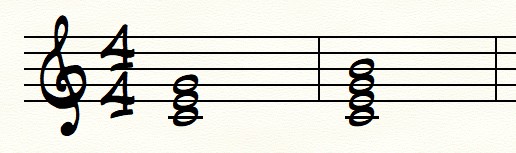
Previously, we have talked about triads, which are chords comprised of three different pitches, with the notes (from lowest to highest) are a third apart from each other.

If we add another third on top of the triads, we get a seventh-chord, which is a chord comprised of four different pitches with the notes (from lowest to highest) are a third apart from each other and span a distance of a seventh.

The alteration of a triad to a seventh-chord will look like as such:

Now, just like triads, seventh-chords have different names depending on the intervals between each chord member. However, if you can identify the triad the seventh-chord is built from as well as the extra interval above it – you will be more comfortable with identifying triads.

Let’s take a look:

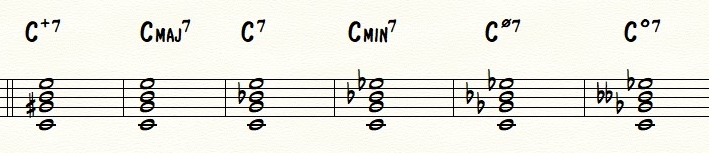
  • Augmented Seventh = Augmented Triad + M7 above root
  • Major Seventh = Major Triad + M7 above root
  • Dominant Seventh = Major Triad +m7 above root
  • Minor Seventh = Minor Triad + m7 above root
  • Half-Diminished Seventh = Diminished Triad + m7 above root
  • Fully-Diminished Seventh = Diminished Triad + d7 above root

This is how they would look (with the third of the chord placed an octave above):

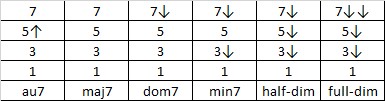
Another way of being able to distinguish between the different seventh-chords is through this diagram:

In comparison to the Major Seventh chord (which we will call “home base” due to its lack of alterations), all the other seventh chords have a pitch raised or lowered.

Thank you so much for taking the time to read! Feel free to comment, share, and subscribe for more daily tips below! Till next time.

Tip #228 – Dressing-Up the Walking Bass

For people looking to write out a walking bass line, today’s tip might be useful.

Regularly, you don’t want to write out note-for-note the bass line. Most bassists prefer a chord chard and they will construct a line from there. However, if you want to be specific on what notes to hit when, then do write it out.

You might have some personal “rules” as to making a walking bass line… such as having each chord change play the root first and then the rest of the chord members. Or maybe the direction or pattern of it. That’s a great start, but it can become too formulaic.

To dress it up and make it a bit more interesting, try adding some chromatic approaches. So, before hitting the root of the next chord, play a note a half-step above or below. You can even make this a string of chromatic notes (or a diatonic scalar run) for a bit of added emphasis to the root you want to hit.

Try it out and see!

Thank you so much for taking the time to read! Feel free to comment, share, and subscribe for more daily tips below! Till next time.

Tip #227 – Understanding the Vagadhisvani Scale

The Carnatic music of South India has 72 scales (melakartas) comprised of seven different notes in either an ascending (arohana) or descending (avarohana) fashion. These scales are used in a kind of India music called rāga and are extremely beautiful. In addition these scales are grouped into different chakras, based on certain similarities.

Today’s melakarta is the Vagadhisvani scale, the fourth scale from the sixth chakra.

Below is a representation of the scale as if it was put into Western notation:

Both the first (SA) and fifth (PA) scale degrees are in a placement normal to most scales found in Western music, but now you have a raised second degree (RI) acting as an augmented second from the root.  In addition, there is the raised sixth degree (DHA).

Try playing around with the scale, possible harmonies, and progressions!

Thank you so much for taking the time to read! Feel free to comment, share, and subscribe for more daily tips below! Till next time.

Thinking Out Loud – Getting a Doctorate Degree

This has been on my mind a lot. So, I want to invite the readers a journey into my head about the topic of a Doctorate degree.

Before I say anything, I want to make sure that this is clear:

If you do have a Doctorate degree, I applaud and congratulate you with the upmost esteem.

Now, aside from that, I have mixed feelings about getting a Doctorate degree. There are certainly pros and cons to it, but this kind of decision greatly impacts your life. It isn’t like deciding chocolate or vanilla ice cream at the candy shop… or even choosing what shirt to wear. This kind of decision to go back for another round of education can either open doors, or close them.

Pros:

  • Job opportunities (maybe)
  • Become more specialized in a field
  • Title

Cons:

  • Expensive
  • A lot of time dedicated to studying and writing papers
  • Possibly having to move to a different location

And there is certainly more with each category. I dunno. What is everyone else’s opinions?

As for me, I’m just thinking out loud.

Tip #226 – Starting a Critique Journal

While this tip isn’t a compositional tip exactly, it can help with your compositional skills.

With all the compositional skills you acquire and use, be sure to reflect on it. Evaluate it. Did what you do help the composition, or did it hurt it? Does a skill apply better to a different kind of musical work or genre more than another? Did it work well, but maybe another variable made the outcome not-so-good? If you did something new and creative, how will be able to do it again?

By starting a “Critique Journal” you can look back at all the compositional skills that you have gained and see what works well for your next piece. Constant honest evaluation of yourself will refine your skills and help make your workflow for writing better – because now you have solidified in your mind on what works and what doesn’t thought the journal.

Try it out. Get a journal made of recycled paper or make one on your laptop/phone. With every piece you start to write, jot down a few notes of what could be better or what is already amazing.

Thank you so much for taking the time to read! Feel free to comment, share, and subscribe for more daily tips below! Till next time.

Tip #225 – To Resolve In or Out

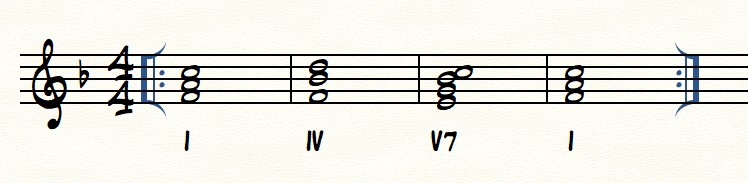
Say your song is based off of a group chords on repeat.  Do you have you progression resolve within the loop…

…or outside the loop…

…or does it really matter?  Do the two options really make a difference?

While one can argue that they don’t, there is a difference in motion between the two.  When you resolve within the loop, you have a return to “home” and completion.  Think of this like picking up a book, coming to an ending, and then picking up a new story.

As for when you resolve outside the loop, your momentum is continuous because the resolution takes place on the start of a new loop.  This is like reading a book then ends off with a “To Be Continued” cliff-hanger to lead into the next book.

Experiment with the two and see which feels right for your piece.

Thank you so much for taking the time to read! Feel free to comment, share, and subscribe for more daily tips below! Till next time.