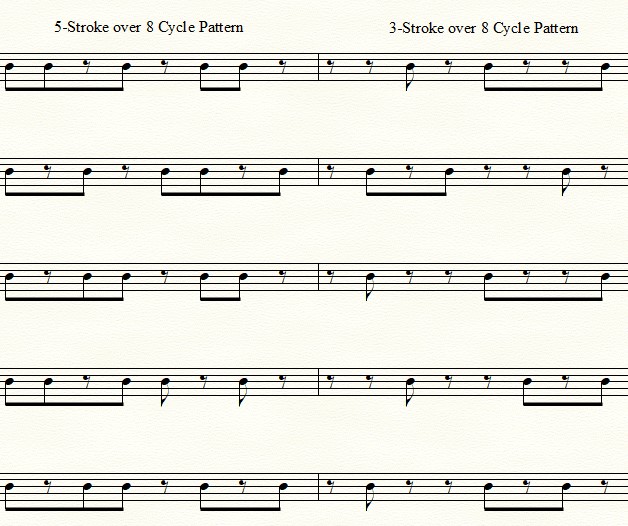
Asymmetric time-line patterns are these rhythmic patterns commonly found in Central and Western Africa. They are intended for percussion parts of one single pitch (or at most two – we’ll discuss more of this soon). A time-line pattern is distinguished by the number of pulses within the cyclical pattern, the number of hits, and the asymmetric grouping.
Below is the 24 pulse cycle broken in a 11+13 asymmetry. The measures on the left show the 13 strike pattern, while the left shows the 11 strike pattern. Notice how they complement each other. While these patterns are intended for a single instrument, a percussion part of two distinct pitches can play these opposing patterns.

In addition, these patterns can be phased into different variations.
While these patterns are not common at all in blues music, I do challenge the creative composer to use these patterns creatively in conjunction with different stylistic combinations.
Thank you so much for taking the time to read! Feel free to comment, share, and subscribe for more daily tips below! Till next time.



 Daily Music Writing Tips - Blog by Bryan M. Waring