Tip #147 – Cheat-Sheet on How to Substitute in Extensions into Triads

Say that you only have three melodic instruments – so only three notes for are harmony are possible. However, you want the harmony to be more than just a triad.

What do you do?

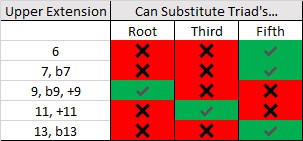
Below, I have created a cheat-sheet on what note of the triad to drop-out and substitute in an upper extension to create a feeling of a larger harmony:

This works best when the substituted note is the highest note in the melody, but you are free to experiment.

Thank you so much for taking the time to read! Feel free to comment, share, and subscribe for more daily tips below! Till next time.
Tip #146 – Understanding the Gayakapriya Scale

The Carnatic music of South India has 72 scales (melakartas) comprised of seven different notes in either an ascending (arohana) or descending (avarohana) fashion. These scales are used in a kind of India music called rāga and are extremely beautiful. In addition these scales are grouped into different chakras, based on certain similarities.

Today’s melakarta is the Gayakapriya scale (meaning “beautiful singer”), the first scale from the third chakra.

Below is a representation of the scale as if it was put into Western notation:

Both the first (SA) and fifth (PA) scale degrees are in a placement normal to most scales found in Western music. However, there is an augmented distance between the second (RI) and third (GA) scale degrees.  In addition, the seventh scale degree (NI) is lowered.  While this may sound dissonant or exotic, this scale gives a great amount of opportunity to play with tension and chromatic passing tones.

Try playing around with the scale, possible harmonies, and progressions!

Thank you so much for taking the time to read! Feel free to comment, share, and subscribe for more daily tips below! Till next time.
Tip #145 – The Seesaw of Acoustic Balance in Counterpoint

If you know what a seesaw is – it is an outdoor playground ride where the changes of force on either side cause the ends to go up in down. When both sides are even, the seesaw is balanced.

You might experience a seesaw feeling when you are writing counterpoint:

  • On one hand, the two melodic lines must be heard; but one cannot completely overpower or be completely in balance in volume.
  • On one hand, the two melodic lines cannot be too similar in timbre where they blend in a mess; but they cannot be too distinctive where they don’t blend.
  • On one hand, the two different melodic lines music be unique; but they still must work together as one whole.

My advice to you the reader is:

  • Make one melodic line slightly louder than the other
  • Choose instruments carefully, as to which best pair for the greater effect of the music
  • And keep in mind intervals, rhythm, and motivic usage when crafting contrapuntal lines.

This could help create a balance.

Of course, this is just my advice – you are the composer, so do whatever you feel is right!

Thank you so much for taking the time to read! Feel free to comment, share, and subscribe for more daily tips below! Till next time.
Tip #144 – Chord Tone for Two-Part Density

If you are like me, you sometimes struggle to find a cool contrapuntal line – or at least, another additional melodic line – to a two-part density effect in the main melody.

Well, here is one very simplistic way that you can make another melodic line to obtain two-part density.

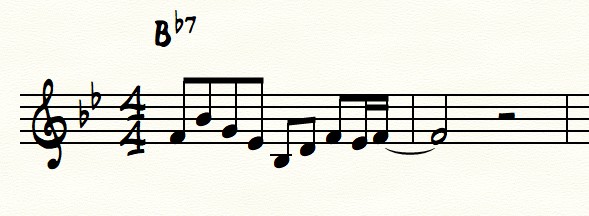
Start with a melody and a basic harmony like the example below:

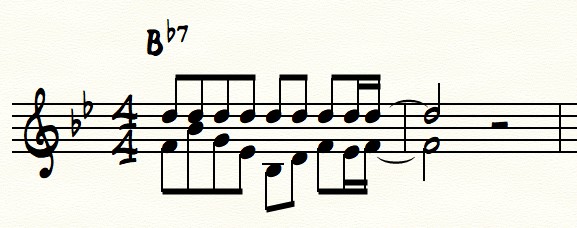
Then, add a stagnant melodic line in the same rhythm above at the closest chord tone of the written harmony WITHOUT touching the main melody (that is why a D was chosen instead of a Bb):

And there you go, a simple way to create two-part density while still maintaining the harmony .

Thank you so much for taking the time to read! Feel free to comment, share, and subscribe for more daily tips below! Till next time.
How To Beat Writer’s Block – Tip #13

If you are like most other composers and songwriters – you spend a heavy amount of time listening to other writers’ works and not of your own. That’s okay, because you are listening to find your sound that you like in your favorite artists.

Starting a new musical work can be a scary task, but if you have a sound in mind from one of your favorite artists – you have gone over the biggest hurdle.

I AM NOT SAYING TO PLAGERIZE!

What I am saying to do is to use your ears and dissect what makes the music itself.

Write down in your notepad about what you hear with the:

  • Instruments, and how many/what kind
  • Timbre, and texture
  • Structure, and where certain sounds appear/disappear
  • Melody, and patterns
  • Harmony, and progressions/voicings
  • Rhythm, and beat/tempo
  • Growth of the music, and change
  • Text, and lyrics

This will give you an advanced analysis on how to make sounds similar to your favorite composers and songwriters.

Thank you so much for taking the time to read! Feel free to comment, share, and subscribe for more daily tips below! Till next time.

Improve Your Lyrics – Tip #17

Most songs have a structure using verses and choruses/refrains.

The chorus or refrain is a repeated section that typically doesn’t change (or if it does, it is minimal and still keeps to a basic theme) so that everyone can sing along. Hence the name – chorus.

The purpose of the verse is to tell a story that will bring out the central meaning of the chorus.

We can think each verse section as a “box” – containing ideas in lyrical form to compose the overall message of the song.

When you are brainstorming how you want to construct your verses, keep in mind this “box rules” for your verses as to how much you should say/reveal to create a good flow in lyrical storytelling:

  • Box 1 – the first verse should be where you introduce the audience into the world of the song, giving a good flow of ideas
  • Box 2 – the return of the next verse should be a continuation of the same ideas, but in a new creative angle/viewpoint
  • Box 3+ – any other verses should get to the point of the theme, but in your own angle or combining ideas from previous verses.

Thank you so much for taking the time to read! Feel free to comment, share, and subscribe for more daily tips below! Till next time.

Tip #143 – Evaluating Your Chord Voicings

So you have the chord harmony you want to play, and you have decided which instruments to play it… now what?

Well, here are three things to keep in mind:

  • Density
  • Weight
  • Span

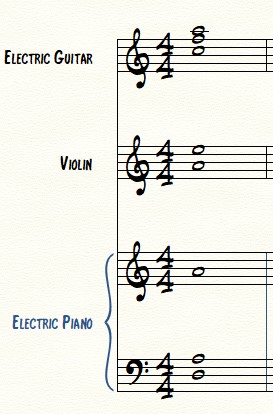
Now, let’s take a look at these three aspects in use with the example below (remember that the guitar is played an octave lower than written):

First, density. That has to deal with how many different pitch classes there are that make the harmony. In the example above, there are 5 different pitch classes {D – F – A – C – E} which form a Dmin9 chord. Relatively, this is more dense than a simple triadic harmony.

Next, weight. What pitch class appears the most? Even though the harmony is structured to be a Dmin9 chord, the A4 pitch is sounded in all three instruments. That means there is less weight on the root of the chord, and more on the 5th.

Finally, span. Span deals with how the dense harmony is spread throughout an octave ore more. From the example above, the range of the harmonic span goes from D3 to E5, which is more than two octaves. So, we can realize that the sound of this will be spacey – and not so condensed.

Keep these in mind as you are consciously thinking about how to voice your chords.

Thank you so much for taking the time to read! Feel free to comment, share, and subscribe for more daily tips below! Till next time.

Tip #142 – Mindfulness of Harmonic Intervals in Two-Part Density

Two-Part Density, as we have talked about before, is two different melodic lines (either in counterpoint or in compliment to each other) played together at the same time.

For those that are nitpicky about everything that they write, here is a way to look at your two-part density in mindful reflection of what note to choose.

First, are the two notes chord-tones to the harmony (either the root, third, fifth, or seventh) or tension tones? Mixture of both?

Second, do the harmonic intervals between the two melodic lines give the desired effect?:

  • Unions – overlapping consonant blend
  • Seconds – dissonant
  • Thirds – consonant, especially if it is a chord-tone
  • Perfect Fourth – hollow, and slightly dissonant
  • Perfect Fifth – hollow, consonant
  • Tritone – very dissonant
  • Sixths – consonant, especially if it is a chord-tone
  • Sevenths – dissonant, but can work well if it is a chord tone

Being conscious of these two ideas of chord-tones and interval effect can help strengthen your two-part density writing.

Thank you so much for taking the time to read! Feel free to comment, share, and subscribe for more daily tips below! Till next time.

Tip #141 – Understanding the Rupavati Scale

The Carnatic music of South India has 72 scales (melakartas) comprised of seven different notes in either an ascending (arohana) or descending (avarohana) fashion. These scales are used in a kind of India music called rāga and are extremely beautiful. In addition these scales are grouped into different chakras, based on certain similarities.

Today’s melakarta is the Rupavati scale (meaning “beautiful one”), the sixth scale from the second chakra.

Below is a representation of the scale as if it was put into Western notation:

Both the first (SA) and fifth (PA) scale degrees are in a placement normal to most scales found in Western music. However, the second scale degree (RI) is lowered, creating a tendency to resolve downward. In addition, the upper scale degrees are clustered into a chromatic grouping.  While this may sound dissonant or exotic, this scale gives a great amount of opportunity to play with tension and chromatic passing tones.

Try playing around with the scale, possible harmonies, and progressions!

Thank you so much for taking the time to read! Feel free to comment, share, and subscribe for more daily tips below! Till next time.

Tip #140 – Cheat-Sheet for Optimum Places of Turnarounds

Previously, we have talked about the idea of forming and crafting a turnaround in a song. But where and when is the best place to have one? You certainly don’t want to overuse the effect of a turnaround.

Below, I have made a little cheat-sheet of what most arrangers to my knowledge consider to be the best place to put a turnaround section (depending on the form/structure of the song):

Thank you so much for taking the time to read! Feel free to comment, share, and subscribe for more daily tips below! Till next time.