Tip #62 – Using the MpyƐmɔ Harmonic Progression and Scale

In some south and central African countries, musicians use homophonic multipart singing style in their songs.  That means that the group of people sing the same song rhythmically, but move in parallel motion at different pitches.  Typically, it is a fourth (interval) apart, but not always.

Below is an example of a multi-part harmonic progression called the MpyƐmɔ tribe progression from the Central African Republic as well as the derived scale. Notice how skipping every other note in the scale on the right produces the functional harmony on the left.  Also, observe the pitch fundamentals that build the harmony as well as act as a bourdon (open drone).

Besides advising you, the reader, to experiment, investigate, and take inspiration from these African harmonic progressions I strictly indorse you not to impose classical theory on these progressions.  While it is tempting to analyze these progressions with the idioms of Western music notation, I recommend not to as it takes away the purity/authenticity of African music’s own stylistic practices by framing it within a box.


Thank you so much for taking the time to read! Feel free to comment, share, and subscribe for more daily tips below! Till next time.


Tip #61 – Using the Nguni Harmonic Progression and Scale

In some south and central African countries, musicians use homophonic multipart singing style in their songs.  That means that the group of people sing the same song rhythmically, but move in parallel motion at different pitches.  Typically, it is a fourth (interval) apart, but not always.

Below is an example of a multi-part harmonic progression called the Nguni/Nyanja tribe progression from Malawi as well as the derived scale. Notice how skipping every other note in the scale on the right produces the functional harmony on the left.  Also, observe the pitch fundamentals that build the harmony as well as act as a bourdon (open drone).

Besides advising you, the reader, to experiment, investigate, and take inspiration from these African harmonic progressions I strictly indorse you not to impose classical theory on these progressions.  While it is tempting to analyze these progressions with the idioms of Western music notation, I recommend not to as it takes away the purity/authenticity of African music’s own stylistic practices by framing it within a box.


Thank you so much for taking the time to read! Feel free to comment, share, and subscribe for more daily tips below! Till next time.

Tip #60 – Using the Nkhumbi Harmonic Progression and Scale

In some south and central African countries, musicians use homophonic multipart singing style in their songs.  That means that the group of people sing the same song rhythmically, but move in parallel motion at different pitches.  Typically, it is a fourth (interval) apart, but not always.

Below is an example of a multi-part harmonic progression called the Nkhumbi/Handa tribe progression from Angola as well as the derived scale. Notice how skipping every other note in the scale on the right produces the functional harmony on the left.  Also, observe the pitch fundamentals that build the harmony as well as act as a bourdon (open drone).

Besides advising you, the reader, to experiment, investigate, and take inspiration from these African harmonic progressions I strictly indorse you not to impose classical theory on these progressions.  While it is tempting to analyze these progressions with the idioms of Western music notation, I recommend not to as it takes away the purity/authenticity of African music’s own stylistic practices by framing it within a box.


Thank you so much for taking the time to read! Feel free to comment, share, and subscribe for more daily tips below! Till next time.

Tip #59 – Using the Gogo Harmonic Progression and Scale

In some south and central African countries, musicians use homophonic multipart singing style in their songs.  That means that the group of people sing the same song rhythmically, but move in parallel motion at different pitches.  Typically, it is a fourth (interval) apart, but not always.

Below is an example of a multi-part harmonic progression called the Gogo progression from Tanzania as well as the derived scale. All from the tribe of the same name. Notice how skipping every other note in the scale on the right produces the functional harmony on the left.  Also, observe the pitch fundamentals that build the harmony as well as act as a bourdon (open drone).

Besides advising you, the reader, to experiment, investigate, and take inspiration from these African harmonic progressions I strictly indorse you not to impose classical theory on these progressions.  While it is tempting to analyze these progressions with the idioms of Western music notation, I recommend not to as it takes away the purity/authenticity of African music’s own stylistic practices by framing it within a box.


Thank you so much for taking the time to read! Feel free to comment, share, and subscribe for more daily tips below! Till next time.

Tip #58 – Using the Swazi Harmonic Progression and Scale

In some south and central African countries, musicians use homophonic multipart singing style in their songs.  That means that the group of people sing the same song rhythmically, but move in parallel motion at different pitches.  Typically, it is a fourth (interval) apart, but not always.

Below is an example of a multi-part harmonic progression called the Swazi/Nguni progression from South Africa as well as the derived scale from the tribe of the same name. Notice how skipping every other note in the scale on the right produces the functional harmony on the left.  Also, observe the pitch fundamentals that build the harmony as well as act as a bourdon (open drone).

Besides advising you, the reader, to experiment, investigate, and take inspiration from these African harmonic progressions I strictly indorse you not to impose classical theory on these progressions.  While it is tempting to analyze these progressions with the idioms of Western music notation, I recommend not to as it takes away the purity/authenticity of African music’s own stylistic practices by framing it within a box.


Thank you so much for taking the time to read! Feel free to comment, share, and subscribe for more daily tips below! Till next time.

Tip #57 – 24 Pulse Asymmetric Time-Line Patterns and Practice

Asymmetric time-line patterns are these rhythmic patterns commonly found in Central and Western Africa.  They are intended for percussion parts of one single pitch (or at most two – we’ll discuss more of this soon).  A time-line pattern is distinguished by the number of pulses within the cyclical pattern, the number of hits, and the asymmetric grouping.

Below is the 24 pulse cycle broken in a 11+13 asymmetry.  The measures on the left show the 13 strike pattern, while the left shows the 11 strike pattern.  Notice how they complement each other.  While these patterns are intended for a single instrument, a percussion part of two distinct pitches can play these opposing patterns.

In addition, these patterns can be phased into different variations.

While these patterns are not common at all in blues music, I do challenge the creative composer to use these patterns creatively in conjunction with different stylistic combinations.


Thank you so much for taking the time to read! Feel free to comment, share, and subscribe for more daily tips below! Till next time.

Tip #56 – 20 Pulse Asymmetric Time-Line Patterns and Practice

Asymmetric time-line patterns are these rhythmic patterns commonly found in Central and Western Africa.  They are intended for percussion parts of one single pitch (or at most two – we’ll discuss more of this soon).  A time-line pattern is distinguished by the number of pulses within the cyclical pattern, the number of hits, and the asymmetric grouping.

Below is the 20 pulse cycle broken in a 9+11 asymmetry.  The measures on the left show the 11 strike pattern, while the left shows the 9 strike pattern.  Notice how they complement each other.  While these patterns are intended for a single instrument, a percussion part of two distinct pitches can play these opposing patterns.

In addition, these patterns can be phased into different variations.

While these patterns are not common at all in blues music, I do challenge the creative composer to use these patterns creatively in conjunction with different stylistic combinations.


Thank you so much for taking the time to read! Feel free to comment, share, and subscribe for more daily tips below! Till next time.

Tip #55 – 16 Pulse Asymmetric Time-Line Patterns and Practice

Asymmetric time-line patterns are these rhythmic patterns commonly found in Central and Western Africa.  They are intended for percussion parts of one single pitch (or at most two – we’ll discuss more of this soon).  A time-line pattern is distinguished by the number of pulses within the cyclical pattern, the number of hits, and the asymmetric grouping.

Below is the 16 pulse cycle broken in a 7+9 asymmetry.  The measures on the left show the 9 strike pattern, while the left shows the 7 strike pattern.  Notice how they complement each other.  While these patterns are intended for a single instrument, a percussion part of two distinct pitches can play these opposing patterns.

In addition, these patterns can be phased into different variations.

While these patterns are not common at all in blues music, I do challenge the creative composer to use these patterns creatively in conjunction with different stylistic combinations.


Thank you so much for taking the time to read! Feel free to comment, share, and subscribe for more daily tips below! Till next time.
Tip #54 – 12 Pulse Asymmetric Time-Line Patterns and Practice

Asymmetric time-line patterns are these rhythmic patterns commonly found in Central and Western Africa.  They are intended for percussion parts of one single pitch (or at most two – we’ll discuss more of this soon).  A time-line pattern is distinguished by the number of pulses within the cyclical pattern, the number of hits, and the asymmetric grouping.

Below is the 12 pulse cycle broken in a 5+7 asymmetry.  The measures on the left show the 7 strike pattern, while the left shows the 5 strike pattern.  Notice how they complement each other.  While these patterns are intended for a single instrument, a percussion part of two distinct pitches can play these opposing patterns.

In addition, these patterns can be phased into different variations.

While these patterns are not common at all in blues music, I do challenge the creative composer to use these patterns creatively in conjunction with different stylistic combinations.


Thank you so much for taking the time to read! Feel free to comment, share, and subscribe for more daily tips below! Till next time.

Tip #53 – 8 Pulse Asymmetric Time-Line Patterns and Practice

If you ask anyone about the origins of the blues genre, more than likely you will get “Africa” as a response.  And while you can most certainly trace origins of blues from early African culture – ponder this:

“Why do blues, which is ‘African’ in origin, have a lack of the percussive rhythms that are typically more associated with African music?”

That is more up to a historian to answer that question, but I want to talk today about these asymmetric time-line patterns.

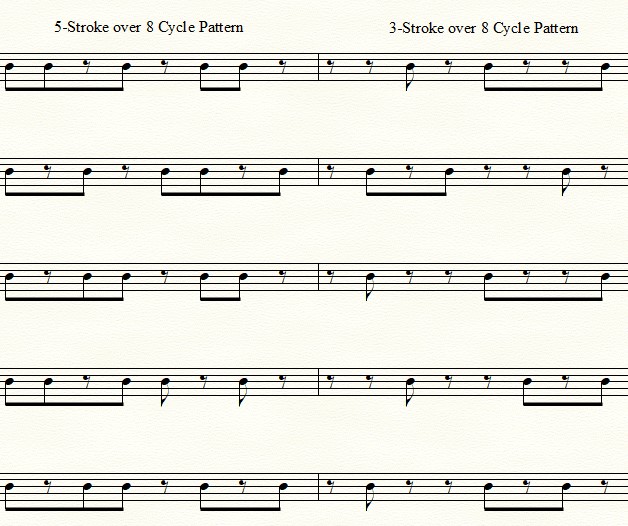
Asymmetric time-line patterns are these rhythmic patterns commonly found in Central and Western Africa.  They are intended for percussion parts of one single pitch (or at most two – we’ll discuss more of this soon).  A time-line pattern is distinguished by the number of pulses within the cyclical pattern, the number of hits, and the asymmetric grouping.

Below is the 8 pulse cycle broken in a 3+5 asymmetry.  The measures on the left show the 5 strike pattern, while the left shows the 3 strike pattern.  Notice how they complement each other.  While these patterns are intended for a single instrument, a percussion part of two distinct pitches can play these opposing patterns.

In addition, these patterns can be phased into different variations.

While these patterns are not common at all in blues music, I do challenge the creative composer to use these patterns creatively in conjunction with different stylistic combinations.


Thank you so much for taking the time to read! Feel free to comment, share, and subscribe for more daily tips below! Till next time.