Tip #158 – Understanding the Mayamalavagowla Scale

The Carnatic music of South India has 72 scales (melakartas) comprised of seven different notes in either an ascending (arohana) or descending (avarohana) fashion. These scales are used in a kind of India music called rāga and are extremely beautiful. In addition these scales are grouped into different chakras, based on certain similarities.

Today’s melakarta is the Mayamalavagowla scale (meaning “love affair”), the third scale from the third chakra.

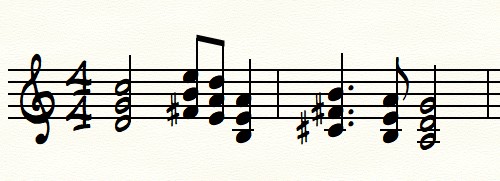
Below is a representation of the scale as if it was put into Western notation:

Both the first (SA) and fifth (PA) scale degrees are in a placement normal to most scales found in Western music. However, there is an augmented distance between the second (RI) and third (GA) scale degrees.  In addition, the seventh scale degree (NI) is raised.  While this may sound dissonant or exotic, this scale gives a great amount of opportunity to play with tension and chromatic passing tones.

Try playing around with the scale, possible harmonies, and progressions!

Thank you so much for taking the time to read! Feel free to comment, share, and subscribe for more daily tips below! Till next time.
Tip #157 – Orchestrating to Avoid Minor Second Dissonance

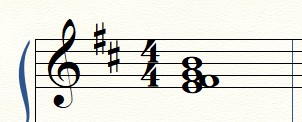
Say that you are creating a closed fifth cluster (or any other cluster as a matter of fact) like the one below:

We have talked about previously about assigning the added tone the disrupts the triadic sound to another instrument family group. However, that rule is not so easy to apply to other clusters…

…especially, even when there is a m2 sound formed in the cluster.

To best resolve around the dissonance of the m2 sound, divide up the cluster chord so that the m2 harmonic interval sound doesn’t appear within the same instrument family.

So, one way of dividing this into two voices would be:

And there you go!

Thank you so much for taking the time to read! Feel free to comment, share, and subscribe for more daily tips below! Till next time.

Tip #156 – Orchestrating Closed Fifth Structures

One interesting idea that I just read about that I want to share with you all is on how to orchestrate the closed fifth cluster.

To remind, the structure of the closed fifth cluster is a major or minor triad in root position with an extra note added a perfect fourth below the melody note.

The orchestration revolves around the idea of separating between two orchestral families.

In other words, try having the three notes that form the major/minor triad from one instrumental family in your orchestration while having the extra tone of the cluster come from a completely different instrument.

Not only will this create a variety and blend in the timbre, but it will also make the “cluster” sound become more pronounced.

Thank you so much for taking the time to read! Feel free to comment, share, and subscribe for more daily tips below! Till next time.
Tip #155 – Building Four-Part Closed Fifth Clusters

Once again, the title of today’s tip might sound a bit intimidating… but it is a lot more simpler than you think.

Today, we will be talking about building clusters that span over the harmonic interval distance of a perfect fifth by using only four different pitches.

Basically, to build a closed fifth cluster, you take a melody and harmonize underneath it by a perfect fifth interval. Then, you “fill in the middle” with the diatonic minor third of major fifth. So, now you have a bunch of triads. Finally, you add a note a perfect fourth below the melody note. And there you go, harmonization built from closed fifth clusters:

Thank you so much for taking the time to read! Feel free to comment, share, and subscribe for more daily tips below! Till next time.

Improve Your Lyrics – Tip #20

A quick mindfulness tip when writing and revising your lyrics:

Say that the purpose of your song is to have a “build-up” of thematic material or a load of hints before the final reveal at the end/chorus.

The best way to make a flow with continuity before the big reveal is to make sure one thing is carried over from one verse to the next. This allows for connectivity as well as continuous exponential growth in the thematic details before everything is pieced together in the end/chorus.

Think of each verse as an opportunity to dig a bit deeper into the details of the story. You start at the surface and work your way to the core.

Thank you so much for taking the time to read! Feel free to comment, share, and subscribe for more daily tips below! Till next time.
Tip #154 – Cheat-Sheet for Four-Part Fourth Structures

Okay, the title may seem really confusing, but this is what it is:

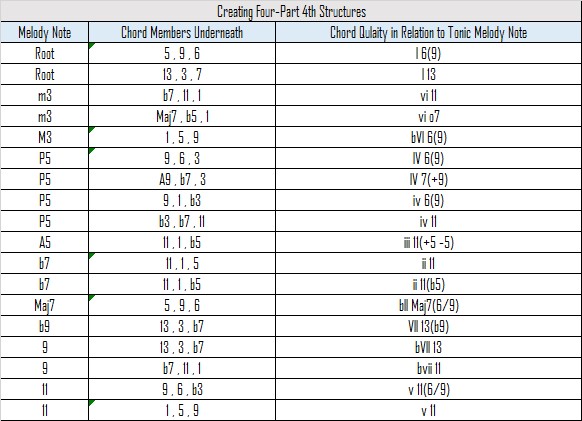
This post is about how to create fourth structures (harmonies built on intervals of fourths) with four notes.

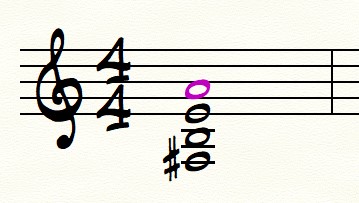
To read the cheat-sheet below, take a melody note and decide what function is it in relation to the chord. Then, you add three remaining chord member notes below it. Finally, you analyze the chord in relation to the melody note being the tonic:

So, say that I have the note A, and I want it to be the m3 of a chord:

Because A is the m3 of the chord, that means the notes below it (from highest to lowest) are E as the b7, B as the 11, and F# as the root 1. We can thus analyze this as vi 11 in the key of A major:

Thank you so much for taking the time to read! Feel free to comment, share, and subscribe for more daily tips below! Till next time.

Tip #153 – Dropped Voices

For the longest time, I had no idea what people meant by “use a ‘drop-2’ voicing on that chord.” That terminology was unfamiliar to me at the time. However, I am here no to tell you all so that you don’t end up in the same situation as I was of not knowing.

Dropped voicing is a simple way of creating an open position chord voicing by lowering specific notes by an octave.

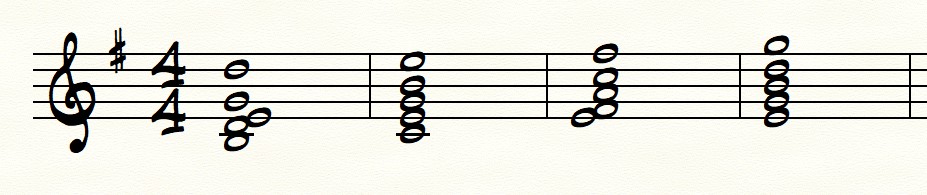
First, you start with a chord (usually, in four-part density with the melody note doubled) just like the examples below:

Then to do “drop-2,” you simply drop the second voice from the top an octave down:

This can also be done as “drop-3” or “drop-4” depending on your liking of the sound. In addition, you can combine certain ones together. Most typically, arrangers use “drop-2 & 4” in their scores:

Thank you so much for taking the time to read! Feel free to comment, share, and subscribe for more daily tips below! Till next time.
Tip #152 – Understanding the Vakulabharanam Scale

The Carnatic music of South India has 72 scales (melakartas) comprised of seven different notes in either an ascending (arohana) or descending (avarohana) fashion. These scales are used in a kind of India music called rāga and are extremely beautiful. In addition these scales are grouped into different chakras, based on certain similarities.

Today’s melakarta is the Vakulabharanam scale (roughly meaning “all of family”), the second scale from the third chakra.

Below is a representation of the scale as if it was put into Western notation:

Both the first (SA) and fifth (PA) scale degrees are in a placement normal to most scales found in Western music. However, there is an augmented distance between the second (RI) and third (GA) scale degrees.  While this may sound dissonant or exotic, this scale gives a great amount of opportunity to play with tension and chromatic passing tones.

Try playing around with the scale, possible harmonies, and progressions!

Thank you so much for taking the time to read! Feel free to comment, share, and subscribe for more daily tips below! Till next time.
Tip #151 – Using Fourth Structures in Harmonization

Continuing with a topic discussed the other day, we are going to take a look at how we can harmonize a melody using these fourth structures.

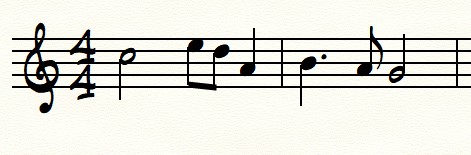
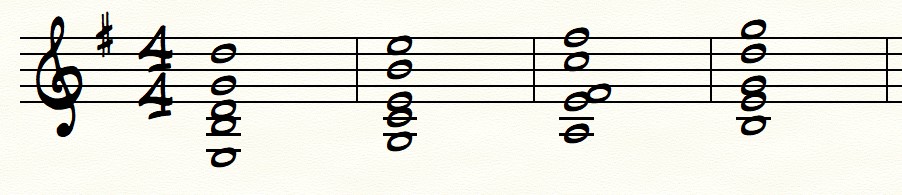
First, start off with a melody:

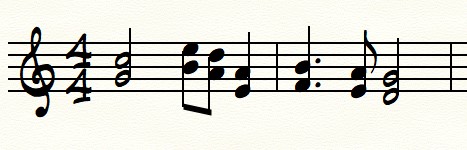
Then, add the diatonic fourth below the melody (this can either be a P4 or a tritone):

Now, we are going to do a closed fourth voicing, which means that we will add a third below the melody note. However, for the harmony that has a tritone, we are going to add a third ABOVE the bottom note:

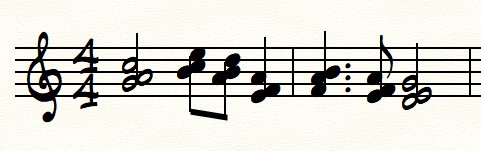
If we instead wanted to do open fourths, we would need to stack two intervals of a fourth on top of each other. So, that simply means adding another fourth below the fourth from the previous example:

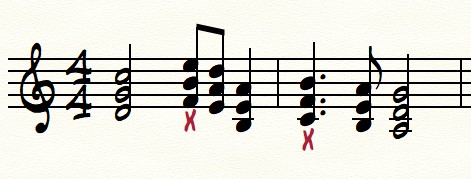
But, notice how the one with X’s have a tritone in them. Technically, that does not exactly fit the definition of an open fourth structure. To edit this, we use chromatics to adjust the harmonic intervals:

And there you go!

Thank you so much for taking the time to read! Feel free to comment, share, and subscribe for more daily tips below! Till next time.

Tip #150 – Difference Between Open and Closed Fourth Structures

Just like triads (tri- three) that are made of thirds, you can construct chords out of the perfect fourth interval.

Simply, and open fourth structure is a chord built from two P4 intervals on top of each other, spanning a m7 interval. A closed fourth structure is one that spans an interval of a P4 with a third below the melody note (either m3 or M3 depending on the diatonic scale)

However, in the case that the interval of the diatonic closed fourth chord is a tritone, the best way to reharmonize it is to create an interval of a third between the bottom note instead of the top:

Thank you so much for taking the time to read! Feel free to comment, share, and subscribe for more daily tips below! Till next time.